On this page
On 21 February 1940, John Randall and Harry Boot, two physicists at the University of Birmingham, switched on a small copper device that made strong microwaves. A blue plaque on the campus records that they "first operated a Cavity Magnetron to produce radar waves here on 21 Feb 1940" (Open Plaques). The same kind of tube now heats food in kitchen microwave ovens.
What did Randall and Boot build in 1940?
Randall and Boot were part of Mark Oliphant's group, which was doing radar research for the British Admiralty, according to a history by Blanchard, Galati and van Genderen in IEEE Antennas and Propagation Magazine (2013). Radar sets needed sharper angular resolution, and the target was at least 1 kW of power at a wavelength of about 10 cm.
Their first device was sealed with wax and kept connected to a vacuum pump, yet it produced 400 W at a wavelength of 9.8 cm, about two orders of magnitude above earlier sources at that wavelength (Blanchard et al., 2013). Within a few weeks the team reached kilowatt levels.
The prototype's copper anode had six cylindrical cavities, according to the IEEE Milestone record. That record also credits their colleague James Sayers, who noticed excessive frequency noise and in August 1941 suggested "strapping" the cavities so they oscillate in chosen modes, improving frequency stability. The IEEE plaque honouring all three went up at Birmingham in 2024 (University of Birmingham).
How does a cavity magnetron work?
The steps below follow the Radartutorial magnetron guide.
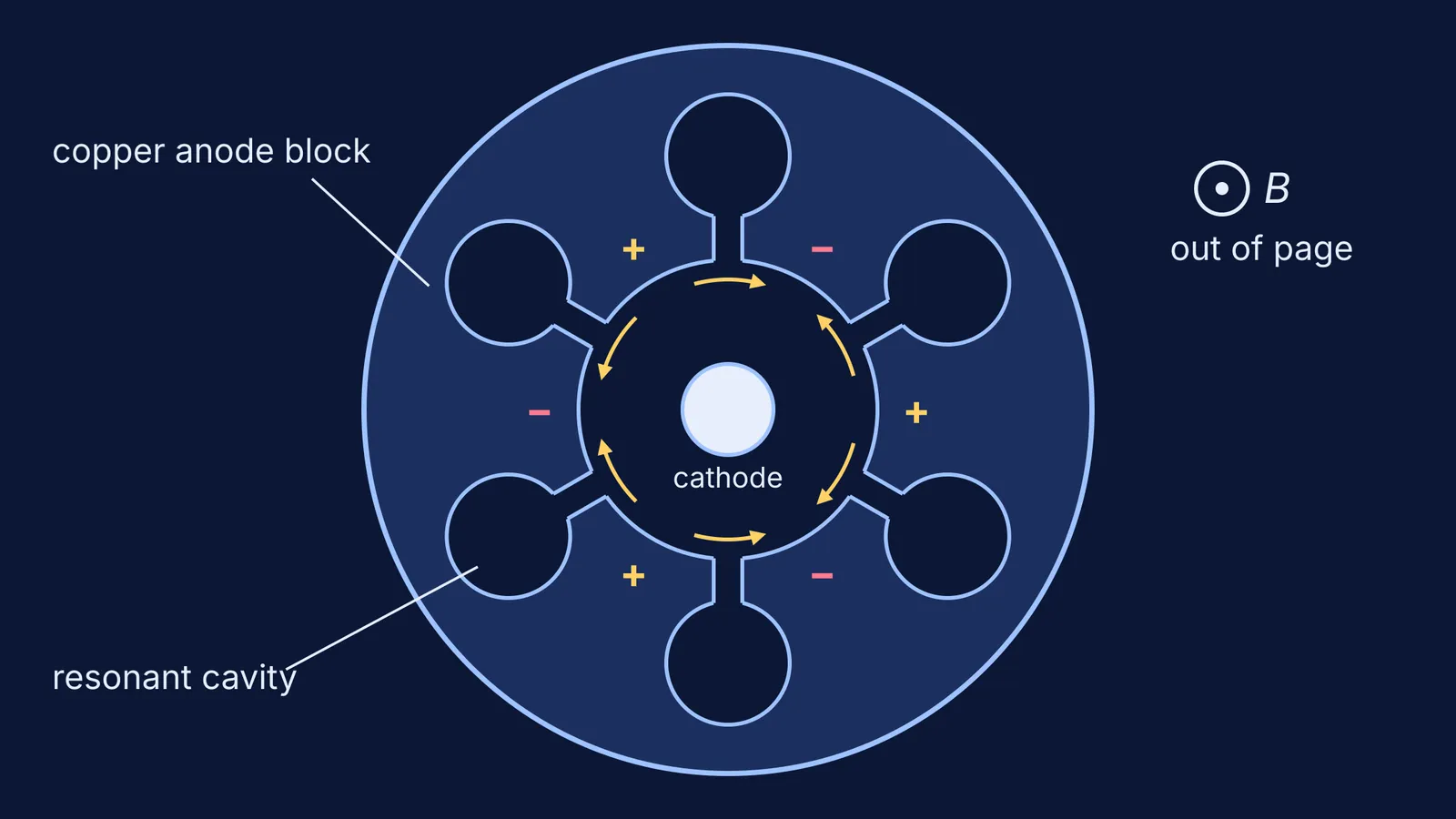
A heated cathode at the centre gives off electrons. It is negative relative to the copper anode block around it, so the electric field pushes electrons outwards.
A magnet supplies a field B along the cathode's axis. The magnetic force bends each moving electron's path. Above a critical field (the Hull cut-off), electrons curve back before reaching the anode.
Holes cut into the anode are the resonant cavities. Each behaves like a parallel LC circuit: the walls of the narrow slot are the capacitor, and the path around the hole is a one-turn inductor.
Electrons sweeping past the slots set the cavities oscillating. Each cavity runs 180 degrees out of step with the next, so neighbouring anode segments keep swapping between + and −.
Electrons moving in step with this field hand it energy. A loop in one cavity carries the microwaves out.
Did Randall and Boot invent the magnetron?
Not the magnetron itself. Albert Hull at General Electric proposed steering electrons in a valve with a magnetic field around 1917. Kinjiro Okabe in Japan reached 12 cm wavelengths with a split-anode magnetron in the late 1920s. Researchers in France, Germany, the Netherlands, the USSR and elsewhere also contributed to the cavity magnetron and its roots (Blanchard et al., 2013). The same authors note that Birmingham is generally credited with the first high-power cavity magnetron that was easy to copy and suited to mass production.
That mattered in wartime. In early September 1940, a GEC-built version that radiated 10 kW at 10 cm went to North America with the Tizard Mission. That autumn MIT created its Radiation Laboratory for microwave radar (Blanchard et al., 2013). For the radar that came before, read about Robert Watson-Watt and the radio echo that became radar.
How did a radar tube end up in your microwave oven?
The University of Birmingham says the magnetron's microwave pulses later became fundamental to microwave ovens and industrial heating. The US Food and Drug Administration explains that in an oven "a device called a magnetron" makes the microwaves, which "cause water molecules in food to vibrate, producing heat" (FDA). The jump from radar to kitchen is the story of Percy Spencer and the first microwave oven, and the heating is explained in how a microwave oven heats food.
Worked example: what frequency did the 1940 magnetron make?
Take c ≈ 3.0 × 10⁸ m/s.
1940 prototype. It ran at 9.8 cm (Blanchard et al., 2013), so f = c/λ = (3.0 × 10⁸)/(0.098) ≈ 3.1 × 10⁹ Hz, about 3.1 GHz.
Kitchen oven. Modern ovens run at 2,450 MHz (HyperPhysics), so λ = (3.0 × 10⁸)/(2.45 × 10⁹) ≈ 0.122 m, about 12 cm.
Why size sets frequency. A cavity resonates at f = 1/(2π√LC). Make every part of the block k times larger and the one-turn inductance and slot capacitance each grow about k times. So √LC grows k times and f falls to f/k.
Put it together. Going from 9.8 cm to 12.2 cm means k ≈ 12.2/9.8 ≈ 1.25: other things equal, an oven magnetron's cavities are roughly a quarter larger than the 1940 prototype's.
If it's hard to see why a moving charge curves in a magnetic field, the Fermi Concept Library has a lesson for every concept in physics. For ideas easier to see than to read, the Fermi Simulation Lab has interactive simulations.
Next time the oven beeps, remember that it began as a wax-sealed experiment in a Birmingham lab.