

On this page
Does a microwave oven cook food from the inside out?
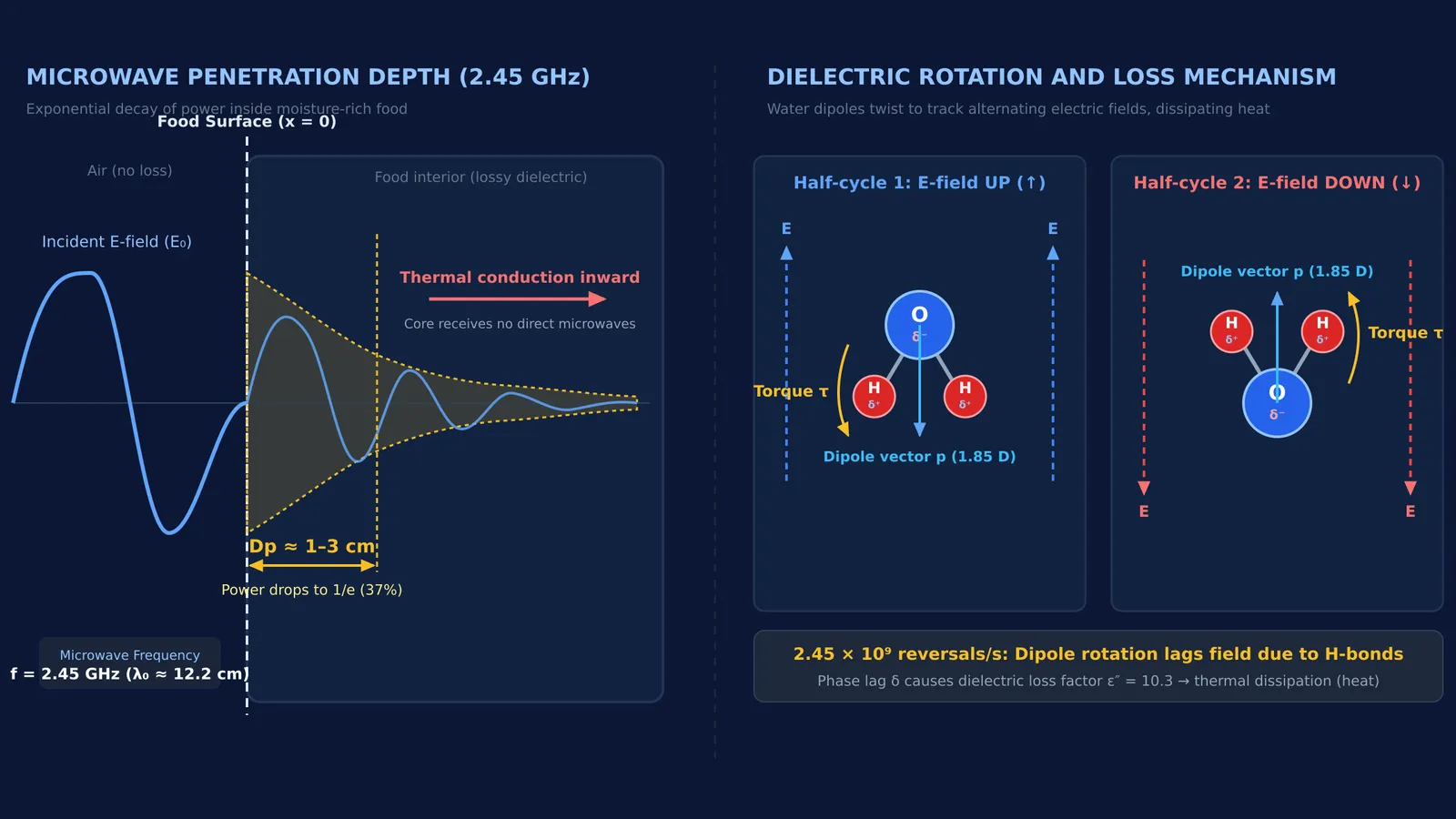
A common kitchen belief is that microwave ovens heat food from the inside out. In physics, that idea is incorrect. As the U.S. Food and Drug Administration (FDA) explains, microwaves do not cook food from the inside out; they penetrate only the outer layers, and heat travels to the interior by thermal conduction.
While a conventional oven warms only the outermost fraction of a millimetre, microwaves penetrate several centimetres into moisture-rich food. Because energy is deposited throughout that outer shell, people assume cooking starts at the center. Differences in composition deepen this illusion: microwaves interact strongly with liquid water, salts, and sugars, so moist pastry fillings heat much faster than dry crusts. For food thicker than a few centimetres, radiation never reaches the core. To understand why, examine where microwaves sit in the electromagnetic waves and spectrum.
Why does 2.45 GHz rotate water molecules instead of resonating?
Many textbooks claim that microwave ovens match the natural resonant frequency of water molecules. That claim is a myth. As physicist Christopher S. Baird at West Texas A&M University points out, liquid water has no resonance peak at 2.45 GHz; its true rotational and vibrational resonances lie above 1 THz in the infrared.
Operating at true resonance would be counterproductive: the outer fraction of a millimetre would absorb all incoming power, charring the exterior while leaving the inside raw. The standard frequency of 2.45 GHz (wavelength λ ≈ 12.24 cm in air) was chosen as an Industrial, Scientific, and Medical (ISM) band to prevent communications interference while providing a practical penetration depth of 1 to 3 centimetres in typical foods.
How does dielectric heating turn electric fields into heat?
The physical process behind microwave cooking is dielectric heating. Water is a polar molecule: oxygen's higher electronegativity gives the bent H₂O molecule an asymmetric charge distribution, with partial negative charge (δ⁻) on oxygen and partial positive charge (δ⁺) on hydrogen, creating a permanent dipole moment of about 1.85 Debye, as explained in OpenStax University Physics. See our guide to dipole moments and molecular polarity for details on molecular geometry.
When an alternating electric field passes through food, it exerts torque τ = p × E on each dipole, reversing direction 2.45 billion times per second. Because of hydrogen bonding and intermolecular friction, dipole rotation lags behind the field. As physicist Michael Vollmer showed in *Physics Education*, this phase lag causes dielectric loss, dissipating electric energy into random thermal motion. Dissolved ions like Na⁺ and Cl⁻ also accelerate in the field, generating additional heat through ionic conduction.
When visualising alternating field vectors and torque in Class 12 physics, static diagrams often obscure how phase lag dissipates energy. The Fermi Simulation Lab provides interactive simulations for the ideas that are easier to see than to read.
Why do ice and dry plates stay cold in the microwave?
In the *Journal of Chemical & Engineering Data*, chemist Udo Kaatze reported that at 25 °C and 2.45 GHz, liquid water has a dielectric constant ε′ of 78.4, a loss factor ε″ of 10.3, and a relaxation time τ of 8.27 picoseconds, making it ideally matched to absorb gigahertz energy.
By contrast, water molecules in ice are locked into a rigid crystal lattice held by fixed hydrogen bonds. Because dipoles cannot reorient freely at 2.45 GHz, ice has an extremely low dielectric loss factor. Frozen food thaws only when a melted surface film absorbs microwaves and conducts heat inward. Similarly, non-polar ceramic and glass pass microwaves without absorption, warming only by conduction from hot food.
How can you calculate penetration depth and ensure even cooking?
As food engineer Juming Tang detailed in the *Journal of Food Science*, power penetration depth Dp is the depth where microwave power drops to 1/e (about 37%) of its surface value:
Dp = λ₀ / (2π √(2ε′)) × [√(1 + (ε″ / ε′)²) − 1]^(−1/2)
For pure water at 25 °C (λ₀ = 12.24 cm, ε′ = 78.4, ε″ = 10.3), this yields Dp ≈ 1.68 cm. In salty food like soup, ionic conduction increases ε″, compressing Dp below 0.8 cm. Food thicker than 3 cm receives direct radiation only in its outer shell; the deep interior warms purely through conduction. You can review how electric fields store energy in our derivation of energy density in an electric field.
To achieve uniform heating based on this physics:
Spread food in a ring: Keeping thickness under 3 cm ensures all food lies within the penetration zone.
Cover to trap steam: Moist steam warms surface dry spots that would otherwise miss the field.
Allow standing time: Resting food gives conduction time to carry heat from the outer shell to the center.
Students tackling electrodynamics can consult the Fermi Problem Library, which features worked problems with a step-by-step solver that explains the reasoning rather than printing an answer. For a complete map of dipoles and radiation, the Fermi Concept Library maps every concept in physics, chemistry, biology, mathematics and computing, each with its own lesson and its place in the map.


