On this page
A cyclotron accelerates a particle by kicking it each time it crosses a gap, and the kick comes from a voltage that flips at one fixed frequency. That only works if the particle reaches the gap at the same point in every cycle, even as it speeds up. Below we follow one proton through ten half-turns and time each one, so you can watch the speed cancel out.
Why does cyclotron frequency not depend on speed?
Inside each hollow D-shaped electrode (a "dee") there is only the magnetic field, and the magnetic force is always perpendicular to the velocity. It bends the path but never changes the speed (see our explainer on why magnetic force does no work on a moving charge). So the particle moves on a circle, with the magnetic force supplying the centripetal force: qvB = mv²/r.
Rearranging gives the radius r = mv/(qB), as derived in OpenStax University Physics, section 11.3. The same source gives the time for one full orbit as T = 2πm/(qB), with no v in it.
Half a circle is a distance πr, so the time for half a turn is πr/v = π(mv/qB)/v = πm/(qB). Double the speed and the radius doubles too, so the particle covers twice the distance at twice the speed in the same time.
The cyclotron angular frequency is ω = qB/m, and HyperPhysics notes that the period is independent of the radius, which is what lets one constant frequency keep accelerating the particle as it spirals out.
What does a half-turn-by-half-turn simulation show?
Here is the set-up. A proton (mass 1.6726 × 10⁻²⁷ kg, from NIST CODATA; charge 1.602 × 10⁻¹⁹ C, also from NIST) sits in a uniform 1.0 T field. We assume a thin gap with 10 kV across it, so each crossing adds 10 keV. We step through the half-turns using r = mv/(qB) and v = √(2K/m).
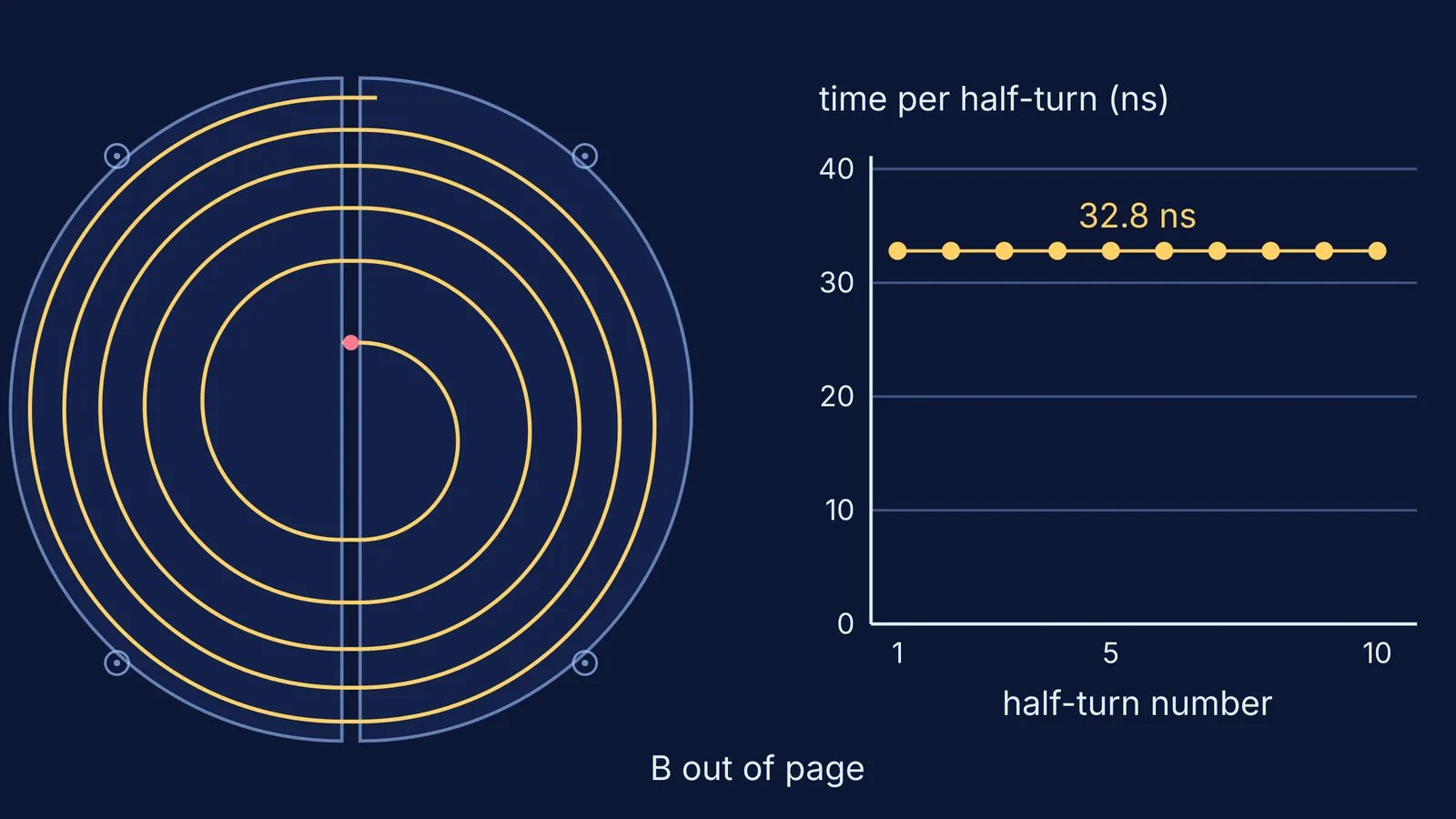
Half-turn 1: 10 keV, speed 1.38 × 10⁶ m/s, radius 1.44 cm, path 4.54 cm, time 32.8 ns
Half-turn 4: 40 keV, speed 2.77 × 10⁶ m/s, radius 2.89 cm, path 9.08 cm, time 32.8 ns
Half-turn 10: 100 keV, speed 4.38 × 10⁶ m/s, radius 4.57 cm, path 14.36 cm, time 32.8 ns
The energy grows ten times. Speed and radius grow by √10, about 3.16 times, and the path grows by exactly the same factor, so the time per half-turn stays at πm/(qB) = 32.8 ns. A full orbit takes 65.6 ns, which works out to a frequency of about 15.2 MHz. If the gap voltage reverses at 15.2 MHz, the proton finds it pointing the right way on every crossing. Radius grows like √n, which is why the turns in the drawing above crowd together further out.
How did Ernest Lawrence use this in 1931?
According to the American Institute of Physics history of the cyclotron, Lawrence and M. Stanley Livingston had their first success in January 1931. A device about 4.5 inches across used a potential of 1,800 volts to accelerate hydrogen ions to 80,000 electron volts. Since each crossing can add at most about 1,800 eV, the ions must have crossed the gap at least 45 times, and that only works because every lap took the same time. They published the method in Physical Review in 1932 as "The Production of High Speed Light Ions Without the Use of High Voltages". For the story behind the machine, read Ernest Lawrence and the cyclotron.
Where does the constant-frequency rule break down?
The rule holds only while the particle is not relativistic, as HyperPhysics points out. At high speed the period becomes T = 2πγm/(qB), where γ = 1 + K/(mc²). For a proton, mc² is 938.27 MeV (NIST). At 10 MeV, γ is about 1.011, so each half-turn takes about 33.15 ns instead of 32.8 ns. That is only 1.1% longer, but the lag adds up lap after lap until the proton arrives after the voltage has flipped. HyperPhysics notes that in current practice the magnetic field is typically altered to keep the timing right.
How can you check this yourself?
Predict first: write down T = 2πm/(qB) for your particle and field before you run anything.
Change one thing at a time. Double the gap voltage, and the spiral opens out faster but the half-turn time stays the same. Double B, and every half-turn takes half as long.
Swap the particle. An alpha particle (mass from NIST, charge 2e) has roughly twice the proton's m/q, so expect roughly twice the period in the same field.
If you would rather watch the spiral than picture it, the Fermi Simulation Lab has interactive simulations for ideas that are easier to see than to read. The same m/q idea also decides which isotope bends more in our mass spectrometer simulation.
In your next cyclotron question, find the period first: it is the number that does not change.