On this page
Two ions with the same charge enter the same magnetic field at the same speed. One is a chlorine ion with 18 neutrons, the other has 20. Which one bends more? Guess before you read on.
How does a mass spectrometer separate isotopes?
The simple design taught in school turns atoms into ions, lets through only ions of one speed, and sends them into a magnetic field that bends each one into a circle. Mass spectrometers are "sensitive detectors of isotopes based on their masses", in the words of HyperPhysics at Georgia State University.
The speed filter is a velocity selector: crossed electric and magnetic fields that pass only ions moving at one particular speed, undeflected. We worked through it in how a velocity selector uses crossed E and B fields. Once every ion has the same speed, the only things left to tell them apart are mass and charge.
For the history of the instrument, read Francis Aston, the mass spectrograph and the whole number rule.
Why does a lighter ion bend more in a magnetic field?
The magnetic force on a moving charge is always perpendicular to its velocity, so it does no work and the ion's speed stays constant (OpenStax University Physics, section 11.3). The force keeps the same size and only turns the ion, so the path is a circle.
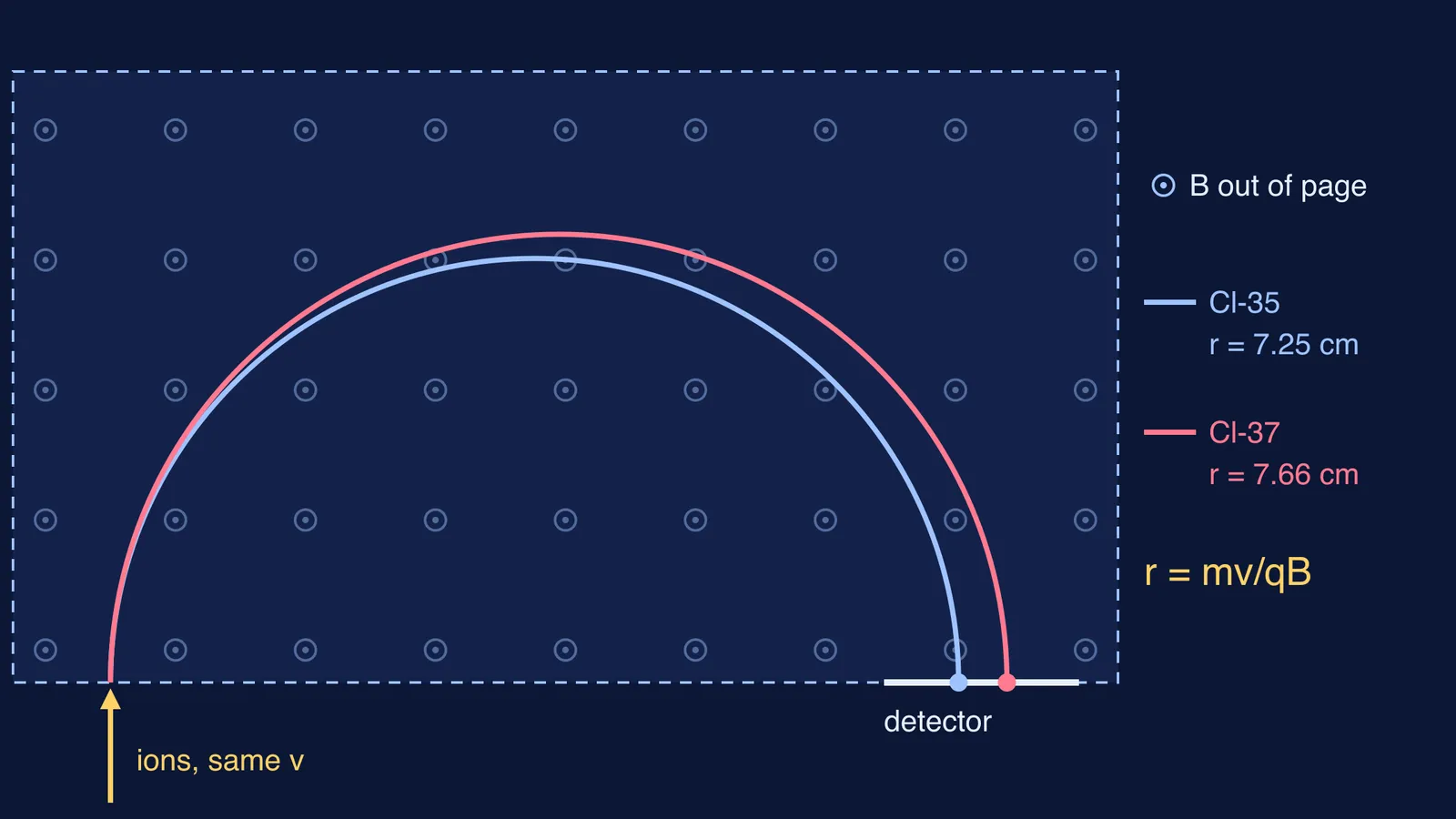
The radius of that circle is r = mv/qB, where m is the ion's mass, v its speed, q its charge and B the field strength (OpenStax).
Keep v, q and B the same, and r is proportional to m. The heavier ion carries more momentum but feels the same force, so it swings through a wider arc. The lighter ion follows the tighter circle: it bends more.
Worked example: chlorine-35 or chlorine-37?
NIST lists chlorine-35 at 34.968852682 u and chlorine-37 at 36.965902602 u, with natural abundances of 75.76% and 24.24% (NIST atomic weights and isotopic compositions). One atomic mass unit is 1.66053906892 × 10⁻²⁷ kg (NIST CODATA), and the elementary charge is exactly 1.602176634 × 10⁻¹⁹ C (NIST CODATA).
Take singly charged ions with v = 1.0 × 10⁵ m/s in a field B = 0.50 T.
Mass of a chlorine-35 ion: 34.969 × 1.6605 × 10⁻²⁷ kg = 5.807 × 10⁻²⁶ kg.
Its radius: r = (5.807 × 10⁻²⁶ × 1.0 × 10⁵) / (1.602 × 10⁻¹⁹ × 0.50) = 0.0725 m, or 7.25 cm.
Mass of a chlorine-37 ion: 6.138 × 10⁻²⁶ kg, so r = 0.0766 m, or 7.66 cm.
After a half-circle each ion lands one diameter from the entry slit: 14.50 cm and 15.32 cm.
The two spots sit about 8.3 mm apart, with chlorine-35 closer to the slit.
The radii are in the same ratio as the masses, about 1.057, so the chlorine-37 circle is 5.7% wider. The chlorine-35 spot is about three times as strong, because that isotope is about three times as common.
What should you try in a mass spectrometer simulation?
Every run below follows from r = mv/qB (OpenStax); write your guess down first.
Same speed, chlorine-35 against chlorine-37. Chlorine-35 lands closer to the slit.
Double B. Both radii halve, and so does the gap between the spots.
Make chlorine-35 doubly charged. Its radius halves to 3.62 cm, so a small circle can mean twice the charge rather than half the mass. That is why a spectrometer really sorts ions by mass-to-charge ratio.
Accelerate both ions through the same voltage V instead. Now qV = ½mv², so r = √(2mV/q)/B grows only as the square root of mass. The lighter ion still bends more, but the spots move closer.
Now try uranium. NIST gives uranium-235 as 235.0439301 u and uranium-238 as 238.0507884 u, a difference of only 1.3% (NIST uranium compositions), so at equal speed their radii differ by just 1.3%. The calutrons at the US Y-12 plant used the same principle, sending a stream of charged particles through a magnetic field and "deflecting the atoms of the lighter isotope more than those of the heavier isotope" (US Department of Energy).
If circles like these are easier to see than to read, the Fermi Simulation Lab has interactive simulations for ideas of this kind. Our post on predicting the radius of a charged particle's circle has more runs to try.
Where do students go wrong on mass spectrometer questions?
JEE-style questions usually test the same few traps:
Mixing up "same speed" and "same accelerating voltage". The first gives r proportional to m, the second r proportional to √m.
Forgetting the charge state. A doubly charged ion traces half the radius of a singly charged ion of the same mass and speed.
Reporting the radius when the question asks where the ion hits. After a half-turn the spot is a diameter, 2r, from the slit.
Thinking the field speeds the ion up. It only turns a moving charge.
If your method keeps going wrong, the Fermi Problem Library has worked problems with a step-by-step solver that explains the reasoning rather than printing an answer.