

On this page
Moving charges in a magnetic field are part of Class 12 physics and JEE Main, and they are hard to picture from a textbook figure. A simulation lets you fire a particle, watch it curve, change one thing and fire again. Predict the answer before each run.
What path does a charged particle take in a magnetic field?
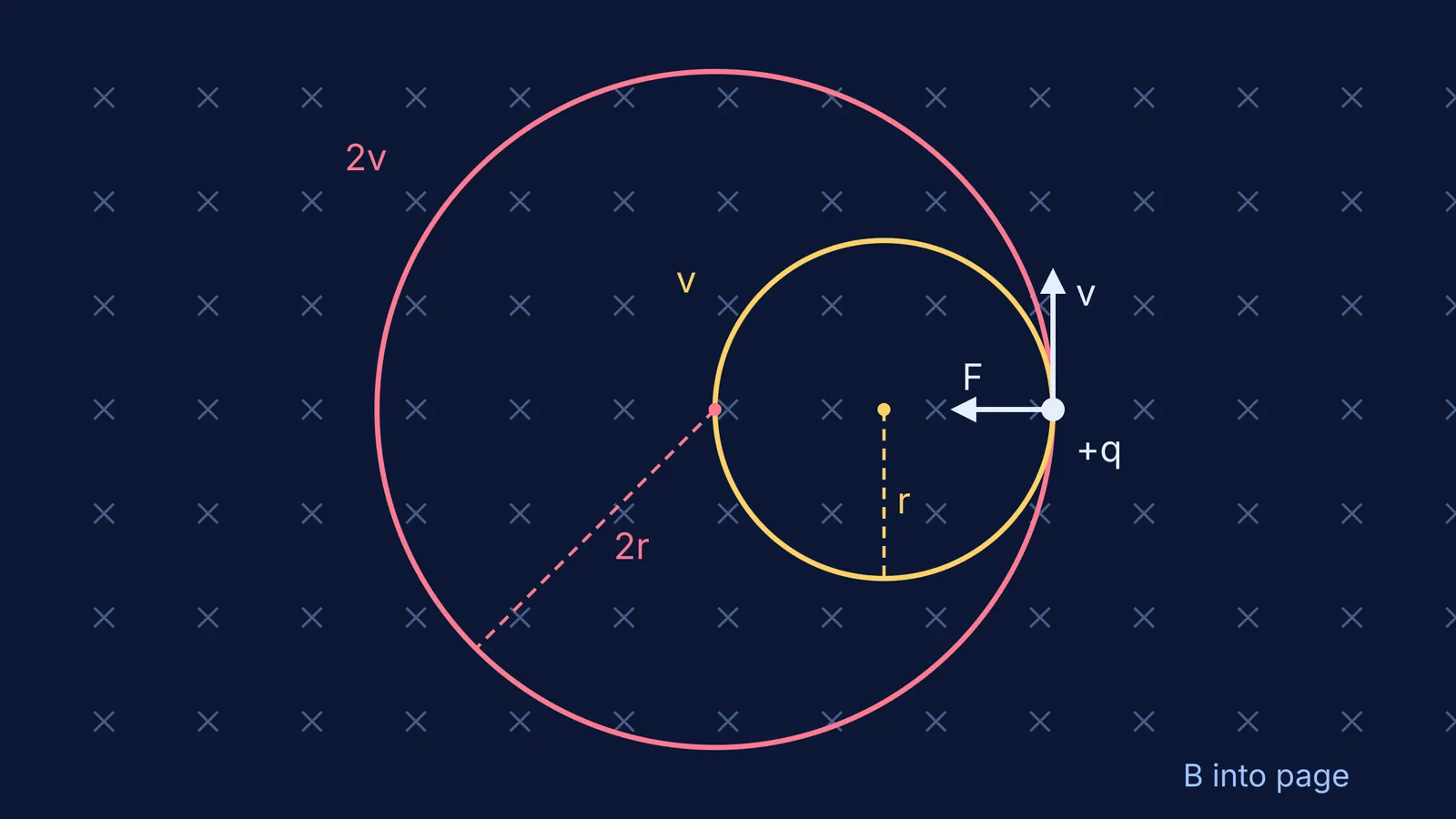
The magnetic force on a moving charge is F = qv × B. It always points at right angles to both the velocity and the field. If the particle enters a uniform field at right angles to it, the force keeps bending its path toward one centre, so the path is a circle.
For a particle moving perpendicular to a uniform magnetic field, the radius of the circle is r = mv/qB (OpenStax University Physics Volume 2, section 11.3).
Read the formula as predictions: a heavier or faster particle gets a bigger circle, while a bigger charge or stronger field gives a smaller one. Flip the sign of the charge and the particle curves the other way. For the direction rules, see our post on right-hand-rule mistakes with magnetic force.
Why does speed stay constant in a magnetic field?
The magnetic force is always perpendicular to the velocity, so it does no work on the particle, and the particle's kinetic energy and speed stay constant (OpenStax). The field changes the direction of motion, never the speed.
The time for one full circle is T = 2πm/qB, from the same OpenStax section, and speed does not appear in it: a faster particle travels a bigger circle in the same time. At speeds well below the speed of light, that is the idea behind the cyclotron, which we explain in charged particles in magnetic fields: circles, helices, cyclotrons.
Worked example: how big is a proton's circle?
We use the CODATA values from NIST: the proton mass is 1.672 621 925 95 × 10^-27 kg (NIST) and the elementary charge is exactly 1.602 176 634 × 10^-19 C (NIST).
Fire a proton at 2.0 × 10^6 m/s at right angles to a 0.50 T field.
Radius: r = mv/qB = (1.673 × 10^-27 × 2.0 × 10^6) / (1.602 × 10^-19 × 0.50) ≈ 0.042 m, about 4.2 cm.
Period: T = 2πm/qB ≈ 1.31 × 10^-7 s, about 131 nanoseconds.
Now predict, then test:
Double the speed to 4.0 × 10^6 m/s: the radius doubles to about 8.4 cm, and the period stays 131 ns.
Double the field to 1.0 T: the radius halves to about 2.1 cm, and the period halves to about 66 ns.
Keep everything but make the charge negative: same 4.2 cm circle, curving the opposite way.
Watch the speed through a full loop: it should not change at all.
What happens if the velocity has a component along the field?
Split the velocity into two parts. The part perpendicular to the field makes the circle. The part parallel to the field feels no force, so it carries on unchanged. Together they make a helix, a spiral wound around a field line, and the distance between loops (the pitch) is p = v∥ × T (OpenStax).
Take the same proton, field and speed, but fire it at 60° to the field:
Perpendicular part: 2.0 × 10^6 × sin 60° ≈ 1.73 × 10^6 m/s, so the radius drops to about 3.6 cm.
Parallel part: 2.0 × 10^6 × cos 60° = 1.0 × 10^6 m/s, so the pitch is 1.0 × 10^6 × 1.31 × 10^-7 ≈ 0.131 m, about 13.1 cm.
The period is still 131 ns, and the speed is still 2.0 × 10^6 m/s.
Check the limits: at 90° you get the flat circle back, and at 0° the particle moves straight along the field line. For more practice, see our post on the radius and pitch of a helical path.
How do you test this in a simulation?
In any charged-particle simulation, treat each run like a small lab experiment:
Pick one field strength and one particle. Predict the radius and turn direction.
Fire at 90° to the field. Measure the diameter and halve it.
Change one variable at a time (speed, field, mass or charge sign) and check the radius scales as the formula says.
Time several loops at two speeds. The periods should match.
Tilt the launch angle, measure the pitch and compare it with v∥ × T.
For more ideas that are easier to see than to read, the Fermi Simulation Lab has interactive simulations. If a numerical still goes wrong, the Fermi Problem Library has worked problems with a step-by-step solver that explains the reasoning rather than printing an answer.
Start with the proton above: predict 4.2 cm, fire, and see if you were right.


