

On this page
A magnetic field can bend a proton into a perfect circle, yet it never speeds it up or slows it down. That sounds odd, because motors use magnets to spin fans. Both are true, and here is how.
Why does magnetic force do no work on a moving charge?
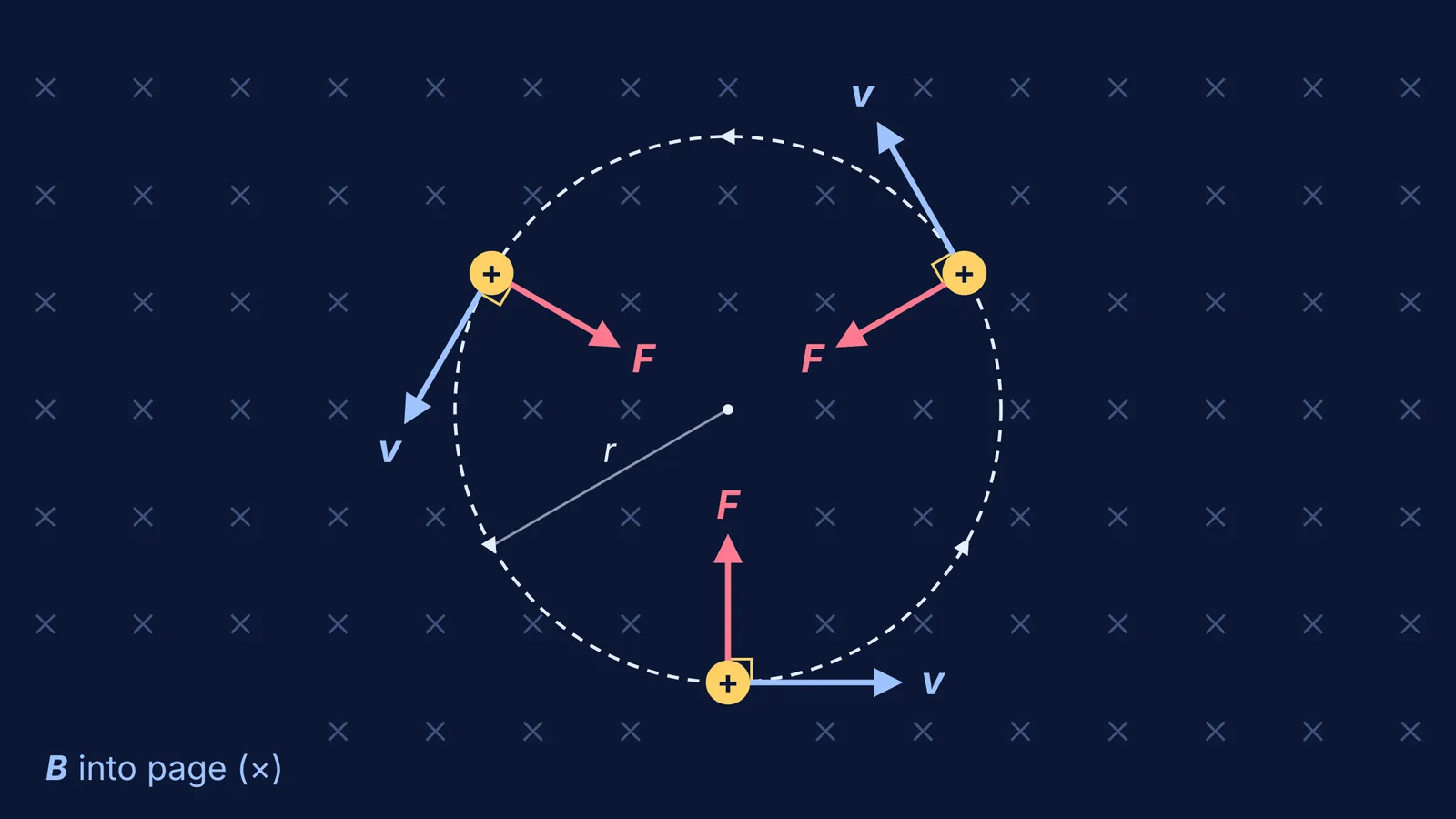
The force on a charge q moving with velocity v through an electric field E and a magnetic field B is the Lorentz force, F = q(E + v × B), as set out in NCERT Class 12 Physics, Chapter 4. The magnetic part, q(v × B), is a cross product, and a cross product is always perpendicular to both vectors that make it.
Only the part of a force along the motion does work. The rate of doing work is P = F · v. For the magnetic force, P = q(v × B) · v, which is zero at every instant because v × B is at right angles to v. Zero added up over any path is zero work.
The work-energy theorem then finishes the job: zero work means zero change in kinetic energy, so ½mv² stays fixed and the speed stays fixed. NCERT says it directly in Section 4.3: "So no work is done and no change in the magnitude of the velocity is produced (though the direction of momentum may be changed)."
Why does the speed stay constant if the direction keeps changing?
Velocity is a vector; speed is its size. A force at right angles to the motion turns the velocity without stretching it. When v is perpendicular to B, the magnetic force acts as the centripetal force, giving a circle of radius r = mv/qB and angular frequency ω = qB/m, which does not depend on speed (NCERT, Section 4.3). Any component of velocity along B is left untouched, so the general path is a helix.
What happens to a proton in a 0.50 T magnetic field?
Take a proton (mass 1.6726 × 10⁻²⁷ kg from NIST CODATA, charge 1.602 × 10⁻¹⁹ C from NIST) moving at 1.0 × 10⁶ m/s at right angles to a 0.50 T field.
Radius: r = mv/qB ≈ 0.021 m, about 2.1 cm.
Kinetic energy: ½mv² ≈ 8.36 × 10⁻¹⁶ J, about 5.2 keV.
One circle takes T = 2πm/qB ≈ 1.3 × 10⁻⁷ s. After a million circles, the kinetic energy is still 5.2 keV.
Now accelerate the proton through 1000 V. The electric field does work qΔV = 1000 eV, so the energy becomes 6.2 keV, the speed about 1.09 × 10⁶ m/s and the radius about 2.3 cm. The period is unchanged, because ω = qB/m has no v in it.
The electric field changed the speed; the magnetic field only changed the direction. See the radius respond in our post on predicting the circle of a charged particle in a magnetic field, or in the Fermi Simulation Lab, which has interactive simulations for ideas that are easier to see than to read.
If magnetic force does no work, how does an electric motor work?
In a current-carrying wire, the magnetic force pushes drifting electrons sideways. They pile up on one side (the Hall effect), setting up an electric field that pulls on the wire's positive ions. Marco Finazzi and Maurizio Zani of Politecnico di Milano look at all the charge populations inside the wire and argue that the force on it "is instead an electrostatic force" (The Physics Teacher, 2023).
The energy comes from the supply. Once the wire moves, its electrons share that motion, and the magnetic force on this new velocity component pushes against the current: the back emf, explained in our post on why a DC motor draws a large starting current. The battery's electric field does work to keep the current flowing, and that becomes the motor's mechanical work. The magnetic force only redirects energy: positive work on the wire, equal negative work against the current, net zero.
The University of Illinois Physics Van sums up the chain as "magnetic field--> electric field--> charge carriers (electrons) --> mechanical motions" (Ask the Van). It also notes that the no-work rule fails for permanent magnets, whose magnetism comes largely from electron spins; for the moving charges in your syllabus, the rule holds.
How do you use this in JEE and board answers?
Only B acting? Kinetic energy is constant, so the speed later equals the starting speed.
Constant speed is not constant velocity or momentum; the direction changes.
Speed changed? Look for an electric field, gravity or friction, never the magnetic force.
Rod, rail or motor question? Balance energy using the source and the back emf.
Two-line board answer: Since F = q(v × B) is perpendicular to v, F · v = 0. So no work is done, and kinetic energy and speed stay constant.
For problems mixing both fields, see our guide to the Lorentz force on a charge in electric and magnetic fields.
To practise, the Fermi Problem Library has worked problems with a step-by-step solver that explains the reasoning rather than printing an answer.


