

On this page
When a charged particle moves through both an electric and a magnetic field, the total force it feels is the Lorentz force. Derived by Hendrik Lorentz in 1895, it combines the straight push of the electric field with the sideways turn of the magnetic field.
What is the force on a charge in an electric field?
If you place a charge in an electric field, it feels a force right away, even if it is sitting still. The force is F = qE, where q is the charge and E is the electric field.
A positive charge is pushed in the direction of the field lines.
A negative charge is pushed exactly opposite to the field.
Because the force is constant in a uniform field, the particle speeds up in a straight line, much like a stone falling under gravity. The electric force does work on the charge, changing its kinetic energy.
What is the force on a charge in a magnetic field?
A magnetic field is different: it ignores stationary charges. A charge only feels a magnetic pull when it is moving. The force is F = q(v × B), where v is the velocity and B is the magnetic field.
This force is always perpendicular to both the velocity and the magnetic field. Since it pushes sideways, it cannot speed the particle up or slow it down; it only changes its direction. A charge entering a uniform magnetic field at right angles will be forced into a circle, or a helical path if it enters at an angle. Finding the exit angle and time inside the field depends entirely on this sideways push.
How does the Lorentz force combine them?
When both fields are present, the particle feels both forces at once. The total force is the vector sum: F = q(E + v × B). This is the Lorentz force, and it governs everything from old television screens to modern particle accelerators.
The Fermi Concept Library holds every concept in physics, each with its own lesson and its place in the map, helping you picture the vector math behind the Lorentz force.
Because E and B are vectors, they can point anywhere. This leads to three classic cases:
Parallel fields: The electric field speeds the particle up, while the magnetic field tries to turn it. If the particle is fired parallel to both fields, the magnetic force is zero (because v × B is zero), and the particle simply accelerates straight ahead.
Perpendicular fields with zero velocity: The particle starts from rest. The electric field pulls it, giving it speed. Once it is moving, the magnetic field wakes up and turns it sideways. The particle traces out a looping cycloid curve.
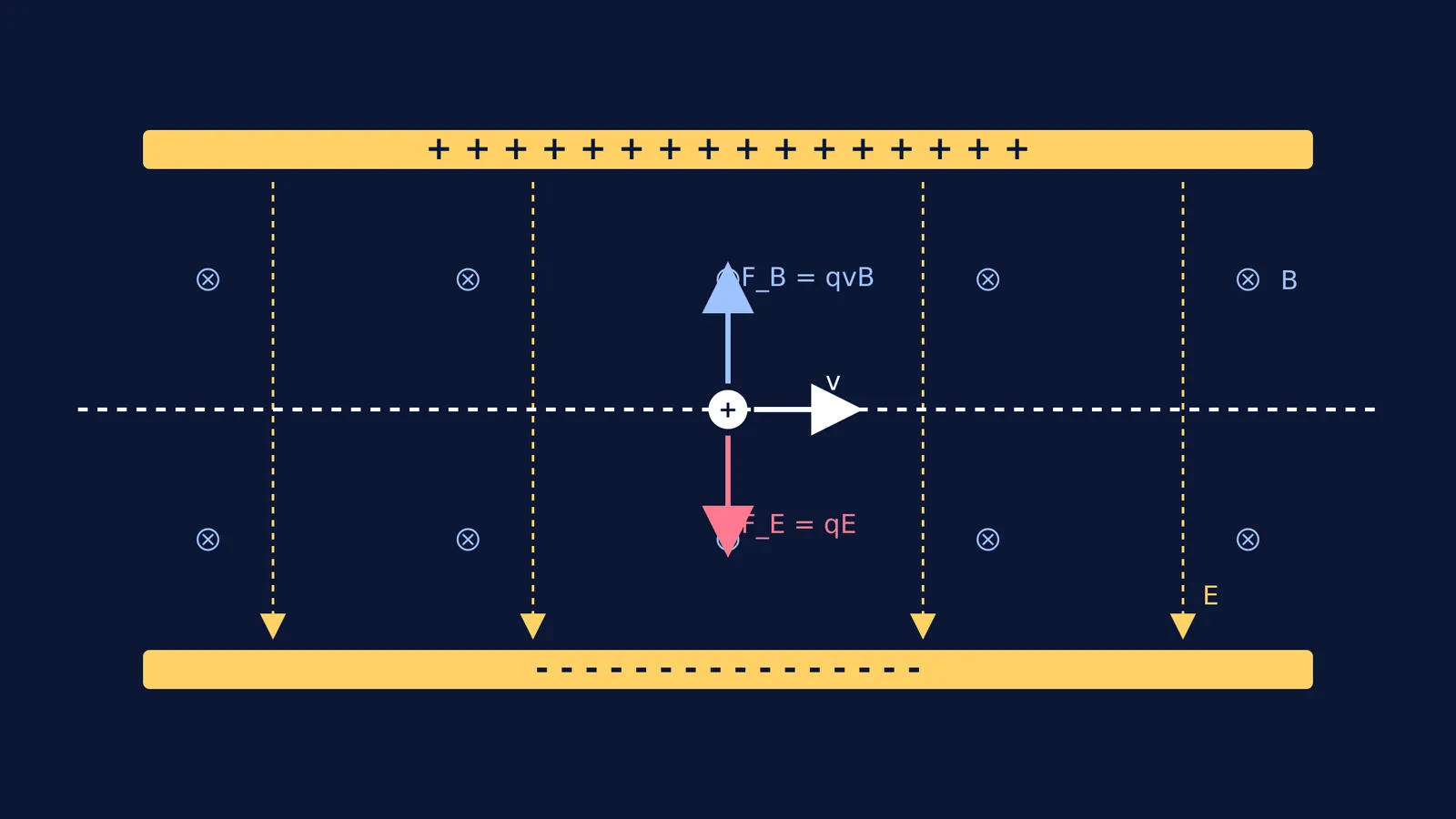
Crossed fields with a specific speed: The electric and magnetic forces point in exactly opposite directions.
How does a velocity selector use crossed fields?
If you set up an electric field and a magnetic field at right angles to each other, you can make the two forces fight. This is called a Wien filter, developed by Wilhelm Wien in 1898 to study charged rays.
Imagine a positive charge fired to the right. An electric field pointing down pushes it down with a force qE. A magnetic field pointing into the page pushes it up with a force qvB.
If the particle has exactly the right speed, the upward and downward forces match: qE = qvB v = E / B
Worked example: Filtering protons
Suppose you have an electric field of 10,000 V/m and a magnetic field of 0.2 T, both perpendicular to a beam of protons.
Find the target speed: v = E / B = 10,000 / 0.2 = 50,000 m/s.
What happens to slower protons? If a proton is moving at 40,000 m/s, the magnetic force is q(40,000)(0.2) = 8,000 q. The electric force is a constant 10,000 q. The electric force wins, pulling the slower proton downward and out of the beam.
What happens to faster protons? If a proton moves at 60,000 m/s, the magnetic force is 12,000 q. The magnetic force wins, deflecting the faster proton upward.
For this specific speed, the forces cancel out. The Lorentz force is zero, and the particle flies straight through. This arrangement filters out all speeds except v = E/B.
If you are stuck on problems combining forces and circular motion, the Fermi Problem Library has worked problems with a step-by-step solver that explains the reasoning rather than printing an answer. It breaks down the Lorentz force equation and shows you how to set up the vectors.
Where is the Lorentz force used?
The interplay of crossed fields helped reveal the building blocks of atoms. In 1897, J. J. Thomson used perpendicular electric and magnetic fields in a cathode ray tube to measure how much they bent a beam of unknown rays. By balancing the fields, he found the charge-to-mass ratio of the particles in the beam, proving they were far lighter than atoms. This was the discovery of the electron.
Today, mass spectrometers use the same principle to separate isotopes, and the Hall effect uses the Lorentz force to measure magnetic fields in smartphones and car engines. Whenever you need to steer, filter or measure a charged particle, you rely on the equation Lorentz wrote down.


