

On this page
A spinning motor is also a generator. Its coil turns in a magnetic field, so an emf is induced in it, and by Lenz's law that emf opposes the supply. This back emf explains three things JEE and board questions keep asking about: the large starting current, the starter resistance, and the condition for maximum power.
What is back emf and why does it rise with speed?
Back emf is the generator output of a motor, so it is proportional to the motor's angular velocity, as OpenStax College Physics 2e, section 23.6 puts it. The same section says that as the motor turns faster, the back emf grows and reduces the current the coil draws.
Write e for the back emf, V for the supply and R for the coil (armature) resistance. The voltage left to push current through the coil is V − e, so:
Why does a motor draw a large current at start?
At the instant you switch on, the coil is not turning, so e = 0. The only thing limiting current is R, and R is kept small for efficiency. A Motion Control Tips explainer on DC motor starters notes armature resistance is typically less than 1 ohm.
OpenStax works through a motor with a 0.400 Ω coil on a 48.0 V supply. At start it draws 120 A and dissipates 5.76 kW as heat in the coil, which would burn the coil out if it lasted. At normal speed the back emf is 40.0 V, so the current drops to 20 A and the heat to 160 W (OpenStax, section 23.6).
OpenStax also warns that if a heavy load slows the motor too much, back emf stays low and I²R heating can burn out the coil.
Why do DC motor starters add resistance?
A starter puts an extra resistance in series with the armature while the motor is slow, so the current is I = (V − e)/(R + Rs). As the motor speeds up and the back emf builds, sections of that resistance are cut out one by one until it is gone at normal speed, as Circuit Globe's page on starting DC motors describes. Its own example is a 0.5 Ω armature on 230 V, which would draw 460 A at start without a starter.
Worked example: sizing a starter
Take the OpenStax example motor (V = 48.0 V, R = 0.400 Ω) and say you want the current never to exceed 30 A.
At start, e = 0, so total resistance must be 48/30 = 1.6 Ω. Add Rs = 1.6 − 0.4 = 1.2 Ω.
As the motor speeds up with Rs in place, current falls. At e = 36 V it is (48 − 36)/1.6 = 7.5 A.
Cut Rs out at that moment: the current becomes (48 − 36)/0.4 = 30 A, right at your limit.
The motor keeps speeding up to e = 40 V, where the current settles at 20 A.
The rule: cut a step out only once e has reached V − (current limit × R). Real starters use several steps so each jump stays small. Our post on cells, emf and internal resistance uses the same idea: an emf minus the drop across a resistance.
When does a motor give maximum mechanical power?
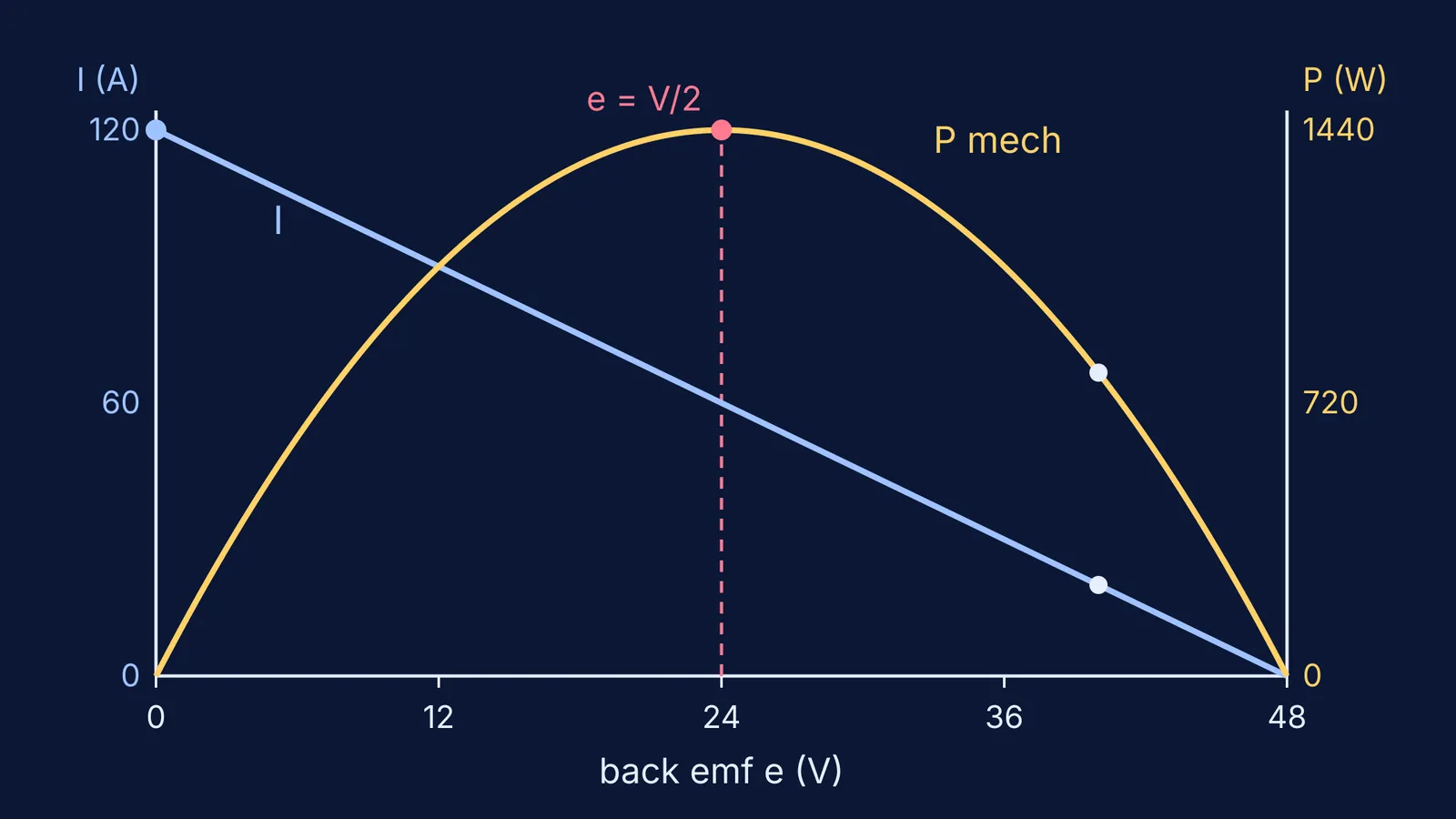
The electrical power the motor converts to mechanical work is eI. Multiply the voltage equation V = e + IR by I: VI = eI + I²R. Supply power equals mechanical power plus coil heating.
Now write P = eI = e(V − e)/R. This is a downward parabola in e, zero at e = 0 (no speed) and at e = V (no current). Setting dP/de = (V − 2e)/R = 0 gives e = V/2, the standard condition stated in Electrical Technology's DC motor formula guide.
Check with the OpenStax example numbers. At e = 24 V, I = 60 A, mechanical power is 1440 W and coil heating is 60² × 0.4 = 1440 W. At the normal running point, e = 40 V, the motor gives 800 W with 160 W of heating, an efficiency of 800/960, about 83 percent. Running at maximum power needs three times the normal current, so the coil would overheat.
A checklist for back emf questions
Write V = e + IR first, every time.
At start or when jammed, set e = 0.
Starter: add Rs in series and use (V − e)/(R + Rs).
Maximum mechanical power: e = V/2, efficiency 50 percent.
If you keep mixing up which emf goes where, the Fermi Problem Library has worked problems with a step-by-step solver that explains the reasoning rather than printing an answer. For where back emf comes from, read our guide to motional emf in a rod sliding on rails, then try power and efficiency problems with motors, pumps and lifts.


