

On this page
Most salt sold in India is iodised with potassium iodate, KIO₃. The amount added is tiny, a few tens of milligrams of iodine per kilogram of salt, so you cannot weigh it. Instead, chemists turn each iodate ion into iodine and count that iodine with sodium thiosulphate. The method is a short, neat piece of redox stoichiometry, and it hides one trap that costs marks every year: most of the iodine you titrate did not come from the salt.
Why is iodised salt fortified with iodate and not iodide?
Iodide (I⁻) is slowly oxidised by air, especially in warm, humid conditions, and the iodine it forms can escape. Iodate (IO₃⁻) is iodine in its +5 state and is far more stable in storage, which is why it is the usual choice in hot climates. The health reasons for adding iodine at all are covered in why iodine is added to salt in India, and the history behind it in V. Ramalingaswami's Kangra valley iodised salt study. This post is only about measuring it.
How do you release iodine from the iodate in salt?
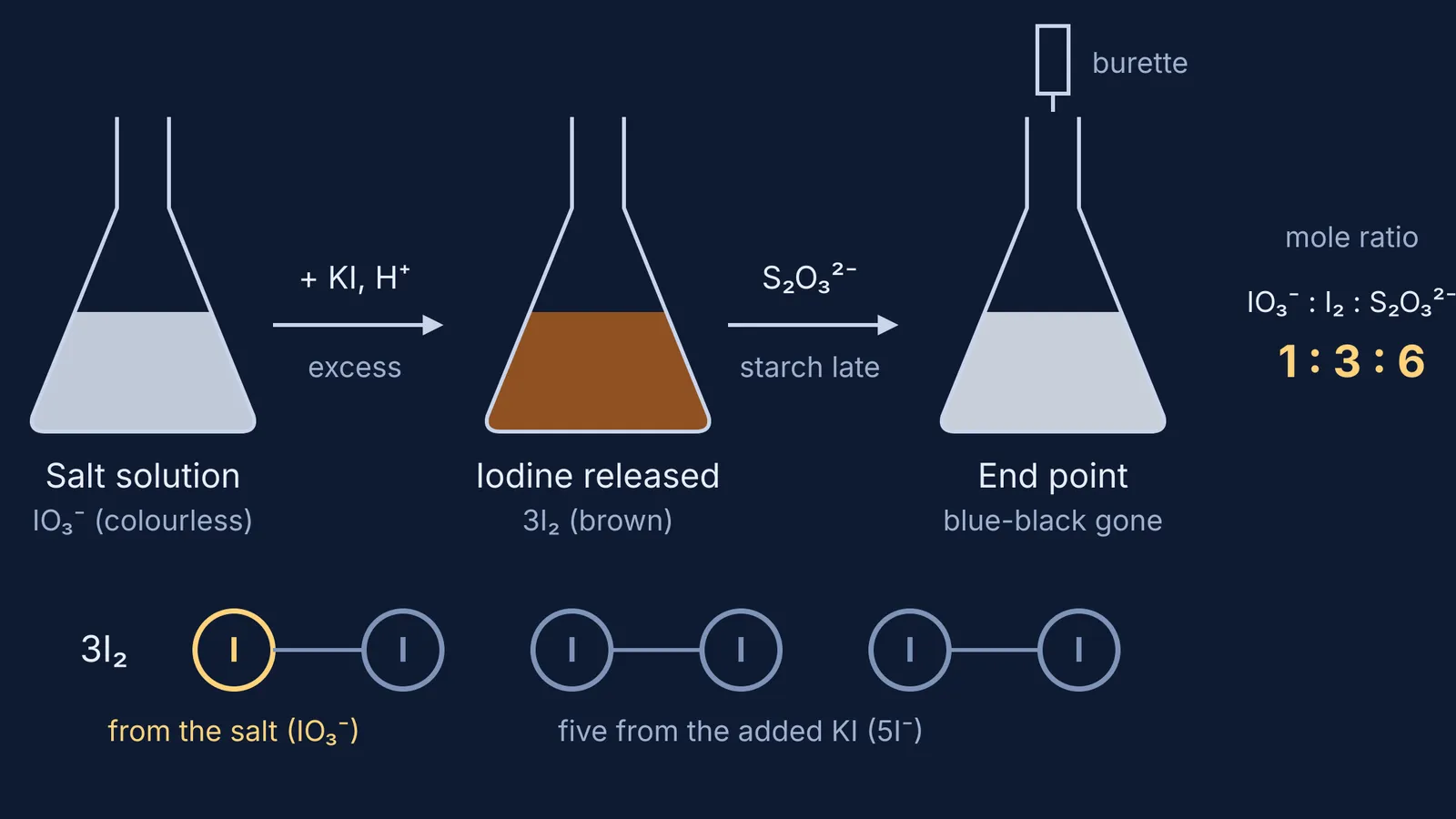
Dissolve a weighed sample of salt in water. Add excess potassium iodide and excess dilute acid (dilute sulphuric acid is common). In acid, iodate and iodide react with each other:
IO₃⁻ + 5I⁻ + 6H⁺ → 3I₂ + 3H₂O
Check it balances: 6 I on each side, 3 O on each side, 6 H on each side, and the charge is −1 − 5 + 6 = 0 on the left and 0 on the right.
This is a comproportionation. Iodine in iodate is at +5, iodine in iodide is at −1, and they meet in the middle at 0 in I₂. One iodine atom drops by 5 and five iodine atoms each rise by 1, so the electrons balance.
Both reagents must be in excess for a reason:
Excess KI makes sure every IO₃⁻ is converted. It also keeps the iodine dissolved as the brown I₃⁻ ion (see why iodine dissolves in KI), which stops it escaping as vapour.
Excess acid is needed because the reaction uses six H⁺ per iodate. Without enough acid, the reaction is incomplete and you under-report the iodine.
The solution turns yellow-brown as iodine forms. Titrate it promptly: in acid, air slowly oxidises extra iodide to iodine too, which would make the result too high.
How does the thiosulphate titration count the iodine?
Run sodium thiosulphate from a burette into the brown solution. Thiosulphate reduces iodine back to iodide and is itself oxidised to tetrathionate:
I₂ + 2S₂O₃²⁻ → 2I⁻ + S₄O₆²⁻
Charges: −4 on the left, −2 − 2 = −4 on the right. The full balancing of this reaction is worked in sodium thiosulphate and iodine: the tetrathionate reaction.
As the iodine is used up, the brown colour fades to pale straw yellow. Add starch only now, near the end point. Starch turns blue-black with the remaining iodine, and the end point is when one more drop of thiosulphate makes the blue-black colour vanish. If you add starch at the start, a lot of iodine binds tightly to the starch and is released slowly, so the end point drags and is hard to read.
This is an iodometric titration: iodine is produced in the flask by a reaction, then titrated. It is not iodimetric, where a standard iodine solution is the titrant. If you mix up the two words, iodometric vs iodimetric titration sets out the difference with general examples.
What is the mole ratio between iodate and thiosulphate?
Chain the two equations:
1 IO₃⁻ gives 3 I₂.
Each I₂ needs 2 S₂O₃²⁻.
So 1 IO₃⁻ ≡ 3 I₂ ≡ 6 S₂O₃²⁻.
That gives the one formula you need:
moles of IO₃⁻ = moles of S₂O₃²⁻ ÷ 6
Each iodate ion carries exactly one iodine atom, so moles of iodine from the salt equal moles of iodate.
Worked example: how many ppm of iodine is in this salt?
A 10.0 g sample of iodised salt is dissolved in water, treated with excess KI and dilute sulphuric acid, and titrated with 0.00500 M sodium thiosulphate. The end point (with starch added near the end) comes at 2.40 mL. Find the iodine content in ppm.
Moles of thiosulphate. 2.40 mL = 2.40 × 10⁻³ L. Moles = 2.40 × 10⁻³ × 0.00500 = 1.20 × 10⁻⁵ mol.
Moles of iodine released. I₂ = 1.20 × 10⁻⁵ ÷ 2 = 6.00 × 10⁻⁶ mol. (This is a check, not the answer.)
Moles of iodate. IO₃⁻ = 1.20 × 10⁻⁵ ÷ 6 = 2.00 × 10⁻⁶ mol. This is also 6.00 × 10⁻⁶ ÷ 3.
Mass of iodine from the salt. One I atom per iodate, molar mass of I = 126.9 g mol⁻¹. Mass = 2.00 × 10⁻⁶ × 126.9 = 2.54 × 10⁻⁴ g = 0.254 mg.
Convert to ppm. Here ppm means milligrams of iodine per kilogram of salt. 0.254 mg in 10.0 g is 0.254 mg in 0.0100 kg, so 0.254 ÷ 0.0100 = 25.4 ppm iodine.
Two wrong answers to watch for:
152 ppm. You get this if you take all 6.00 × 10⁻⁶ mol of I₂ (1.20 × 10⁻⁵ mol of I atoms) as iodine from the salt. That counts the iodide you added. It is exactly six times too high.
42.8 ppm. You get this if you report the mass of KIO₃ instead of iodine. KIO₃ has a molar mass of 214.0 g mol⁻¹, so 2.00 × 10⁻⁶ mol is 0.428 mg, or 42.8 ppm of KIO₃. Iodine is only about 59% of KIO₃ by mass. Food standards quote iodine, not the compound, so read the question.
India's food regulator, FSSAI, sets minimum iodine levels for iodised salt in this same unit, with a higher minimum at the factory than at the point of sale, because some iodine is lost during storage and transport. A titration like this one is how those levels are checked. Look up the current FSSAI standard if you need the exact figures.
If you want more titration problems where the mole ratio is the whole question, the Fermi Problem Library has a step-by-step solver that explains the reasoning at each stage.
What if the salt is iodised with KI instead of KIO₃?
Some salt is fortified with potassium iodide. Then the method above does not work as written: adding more KI and acid does nothing, because there is no oxidant in the sample to free the iodine. The iodide has to be oxidised first, for example to iodate, and the excess oxidant removed before the KI and acid step. The mole ratio then changes with the route, so always write the equations for the method actually used instead of reusing 1 : 6 from memory.
Quick checklist
Iodate route: IO₃⁻ + 5I⁻ + 6H⁺ → 3I₂ + 3H₂O, then I₂ + 2S₂O₃²⁻ → 2I⁻ + S₄O₆²⁻.
Mole ratio IO₃⁻ : I₂ : S₂O₃²⁻ = 1 : 3 : 6.
KI and acid both in excess; titrate promptly.
Starch near the end point, at pale straw yellow, not at the start.
Only one I in 3I₂ came from the salt.
ppm here means mg of iodine per kg of salt, not mg of KIO₃.
It is an iodometric titration, not iodimetric.


