

On this page
Rotate a figure about a point, then stretch it from the same point, and every dot on it slides out along a spiral. Wikipedia's article on spiral similarity defines it as a plane transformation composed of a rotation and a dilation. Its origin is not known; Coxeter documented it in 1967 in Geometry Revisited. Olympiad geometry uses it widely to reduce a busy diagram to similar triangles.
What is a spiral similarity, in simple terms?
Fix a centre O, an angle and a scale factor k. Every point X goes to X′ with OX′ = k times OX, and angle XOX′ is the same for every point, turned the same way. So for any points X and Y, triangles OXY and OX′Y′ are similar with the same orientation.
With complex numbers, a spiral similarity with centre z0 is T(z) = z0 + α(z − z0), where |α| is the scale factor and arg α is the angle of rotation (Wikipedia). If |α| = 1 it is a plain rotation; if α is real it is a homothety, covered in what a homothety is and how centres of similarity work.
How do you find the centre of a spiral similarity from two segments?
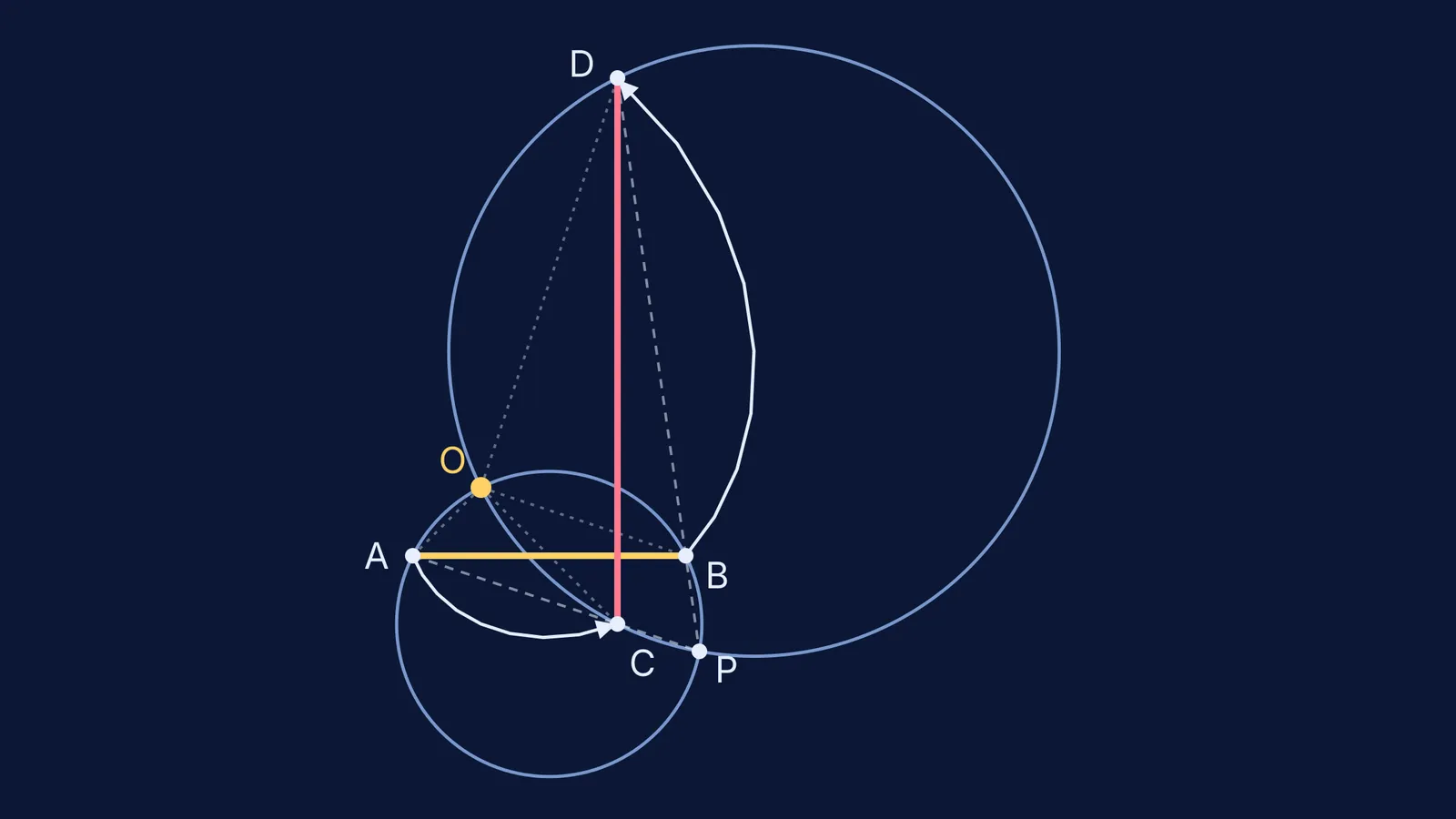
Take segments AB and CD with lines AC and BD not parallel. One spiral similarity sends A to C and B to D, with scale CD/AB and angle equal to the angle from AB to CD. To find its centre (Wikipedia):
Draw lines AC and BD and call their intersection P.
Draw the circle through P, A, B and the circle through P, C, D.
The two circles meet at P and at one more point. That second point is the centre O.
Why it works: O is on circle PAB, so angle OBA equals angle OPA. O is on circle PCD, so angle ODC equals angle OPC. P, A and C lie on one line, so those angles at P match, giving angle OBA = angle ODC. Likewise angle OAB = angle OCD. So triangles OAB and OCD are similar with the same orientation: a spiral similarity centred at O. (Directed angles cover diagrams where these pairs are supplementary.)
A worked example you can check by hand
Take A = 0, B = 4, C = 3 − i and D = 3 + 7i as complex numbers. Using the formulas on the Wikipedia page:
The multiplier is α = (d − c)/(b − a) = 8i/4 = 2i. So the scale factor is 2 and the rotation is 90° anticlockwise.
The centre is z0 = (ad − bc)/(a + d − b − c) = (−12 + 4i)/(−4 + 8i) = 1 + i.
Check: T(0) = (1 + i) + 2i(−1 − i) = 3 − i, which is C. And T(4) = (1 + i) + 2i(3 − i) = 3 + 7i, which is D.
Now the circles. Line AC is y = −x/3 and line BD runs through (4, 0) and (3, 7); they meet at P = (4.2, −1.4). The circle through P, A, B has centre (2, −1) and radius √5; the circle through P, C, D has centre (5, 3) and radius √20. The point (1, 1) is √5 from the first centre and √20 from the second, so both circles pass through it. So O = 1 + i, as the algebra said; the diagram at the top is this figure.
Where does the Miquel point come in?
Four lines in general position make a complete quadrilateral with four triangles, and the circumcircles of all four meet at one point, the Miquel point (Miquel's theorem on Wikipedia). Jakob Steiner announced this result in two lines in the 1827/1828 issue of Gergonne's Annales; a detailed proof was given by Auguste Miquel.
Lines AB, CD, AC and BD form a complete quadrilateral, triangles PAB and PCD are two of its four triangles, and O lies on both circumcircles. So the spiral centre is the Miquel point of those four lines. The spiral similarity article uses this to prove Miquel's quadrilateral theorem. For another many-circle tool, see what inversion in a circle is.
How do you spot a spiral similarity in a problem?
Signs to look for:
Two circles meet at two points, with lines through one meeting point. The other meeting point is often a spiral centre.
Triangles OAB and OCD are similar with the same orientation and share the vertex O. Then O is the centre sending AB to CD.
You must show a circle passes through a fixed point. Try the Miquel point.
You see z0 + α(z − z0). Read the scale and angle off α.
For the algebra side, see testing collinear and concyclic points with complex numbers.
The Fermi Concept Library gives every concept in mathematics its own lesson, including complex numbers and cyclic quadrilaterals. For practice, the Fermi Problem Library has worked problems with a step-by-step solver that explains the reasoning rather than printing an answer.


