

On this page
Barycentric coordinates describe a point by how much of each corner of a triangle it is made of: "half A, a quarter B, a quarter C" instead of an x and a y. For ratio and area problems in olympiad geometry, that one idea can turn long constructions into short calculations.
What are barycentric coordinates?
August Möbius introduced barycentric coordinates in 1827, according to the Wikipedia article on the barycentric coordinate system, which cites his book Der barycentrische Calcul.
In the form used by Max Schindler and Evan Chen in their handout Barycentric Coordinates in Olympiad Geometry, a point P gets a triple (x, y, z) with P = xA + yB + zC and x + y + z = 1.
Read it as a weighted average: hang weights x, y and z at the corners and P is the balance point. The corners are A = (1, 0, 0), B = (0, 1, 0) and C = (0, 0, 1). The midpoint of AB is (1/2, 1/2, 0), what the section formula for internal and external division gives for the ratio 1 : 1.
Coordinates written as ratios, such as (1 : 1 : 1), mean "divide by the sum first": (1 : 1 : 1) is (1/3, 1/3, 1/3).
How do barycentric coordinates relate to areas?
Each coordinate is an area ratio: x = area(PBC)/area(ABC), y = area(PCA)/area(ABC) and z = area(PAB)/area(ABC), which is why they are also called areal coordinates (Wikipedia).
The areas are signed, so the signs tell you where P sits: all three positive means inside, one zero (the others positive) means on a side, two zeros mean a vertex, and any negative means outside.
This is the weighing idea behind mass point geometry for length ratios, with areas doing the bookkeeping.
Why is the centroid (1 : 1 : 1) and the incentre (a : b : c)?
The Schindler and Chen handout lists centroid G = (1 : 1 : 1) and incentre I = (a : b : c), where a = BC, b = CA and c = AB. Areas show why.
Centroid. The three medians cut ABC into six small triangles of equal area, so GBC, GCA and GAB each hold one third. Equal areas, equal weights.
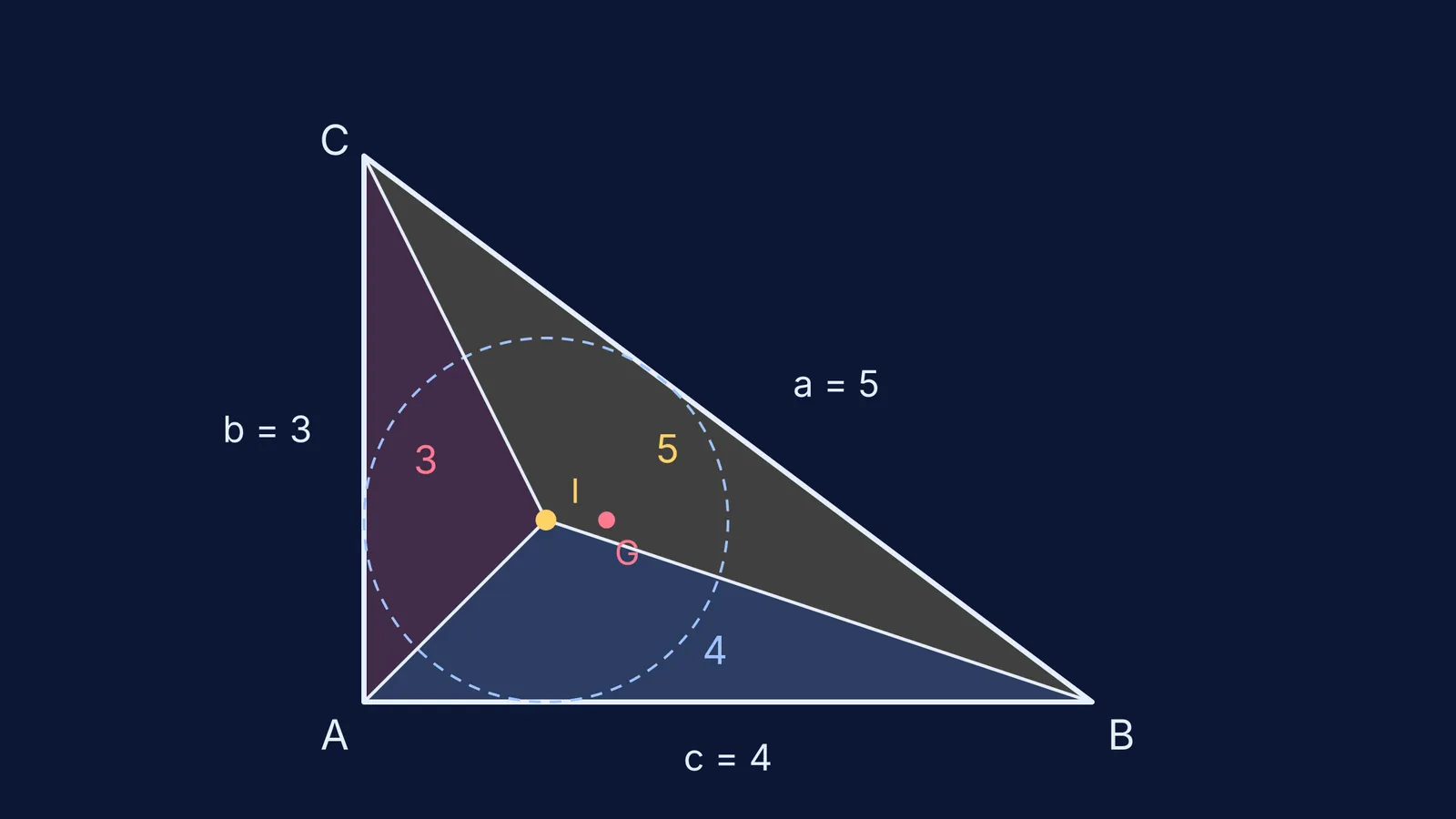
Incentre. The incentre is the same distance r, the inradius, from every side. So area(IBC) = ra/2, area(ICA) = rb/2 and area(IAB) = rc/2. The factor r/2 cancels, leaving a : b : c.
A worked example on a 3-4-5 triangle
Take A = (0, 0), B = (4, 0) and C = (0, 3). Then a = BC = 5, b = CA = 3, c = AB = 4, and the area is 6.
Centroid: weights (1/3, 1/3, 1/3) give (A + B + C)/3 = (4/3, 1).
Incentre: weights 5/12, 3/12 and 4/12 give (5(0, 0) + 3(4, 0) + 4(0, 3))/12 = (12, 12)/12 = (1, 1).
Check with areas: area(IBC) should be 5/12 of 6, or 2.5. The inradius is area over semi-perimeter, 6/6 = 1, and ra/2 = 2.5. It matches.
Check with distances: (1, 1) is 1 unit from both axes and |3 + 4 - 12|/5 = 1 unit from BC, the line 3x + 4y = 12.
How do you test whether three points are collinear?
Three points are collinear exactly when their triangle has zero area. With normalised coordinates, the signed area of PQR equals area(ABC) times the 3 by 3 determinant of their coordinates, so P, Q and R are collinear if and only if that determinant is zero (Schindler and Chen).
Try the median from C: M = (1/2, 1/2, 0), G = (1/3, 1/3, 1/3), C = (0, 0, 1). Two columns are identical, so the determinant is 0 and G lies on the median.
Now test G, I and C from the example. Expanding along the row of C, the determinant of (1/3, 1/3, 1/3), (5/12, 3/12, 4/12) and (0, 0, 1) is 1/12 - 5/36 = -1/18. Not zero, so not collinear. The minus sign only records the order of the points, so triangle GIC has area 6 × 1/18 = 1/3. Check: GI is a horizontal segment of length 1/3 and C is 2 units above it, so the area is ½ × 1/3 × 2 = 1/3.
For a different route to the same test, compare complex numbers for collinear and concyclic points.
How should you practise barycentric coordinates?
Learn the vertices, midpoints, centroid and incentre cold.
Redo two ratio problems you once solved with similar triangles, this time with weights.
Check every answer once in ordinary coordinates, as above.
If a weighted average or a 3 by 3 determinant still feels shaky, the Fermi Concept Library gives each concept in mathematics its own lesson. When a step goes wrong, the Fermi Problem Library has worked problems with a step-by-step solver that explains the reasoning rather than printing an answer.
Start with the 3-4-5 triangle above: find its centroid and incentre yourself before you look back.


