

On this page
Vieta jumping uses nothing beyond the sum and product of a quadratic's roots, which you know from Class 10, yet it cracked one of the most famous olympiad problems ever set.
What is Vieta jumping?
Vieta jumping, also called root flipping, is a proof technique for problems that give a relation between two integers and ask you to prove something about all its solutions, as described in the Wikipedia article on Vieta jumping.
It rests on Vieta's formulas: if r and s are the roots of x² + px + q, then r + s = −p and rs = q, as set out in Kyle Wu's article in Parabola, the UNSW mathematics journal for school students.
The method has three moves:
Fix one variable and read the equation as a quadratic in the other. One root is the solution you already have.
Use the sum of roots to show the other root is an integer, and the product of roots (often with the sum) to show it is not negative and is smaller.
Jump to the new, smaller solution and repeat. Positive integers cannot shrink forever, so you land on a base case that gives the answer.
That third move is infinite descent.
Why was IMO 1988 Problem 6 so hard?
The problem: let a and b be positive integers such that ab + 1 divides a² + b². Prove that (a² + b²)/(ab + 1) is the square of an integer.
IMO 1988 Problem 6 had an average score of 0.634 points out of 7, the lowest average on a Problem 6 until 2002, according to Kyle Wu in Parabola.
Arthur Engel, in his book Problem-Solving Strategies (Springer, 1998), wrote, as quoted on Wikipedia, that none of the six members of the Australian problem committee could solve it, nor could four renowned Australian number theorists given six hours. The jury still chose it as the last problem, and eleven students gave perfect solutions.
The hard part was not machinery. It was seeing that a divisibility statement is secretly a quadratic.
How does Vieta jumping solve the problem?
Write a² + b² = k(ab + 1) with a ≥ b, fix b and treat a as the unknown:
a² − (kb)a + (b² − k) = 0
One root is a. Call the other root a′. Vieta's formulas give two facts, following the proof in Parabola:
Sum: a′ = kb − a, so a′ is an integer.
Product: a′ = (b² − k)/a, so a′ = 0 exactly when k = b².
Multiplying out, (1 + a)(1 + a′) = 1 + (b − 1)k + b², which is positive, so a′ cannot be negative. And since a ≥ b, a′ = (b² − k)/a is less than b²/a, which is at most a. So the jump always goes down.
Now pick the solution with the smallest a + b. If a′ were positive, (a′, b) would be a smaller solution, which is impossible. So a′ = 0, which forces k = b². The quotient is a perfect square.
A worked jump you can check by hand
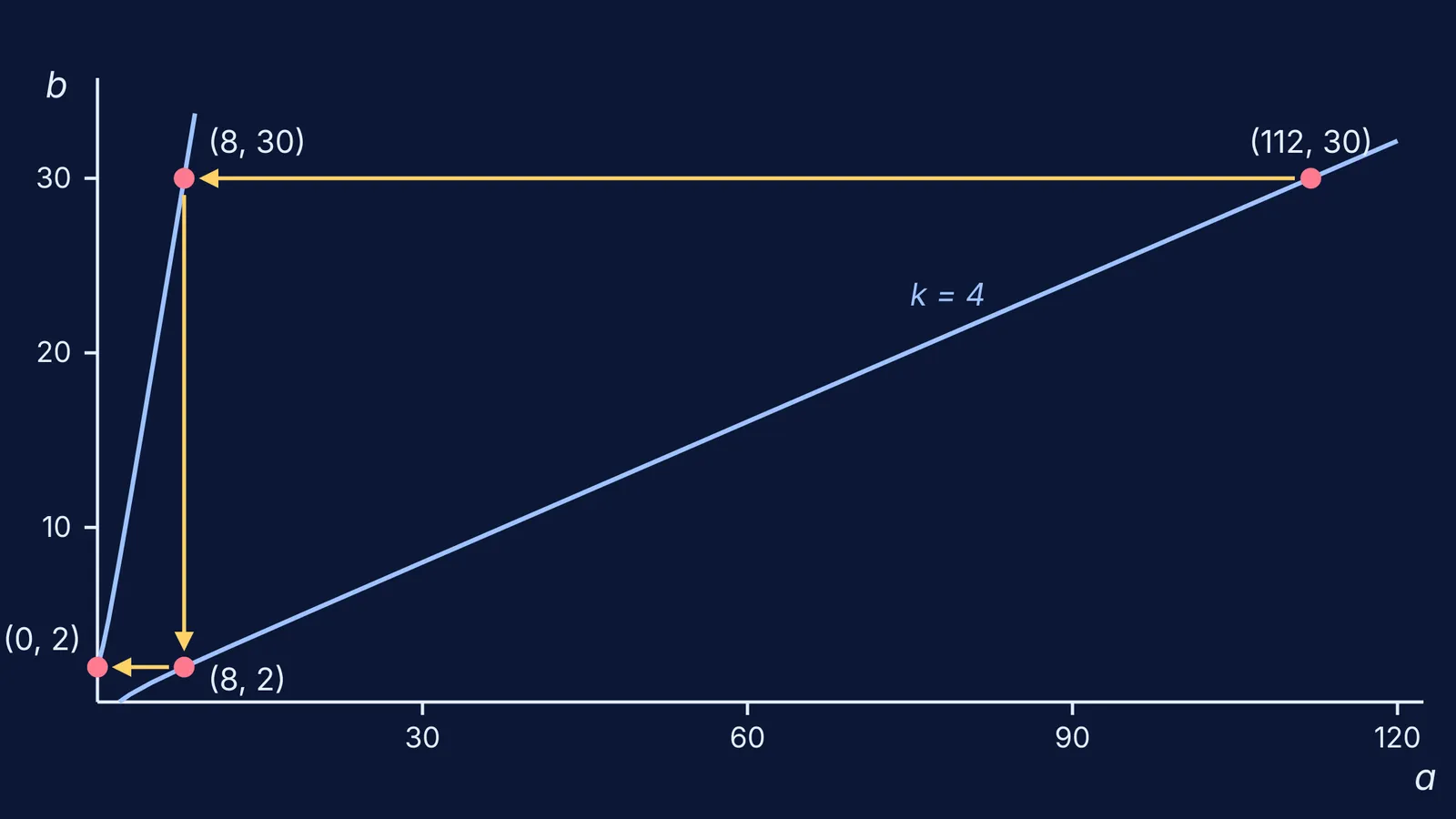
Take a = 112, b = 30. Then a² + b² = 12544 + 900 = 13444 and ab + 1 = 3361, so k = 4. Parabola draws this exact path.
Fix b = 30: a′ = kb − a = 120 − 112 = 8. Check (8, 30): 64 + 900 = 964 = 4 × 241.
Fix a = 8: b′ = 4 × 8 − 30 = 2. Check (8, 2): 64 + 4 = 68 = 4 × 17.
Fix b = 2: a′ = 4 × 2 − 8 = 0. You have reached (0, 2), and k = 2² = 4.
Every jump keeps k fixed and shrinks the numbers until the chain hits an axis, where k is visibly a square.
When should you try Vieta jumping?
Check for these signs:
The unknowns are integers, usually positive.
The condition is a divisibility or a fraction that must be an integer.
Each variable appears with degree at most 2, so fixing one leaves a quadratic.
The expression is symmetric in a and b, so you can swap roles after each jump.
You can name a base case: a zero, a 1, or a = b.
Practice problem: if ab divides a² + b² + 1 for positive integers a and b, show the quotient is 3, a constant-descent example from the Wikipedia article. Jumping down by hand from (34, 13), you should pass through (13, 5), (5, 2) and (2, 1) before reaching (1, 1).
For related tools, see finding the common root of two quadratics, parity arguments for olympiad problems and where to begin with olympiad algebra.
The usual slip is in the checks: integer, not negative, strictly smaller. To practise them, the Fermi Problem Library has worked problems with a step-by-step solver that explains the reasoning rather than printing an answer.


