

On this page
You already know three special lines from a vertex of a triangle: the altitude, the angle bisector and the median. The symmedian is a fourth, common in olympiad geometry. Once you see where it comes from, a short sine-rule argument shows where it lands.
What is a symmedian of a triangle?
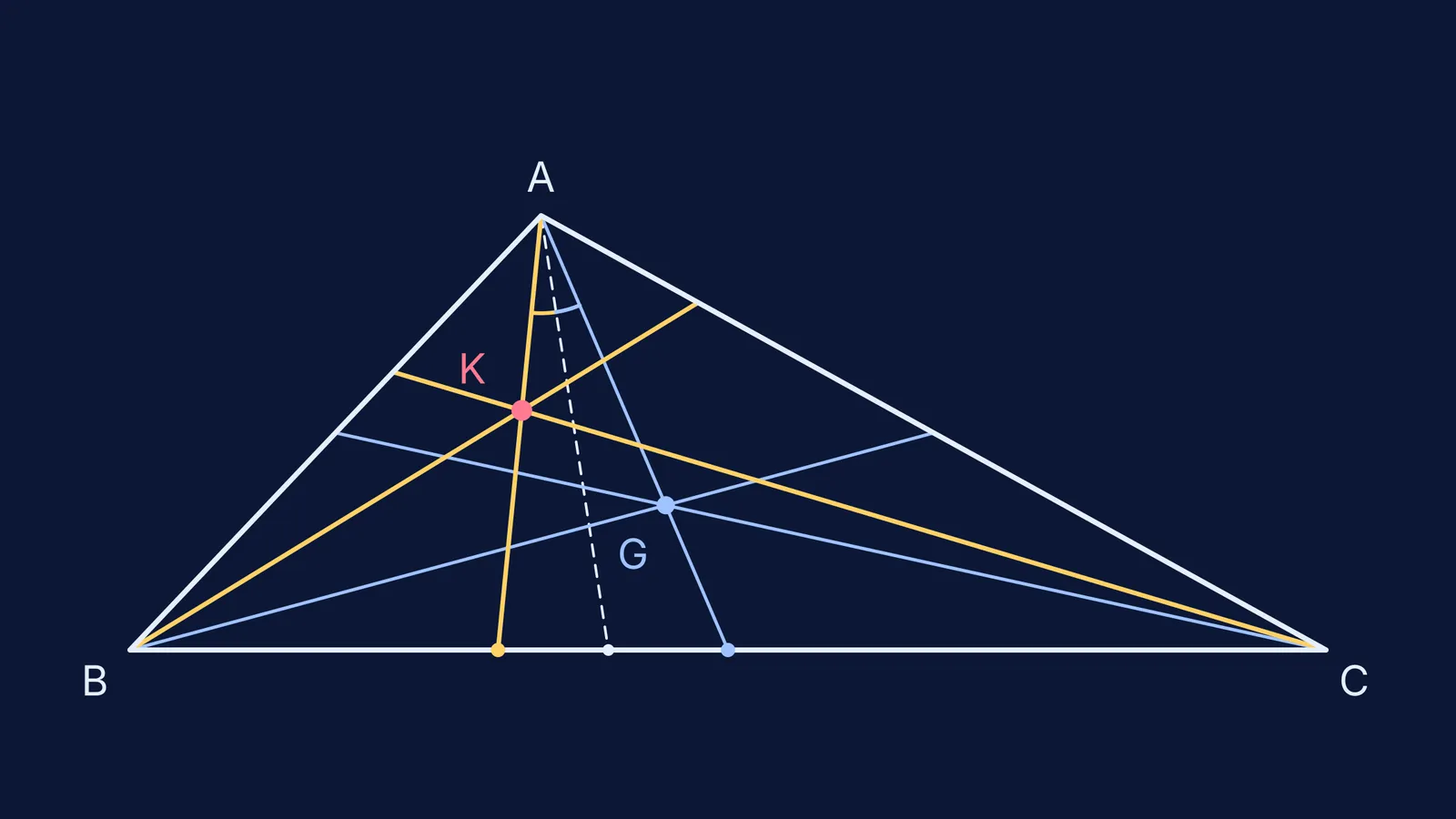
A symmedian is the line you get by taking a median of a triangle and reflecting it in the angle bisector from the same vertex, as defined on Wikipedia's symmedian page.
So if AM is the median from A (M is the midpoint of BC) and AN is the symmedian, then the angle BAM equals the angle CAN. The median and the symmedian make equal angles with the bisector, one on each side of it. That is why the bisector always lies between them. Yufei Zhao's olympiad notes Three Lemmas in Geometry use the same definition.
What is an isogonal conjugate?
The same trick works for any point P inside a triangle. Draw AP, BP and CP, then reflect each line in the angle bisector at its own vertex. The three reflected lines meet at one point, called the isogonal conjugate of P; Wikipedia's isogonal conjugate page notes this follows from the trigonometric form of Ceva's theorem.
Three pairs from the same page:
The incentre is its own isogonal conjugate.
The orthocentre and the circumcentre are isogonal conjugates of each other.
The isogonal conjugate of the centroid is the symmedian point.
That last pair explains why the three symmedians meet: the medians meet at the centroid, so their reflections meet at its conjugate.
Why does the symmedian cut the opposite side in the ratio c²:b²?
With the usual labels a = BC, b = CA and c = AB, the symmedian from A meets BC at D with BD/DC = c²/b², as stated on Cut-the-Knot's page All about Symmedians. The converse also holds: the only point X on BC with BX/CX = AB²/AC² is the foot of the symmedian, by Steiner's ratio theorem.
Here is a short proof you can reproduce.
For any line AD from A to a point D on BC, triangles ABD and ACD share the same height from A, so BD/DC equals the ratio of their areas.
Write each area as half the product of two sides and the sine of the angle between them: BD/DC = (c · sin BAD) / (b · sin CAD).
For the median, BD/DC = 1. If the median splits angle A into x (next to AB) and y (next to AC), this gives c · sin x = b · sin y, so sin y / sin x = c/b.
The symmedian swaps the two angles: it makes angle y with AB and angle x with AC. So for the symmedian, BD/DC = (c · sin y) / (b · sin x) = (c/b) · (c/b) = c²/b².
So each piece of BC is proportional to the square of the side it touches.
A worked example with numbers
Take a triangle with AB = c = 4, AC = b = 6 and BC = a = 8, and measure every foot from B.
Median: the midpoint, so BM = 4.
Angle bisector: BD/DC = c/b = 4/6, so BD = 8 × 4/10 = 3.2.
Symmedian: BD/DC = c²/b² = 16/36 = 4/9, so BD = 8 × 4/13 = 32/13, about 2.46.
The order on BC is symmedian, bisector, median, starting from B. The symmedian foot sits nearest B, the end of the shorter side AB, and the bisector foot sits between it and the median foot, as the reflection predicts.
If you get stuck on step 4 of the proof, the Fermi Problem Library has worked problems with a step-by-step solver that explains the reasoning rather than printing an answer.
How do you spot a symmedian in a problem?
Problems rarely say "symmedian". Look for these signs:
Tangents to the circumcircle at B and C meet at a point T. Then AT is the symmedian from A; this is Lemma 3 in Zhao's notes, which gives three proofs.
A cevian with angle BAD equal to angle CAM, where M is the midpoint of BC.
A ratio of squared sides, such as BD/DC = AB²/AC².
Where is the symmedian point?
The three symmedians meet at the symmedian point, also called the Lemoine point or Grebe point; it is centre X(6) in the Encyclopedia of Triangle Centers and has trilinear coordinates a : b : c, according to Wikipedia's Lemoine point page. The same page records that Simon L'Huilier noted the point in 1809, Ernst Grebe published on it in 1847 and Émile Lemoine proved its existence in 1873.
It also has a neat extremal property: the symmedian point minimises the sum of the squared distances to the three side lines, as MathWorld's Symmedian Point entry states.
If isogonal lines or Ceva's theorem feel shaky, revise them in the Fermi Concept Library, then try the proof above without looking.


