

On this page
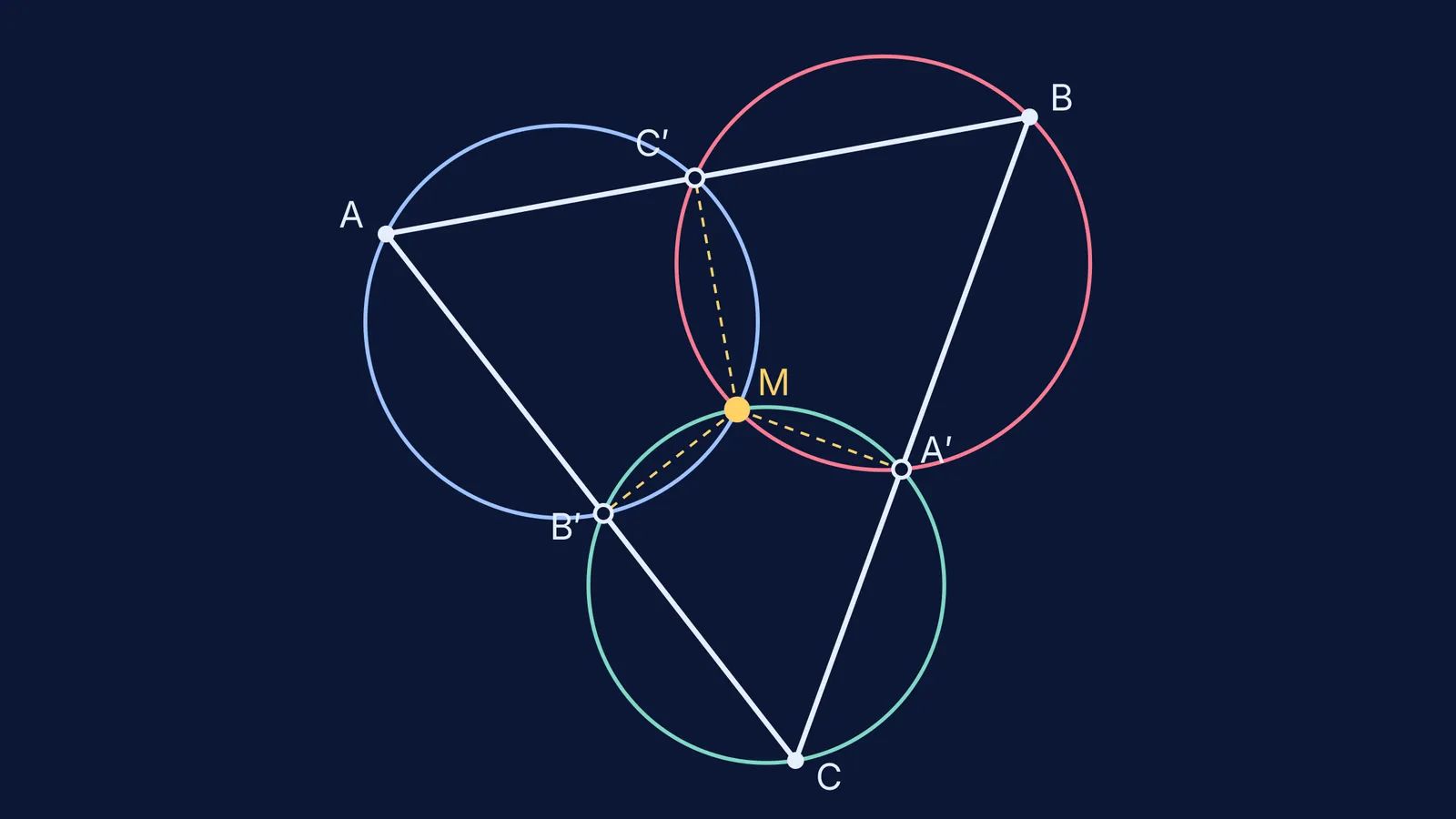
Draw any triangle, put a dot anywhere on each side, and draw three circles, each through one corner and the two dots next to it. However you place the dots, the three circles meet at a single point. That is Miquel's theorem.
What is Miquel's theorem?
Take triangle ABC with a point A′ on BC, B′ on CA and C′ on AB. Miquel's theorem states that the circles through A, B′, C′, through B, C′, A′ and through C, A′, B′ all pass through one point, called the Miquel point (Wikipedia: Miquel's theorem). The marked points may also sit on the extensions of the sides (Wolfram MathWorld: Miquel's theorem).
The result is named after Auguste Miquel, a high-school teacher in Nantua, France, who published it in 1838 in Liouville's Journal de mathématiques pures et appliquées (the 1838 volume on the Internet Archive).
How do you prove Miquel's theorem?
You need one fact: a convex quadrilateral is cyclic if and only if its opposite angles add up to 180° (Wikipedia: cyclic quadrilateral). The forward direction is Proposition 22 in Book 3 of Euclid's Elements, as the same page notes. The proof uses the fact forwards twice and backwards once.
Assume the meeting point lands inside the triangle, as in the diagram at the top of this post.
Draw the circles through A, B′, C′ and through B, C′, A′. They already share C′, so they meet at a second point. Call it M.
A, C′, M, B′ lie on one circle, so angle C′MB′ = 180° − A.
B, A′, M, C′ lie on one circle, so angle A′MC′ = 180° − B.
The three angles around M add up to 360°, so angle A′MB′ = 360° − (180° − A) − (180° − B) = A + B.
The angles of a triangle add up to 180°, so A + B = 180° − C, which means angle A′MB′ + C = 180°.
By the converse, C, A′, M, B′ lie on one circle. The third circle passes through M too.
If M falls outside the triangle, some angle pairs become equal instead of adding to 180°, so careful solutions use directed angles.
A worked example you can check
Let the triangle's angles be A = 50°, B = 60° and C = 70°, and use the cyclic-quadrilateral rule from the same page at each step.
Circle through A: angle C′MB′ = 180° − 50° = 130°.
Circle through B: angle A′MC′ = 180° − 60° = 120°.
Around M: angle A′MB′ = 360° − 130° − 120° = 110°.
Third quadrilateral CA′MB′: 110° + 70° = 180°, so it is cyclic.
Notice that where you put the dots never entered the arithmetic. That is why the same chase works wherever they sit, with directed angles when M lands outside. For a second check with a protractor, the angles MA′B, MB′C and MC′A are all equal (Wikipedia: Miquel's theorem).
Where is Miquel's theorem used?
The pivot theorem. When the three marked points form a triangle, the result is also called the pivot theorem, the name used in H. G. Forder's 1960 book Geometry (Wikipedia: Miquel's theorem).
Points on one line. If A′, B′ and C′ are collinear, the Miquel point lies on the circumcircle of ABC. Four lines in general position make four triangles whose circumcircles share one point; Steiner announced this and Miquel gave a detailed proof (same source).
Midpoints. If A′, B′ and C′ are the midpoints of the sides, the Miquel point is the circumcentre (Wolfram MathWorld: Miquel point).
Radical centre. Because M lies on all three circles, it is their radical centre (same MathWorld page).
How do you spot Miquel's theorem in a problem?
Use this checklist before you start an angle chase:
Look for a triangle with one point on each side or extended side.
Look for circles through a vertex and the two points beside it, or quadrilaterals that might be cyclic.
Name the second meeting point of two of the circles, then prove the third circle passes through it.
Write each cyclic quadrilateral with its vertices in order around the circle before you pair opposite angles; pairing the wrong angles is an easy slip.
Check where M sits. If it is outside the triangle, switch to directed angles.
The same angle chase drives our post on the Simson line and cyclic quadrilaterals. Geometric inversion turns circles through the centre of inversion into straight lines, which is how many Miquel-style problems get simplified. If you want to see why three points fix exactly one circle, try the interactive circumcircle through three points.
If cyclic quadrilaterals still feel shaky, the Fermi Concept Library covers every concept in mathematics, each with its own lesson and its place in the map. When an angle chase stalls, the Fermi Problem Library has worked problems with a step-by-step solver that explains the reasoning rather than printing an answer.
Try the 50°, 60°, 70° chase with your own angles; the circles meet every time.


