

On this page
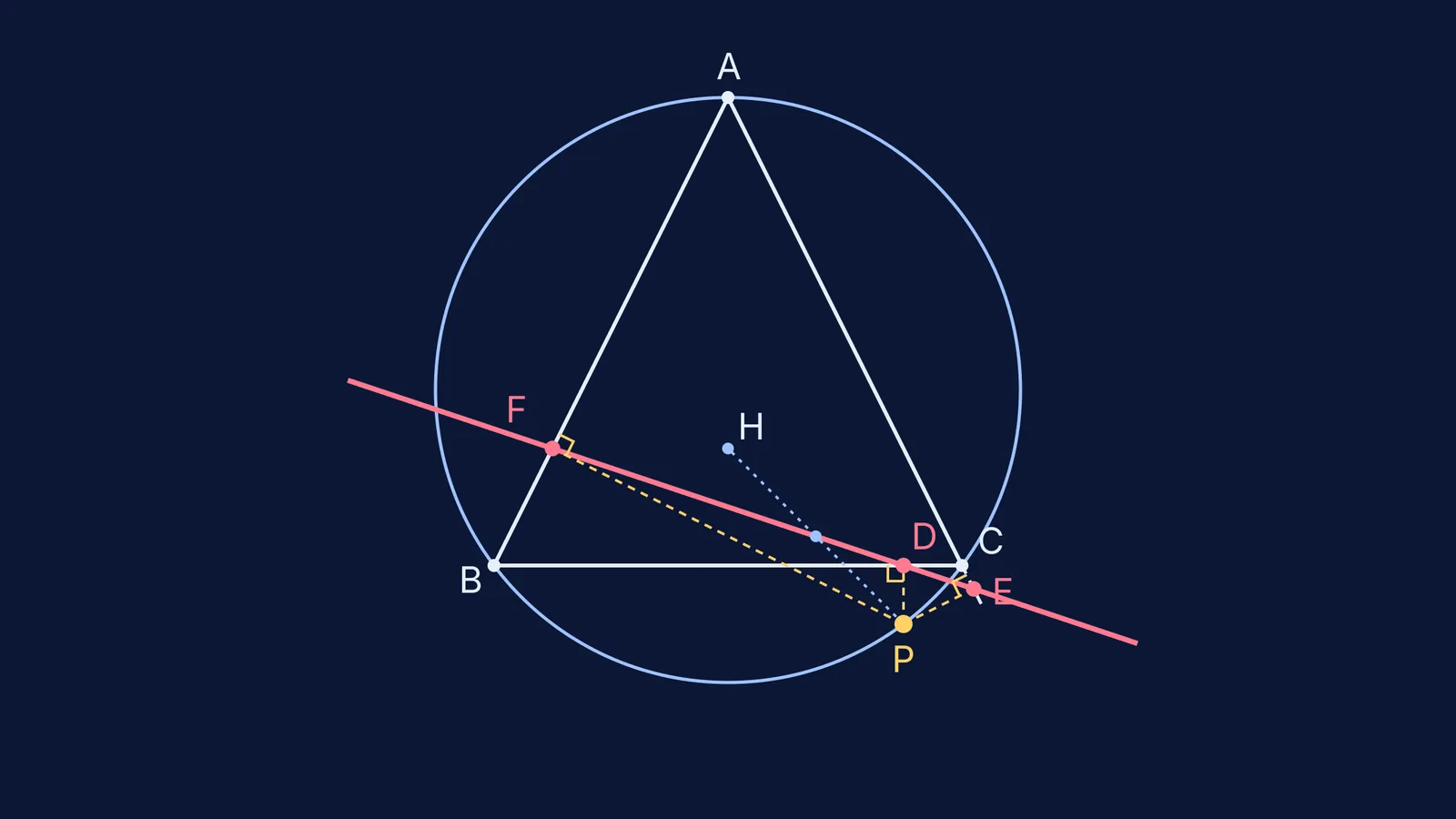
Take any triangle ABC and its circumcircle, the circle through all three vertices. Pick a point P on that circle and drop a perpendicular from P to each side, extending a side where you need to. The three feet always land on one straight line: the Simson line of P.
What is the Simson line of a triangle?
For a point P on the circumcircle of triangle ABC, the Simson line is the line containing the feet of the perpendiculars from P to the sides BC, CA and AB, or their extensions (MathWorld, Simson Line).
The line is named for Robert Simson, but it was first published by William Wallace in 1799, which is why it is sometimes called the Wallace line (Wikipedia, Simson line). MathWorld notes it does not appear in any work of Simson.
Call the feet D on BC, E on CA and F on AB. In the figure above, P is on arc BC away from A, and E lands just beyond C.
Why are the three feet collinear?
The key idea: two right angles on the same segment put four points on one circle.
Angles PDB and PFB are both 90°, so P, D, B, F lie on a circle with diameter PB.
Angles PDC and PEC are both 90°, so P, D, C, E lie on a circle with diameter PC.
In the first circle, angles BDF and BPF stand on the same chord BF, so ∠BDF = ∠BPF.
In the second circle, angles CDE and CPE stand on chord CE, so ∠CDE = ∠CPE.
ABPC is a cyclic quadrilateral, so its opposite angles add to 180°: ∠ABP + ∠ACP = 180°. Since E lies beyond C, ∠PCE = 180° − ∠ACP = ∠ABP = ∠PBF.
In the right triangles PFB and PEC, ∠BPF = 90° − ∠PBF and ∠CPE = 90° − ∠PCE, and step 5 makes these equal.
So ∠BDF = ∠CDE. B, D, C lie on one line and F, E sit on opposite sides of it, so these equal angles are vertically opposite, and F, D, E are collinear.
Does the converse of the Simson line theorem hold?
Yes. If the feet of the perpendiculars from a point P to the three side lines are collinear, then P lies on the circumcircle (Wikipedia, Simson line). MathWorld states it as a locus: the points whose three feet are collinear make up exactly the circumcircle.
With the points arranged as in the figure, run the chain backwards. Collinear feet give ∠BDF = ∠CDE. Steps 3 and 4 use only the right-angle circles, not the circumcircle, so they still give ∠BPF = ∠CPE. The right triangles then give ∠PBF = ∠PCE, which becomes ∠ABP + ∠ACP = 180°, so ABPC is cyclic.
How do you check a Simson line with coordinates?
Put the circumcircle at x² + y² = 25 with A = (0, 5), B = (−4, −3), C = (4, −3), and take P = (3, −4), which is on the circle because 9 + 16 = 25. These are the exact points in the figure above.
Foot on BC (the line y = −3): D = (3, −3).
Foot on CA (direction (−1, 2)): E = (4.2, −3.4), just past C.
Foot on AB (direction (1, 2)): F = (−3, −1).
Slope DE = (−3.4 + 3)/(4.2 − 3) = −1/3, and slope DF = (−1 + 3)/(−3 − 3) = −1/3.
Equal slopes through D mean the three feet lie on y = −x/3 − 2. That is the Simson line of P.
A bonus to check on the same numbers: the Simson line of P bisects the segment from P to the orthocentre H (Wikipedia, Simson line). With the circumcentre at the origin, H = A + B + C = (0, −1). The midpoint of PH is (1.5, −2.5), and −1.5/3 − 2 = −2.5, so it sits on the line.
Now try P = (5, 0) yourself. You should find D = (5, −3), E = (3, −1), F = (−1, 3), all on y = −x + 2.
How should you practise problems like this?
Draw the figure large with a compass, with P placed so the feet fall differently from your textbook's picture.
Mark every right angle first, then find the circle each pair creates.
Note which side of each line every point lies on before equating angles.
Confirm once with coordinates, then write the proof cleanly.
For an algebraic route, see testing collinear and concyclic points with complex numbers or Stewart's theorem for the length of a cevian. If cyclic quadrilaterals feel rusty, revise the key terms of circles from Class 9.
If "a right angle stands on a diameter" is the shaky step, the Fermi Concept Library covers every concept in mathematics, physics, chemistry, biology and computing. For more geometry, the Fermi Problem Library has a step-by-step solver that explains the reasoning.


