

On this page
If you are preparing for JEE Advanced or an olympiad, complex numbers turn many geometry questions into short algebra. Two tests do most of the work: one for three points on a line, one for four points on a circle. Both come down to one question: is this complex number real?
Why does a real ratio mean three points are collinear?
Treat each point as a complex number: A is a, B is b, C is c. The difference c − a is the arrow from A to C.
When you divide two complex numbers, their arguments subtract; the polar form of division on Wikipedia's complex number page gives the quotient's angle as φ1 − φ2. So the argument of (c − a)/(b − a) is the angle between the two arrows.
Three distinct points A, B, C are collinear if and only if (c − a)/(c − b) is real, which is Proposition 2 in Evan Chen's olympiad notes, Bashing Geometry with Complex Numbers. An angle of 0 or 180 degrees between the arrows is exactly what makes the quotient real. In a written proof, show that the ratio equals its own conjugate.
Worked example 1
Take A = 1 + i, B = 3 + 2i, C = 7 + 4i.
c − a = 6 + 3i and b − a = 2 + i.
(6 + 3i)/(2 + i) = 3, because 3(2 + i) = 6 + 3i.
The answer is real, so A, B, C are collinear.
Now move C to 7 + 5i. Then (6 + 4i)/(2 + i) = (16 + 2i)/5. The imaginary part is not zero, so the points are not on one line.
How do you prove four points are concyclic with complex numbers?
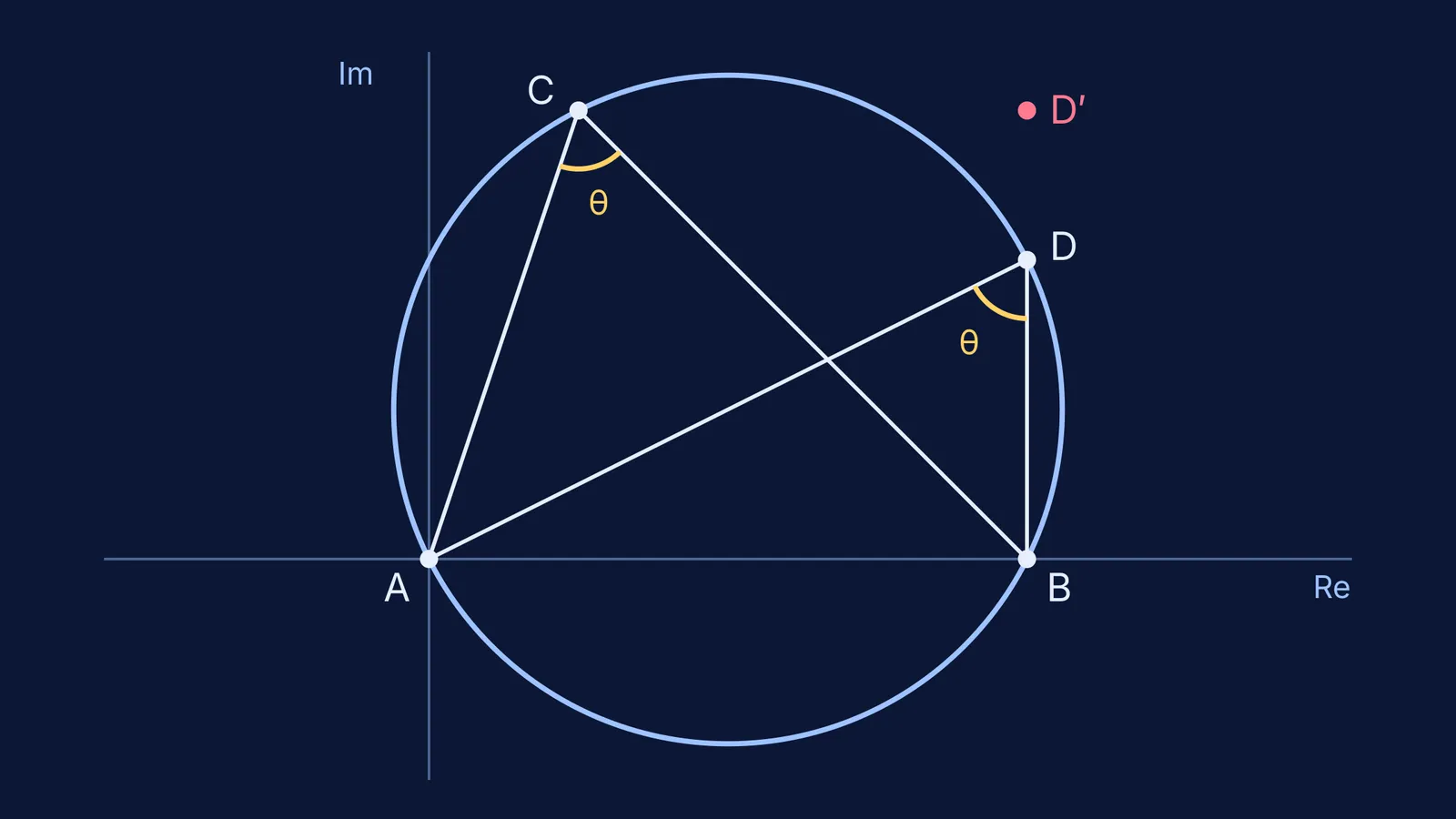
The idea is the inscribed angle theorem. In Chen's notes, the argument of (c − a)/(c − b) is the directed angle ACB, and the argument of (d − a)/(d − b) is the directed angle ADB. Points C and D lie on one circle through A and B when they see the chord AB under equal directed angles, taken modulo 180 degrees. Dividing the two ratios subtracts the angles, so the test is:
(c − a)/(c − b) divided by (d − a)/(d − b) is real.
That expression is the cross-ratio. The Wikipedia article on concyclic points states that four points in the complex plane are either concyclic or collinear if and only if their cross-ratio is a real number, citing Liang-shin Hahn's book Complex Numbers and Geometry. The cross-ratio article explains why lines appear too: Möbius transformations map circles and lines (generalised circles) to circles and lines.
Worked example 2
Take A = 0, B = 4, C = 1 + 3i, D = 4 + 2i.
(c − a)/(c − b) = (1 + 3i)/(−3 + 3i) = (1 − 2i)/3. It is not real, so A, B, C are not collinear.
(d − a)/(d − b) = (4 + 2i)/(2i) = 1 − 2i.
Divide: ((1 − 2i)/3)/(1 − 2i) = 1/3. Real, so the four points are concyclic.
Check: all four points are √5 from 2 + i. Now try D′ = 4 + 3i. The cross-ratio becomes (1 − 2i)/(3 − 4i) = (11 − 2i)/25. Not real, and indeed D′ is √8 from the centre, outside the circle.
What mistakes cost marks on these questions?
Writing concyclic without ruling out the collinear case.
Mixing the pairing: both ratios must use the same two base points, A and B, in the same order.
Calling a number real before the imaginary part is fully simplified. Multiply by the conjugate of the denominator and finish the arithmetic.
Ignoring the unit circle. If the figure has a circle, make it |z| = 1, where the conjugate of z is 1/z (Section 3 of Chen's notes).
How should you practise this for JEE Advanced?
Re-derive both tests once from the rule that arguments subtract.
Make your own examples: pick a centre and radius, choose four points on the circle, check the cross-ratio is real, then nudge one point and watch it fail.
Move to exam-style questions once both tests feel routine.
For modulus, argument and conjugate, see our complex numbers Class 11 formulas with worked examples. For a study plan, read complex numbers and quadratics for JEE Advanced: how to prepare, then test yourself with complex numbers JEE Advanced practice questions, fully solved.
If the argument of a quotient feels shaky, the Fermi Concept Library gives each mathematics concept its own lesson. If your algebra goes wrong midway, the Fermi Problem Library has worked problems with a step-by-step solver that explains the reasoning rather than printing an answer, so you can see which line went wrong.


