On this page
Eight new JEE Advanced-style questions, easy to hard. Every option was checked in Python, and each solution ends with the trap: the wrong option that looks most right.
What does JEE Advanced ask from this chapter?
The official JEE (Advanced) 2026 syllabus lists polar representation, principal argument, the triangle inequality, cube roots of unity, geometric interpretations and symmetric functions of roots. For the theory, read our guide on how to prepare complex numbers and quadratics for JEE Advanced.
How should you use this set?
Hide the solutions; allow 3 minutes per easy question, 6 per hard one.
In multiple-correct questions, judge each option on its own.
For each miss, note the trap and redo it in three days.
New to these formats? See JEE Advanced question types.
Easy: arguments, cube roots and symmetric functions
Q1 (easy, single correct). The principal argument of z = (−1 + i)⁷ / (√3 + i)² is
(A) −π/12
(B) 11π/12
(C) 59π/12
(D) −13π/12
Answer: (B). arg z = 7(3π/4) − 2(π/6) = 59π/12. Subtract 4π: 11π/12. Trap: (A) takes arg(−1 + i) as −π/4, ignoring the quadrant; (C) and (D) are not principal.
Q2 (easy, single correct). ω is a non-real cube root of unity. The value of (3 − ω)(3 − ω²)(3 + ω)(3 + ω²) is
(A) 91
(B) 169
(C) 73
(D) 7
Answer: (A). With ω + ω² = −1 and ω³ = 1, (3 − ω)(3 − ω²) = 9 + 3 + 1 = 13 and (3 + ω)(3 + ω²) = 9 − 3 + 1 = 7, so the product is 91. Trap: (B) squares 13.
Q3 (easy, numerical value). α and β are the roots of 2x² − 5x + 1 = 0. The value of α/β² + β/α² is ____.
Answer: 47.5. It equals (α³ + β³)/(αβ)². With α + β = 5/2 and αβ = 1/2, α³ + β³ = 125/8 − 15/4 = 95/8; divide by 1/4. Trap: 10.5 is (α² + β²)/αβ, one power short.
Medium: loci and rotation
Q4 (medium, one or more options correct). z moves so that |z − 1| = 2|z + 2|. Which statements are true?
(A) The locus is a circle with centre −3 and radius 2.
(B) The greatest value of |z − 1| on the locus is 4.
(C) The least value of |z + 2| on the locus is 1.
(D) The locus meets the imaginary axis.
Answer: (A), (C). Squaring with z = x + iy gives x² + y² + 6x + 5 = 0: centre −3, radius 2. The point 1 is 4 from the centre, so |z − 1| reaches 6, not 4. The point −2 lies inside, 1 from the centre, so the least |z + 2| is 1. x = 0 gives y² = −5, so (D) fails. Trap: (B) is the distance to the centre. More in the Argand plane as a geometry tool.
Q5 (medium, single correct). ABCD is a square labelled anticlockwise, with A = 1 + 2i and B = 4 + 3i. Vertex D is
(A) 5i
(B) 2 − i
(C) 3 + 6i
(D) 2 + 5i
Answer: (A). Rotating AB = 3 + i by +90° gives AD = i(3 + i) = −1 + 3i, so D = 5i. Trap: (B) multiplies by −i, building the square clockwise; (C) is vertex C.
Hard: where the two topics meet
Q6 (hard, one or more options correct). For real k, consider z² − kz + 9 = 0. Which statements are true?
(A) If |k| < 6, both roots lie on |z| = 3.
(B) If k = 3√3, the principal arguments of the roots are ±π/6.
(C) If k = −3, the principal arguments of the roots are ±π/3.
(D) If k = 3, each root z satisfies z³ = −27.
Answer: (A), (B), (D). For |k| < 6 the roots are conjugates with product 9, so each has modulus 3. As 3(cos θ ± i sin θ), their sum gives 6 cos θ = k. For k = 3√3, cos θ = √3/2 and θ = π/6. For k = −3, cos θ = −1/2, so θ = 2π/3 and (C) is false. For k = 3, θ = π/3 and De Moivre gives z³ = 27(cos π ± i sin π) = −27. Trap: (C) reads cos θ = −1/2 as θ = π/3.
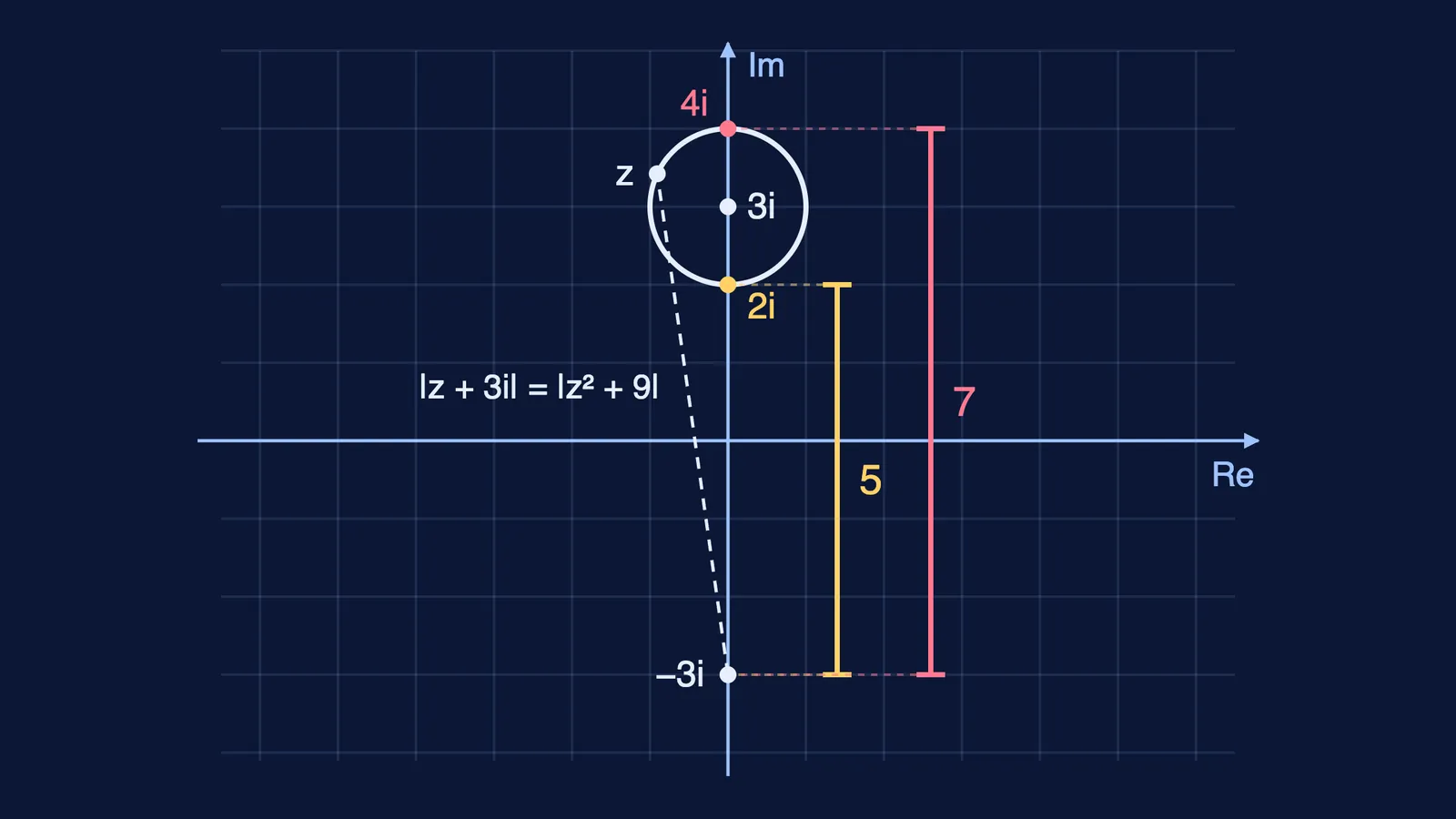
Q7 (hard, numerical value). z satisfies |z − 3i| = 1. The sum of the greatest and least values of |z² + 9| is ____.
Answer: 12. |z² + 9| = |z − 3i| · |z + 3i| = |z + 3i|, the distance from z to −3i. That point is 6 from the centre, so the distance runs from 5 (at 2i) to 7 (at 4i). Trap: 25 uses |z² + 9| ≤ |z|² + 9, a bound never reached here. The diagram above draws it to scale.
Q8 (hard, list match). α and β are the roots of x² − 2x + 4 = 0. Match List-I with List-II.
List-I: (P) α⁶ + β⁶, (Q) α⁹ + β⁹, (R) α² + β², (S) α/β + β/α
List-II: (1) −1024, (2) −4, (3) −1, (4) 128, (5) 1024
(A) P→4, Q→5, R→2, S→3
(B) P→4, Q→1, R→2, S→3
(C) P→4, Q→1, R→3, S→2
(D) P→4, Q→1, R→2, S→2
Answer: (B). The roots are 1 ± i√3 = 2(cos π/3 ± i sin π/3), so αⁿ + βⁿ = 2ⁿ⁺¹ cos(nπ/3). So n = 6, 9, 2 give 128, −1024 and −4. And α/β + β/α = −4/4 = −1. Trap: (A) forgets that cos 3π = −1.
How did you do?
Count a multiple-correct question right only if you picked every true option and no false one.
7 or 8: move on to timed mixed algebra sets.
4 to 6: redo your misses after three days.
3 or fewer: revise modulus, argument and root-coefficient relations first.
Stuck on the same step every time? The Fermi Problem Library has worked problems with a step-by-step solver that explains the reasoning rather than printing an answer.