On this page
Eight new JEE Advanced-style questions, easy to hard, in four formats: single-correct, one-or-more-correct, numerical-value and list-match. Each answer was checked in SymPy, and each solution names the trap.
What does JEE Advanced test in matrices and determinants?
The latest published JEE (Advanced) 2026 syllabus (unchanged from 2025) lists matrix operations, transpose, row and column transformations, determinants, adjoint and inverse up to order three, diagonal, symmetric and skew-symmetric matrices, and linear equations in two or three variables. For the theory and a study plan, read our guide on how to prepare matrices and determinants for JEE Advanced.
How should you use this set?
Cover the solutions; allow 3 minutes per easy question, 6 per hard one.
In one-or-more-correct questions, judge each option separately.
Log each miss as a wrong property, a sign or power slip, or arithmetic, and redo it after three days.
If a step still feels like magic, the Fermi Problem Library has worked problems with a step-by-step solver that explains the reasoning rather than printing an answer.
Easy: read the structure first
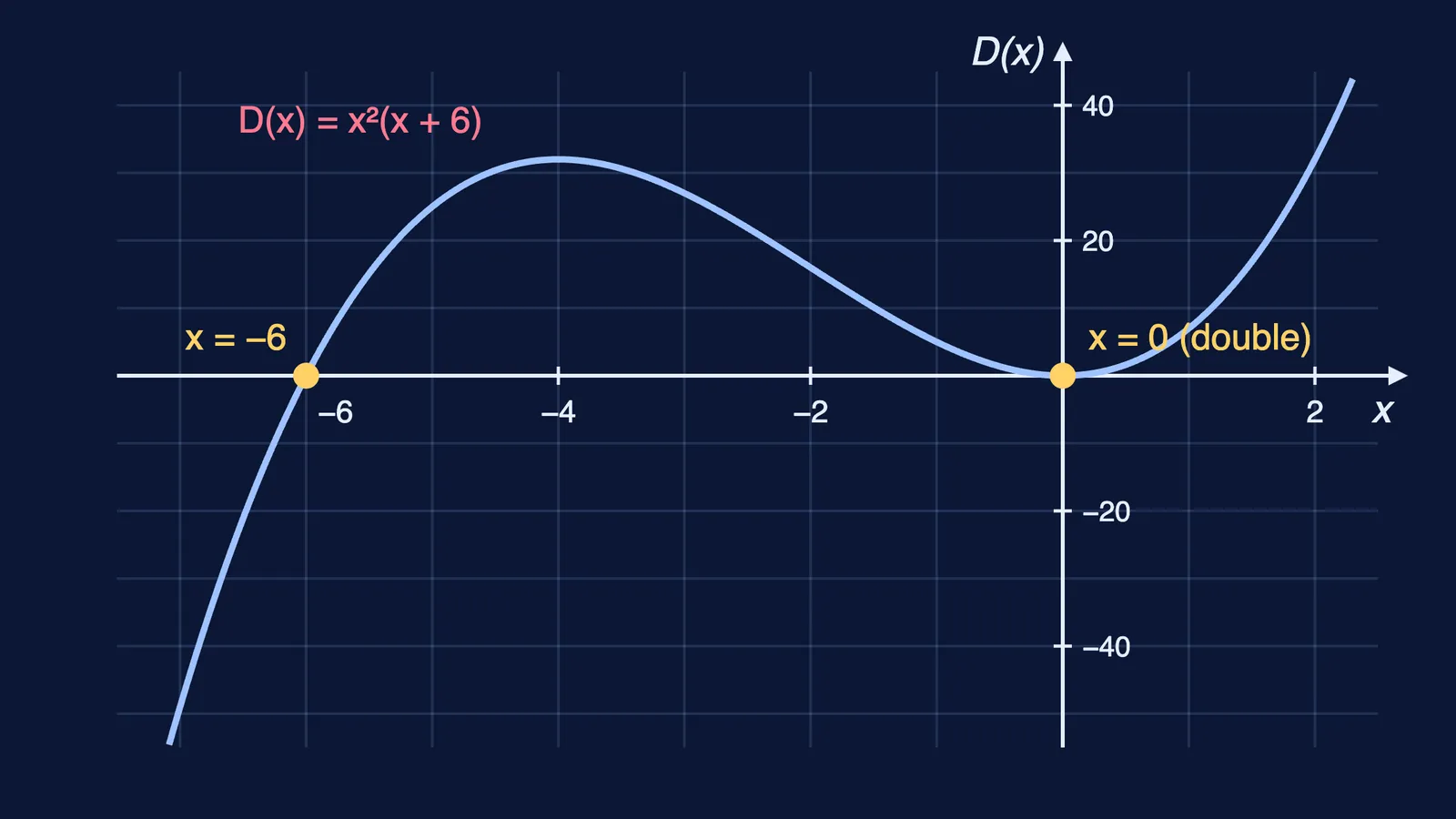
Q1 (easy, single correct). The real values of x for which the matrix with rows (x + 1, 2, 3), (1, x + 2, 3), (1, 2, x + 3) is singular are
(A) 0 and −6
(B) −1, −2 and −3
(C) 0 and 6
(D) −6 only
Answer: (A). Every row sums to x + 6: add columns 2 and 3 to column 1, take out x + 6, then subtract row 1 from rows 2 and 3 to get D(x) = x²(x + 6). Trap: (B) sets the diagonal entries to zero; (D) drops the double root at 0.
Q2 (easy, single correct). A and B are non-commuting 3×3 symmetric matrices. Which must be symmetric?
(A) AB
(B) AB − BA
(C) ABA
(D) ABAB
Answer: (C). (ABA)ᵀ = AᵀBᵀAᵀ = ABA. Trap: (A); (AB)ᵀ = BA ≠ AB here. (B) is skew-symmetric.
Medium: properties under pressure
Q3 (medium, one or more correct). K is a non-zero 3×3 real skew-symmetric matrix. Which are true?
(A) det K = 0
(B) I + K is invertible
(C) K² is skew-symmetric
(D) det((I − K)(I + K)⁻¹) = 1
Answer: (A), (B), (D). (A): det K = det(−Kᵀ) = −det K. (B): with a, b, c above the diagonal, det(I + K) = 1 + a² + b² + c² > 0. (D): I − K = (I + K)ᵀ, so the determinants cancel. Trap: (C); (K²)ᵀ = (−K)² = K², so K² is symmetric. More: why a skew-symmetric matrix of odd order has determinant zero.
Q4 (medium, numerical value). Matrix A has rows (1, 3, 0), (0, 1, 2), (0, 0, 1). The (1, 3) entry of A⁸ is ____.
Answer: 168. A = I + N, with N² having a single 6 at (1, 3) and N³ = O. I and N commute, so A⁸ = I + 8N + 28N² and the entry is 28 × 6 = 168. Trap: 28 forgets that N² carries 3 × 2 = 6, not 1. See nilpotent and idempotent matrices.
Q5 (medium, numerical value). A is any invertible 3×3 matrix. B is made from A by R₁ ↔ R₃, then R₂ → −3R₂, then C₁ → C₁ + 4C₃. The value of det(2BA⁻¹) is ____.
Answer: 24. The factors are −1 (swap), −3 (scaling) and 1 (column addition), so det B = 3 det A. Then det(2BA⁻¹) = 2³ × 3 = 24. Trap: 6 scales by 2 instead of 2³; 96 treats C₁ → C₁ + 4C₃ as multiplying by 4.
Hard: several ideas in one question
Q6 (hard, one or more correct). M is a 3×3 real matrix with M² = M, M ≠ O and M ≠ I. Which are true?
(A) det M = 0
(B) (I + M)⁻¹ = I − M
(C) I − M also satisfies X² = X
(D) (I + M)⁻¹ = I − M/2
Answer: (A), (C), (D). (A): (det M)² = det M; if det M = 1, M is invertible and M² = M forces M = I. (C): (I − M)² = I − 2M + M² = I − M. (D): (I + M)(I − M/2) = I + M/2 − M²/2 = I. Trap: (B); (I + M)(I − M) = I − M, not I.
Q7 (hard, list-match). Consider x + y + 2z = 3, 2x + 3y + kz = 7, 3x + 4y + 7z = m.
List-I: (P) k ≠ 5; (Q) k = 5, m = 10; (R) k = 5, m ≠ 10; (S) k = 5, m = 10 and z = 1.
List-II: (1) no solution; (2) exactly one solution; (3) infinitely many solutions; (4) x = 1, y = 0; (5) x = 2, y = 1.
(A) P→2, Q→3, R→1, S→4
(B) P→2, Q→1, R→3, S→4
(C) P→3, Q→2, R→1, S→5
(D) P→2, Q→3, R→1, S→5
Answer: (A). The coefficient determinant is 5 − k, so k ≠ 5 gives one solution. At k = 5, the left side of equation 3 is the sum of equations 1 and 2, so it needs m = 3 + 7 = 10. The solutions are then (2 − t, 1 − t, t), and t = 1 gives x = 1, y = 0. Trap: (D) uses (2, 1, 0), the solution with z = 0.
Q8 (hard, one or more correct). D(x) is the determinant with rows (x, 1, 2), (1, x, 2), (1, 2, x). Which are true?
(A) The product of the roots of D(x) = 0 is 6
(B) x = −3 is a root
(C) The matrix is singular for exactly two positive values of x
(D) D(x) < 0 for 1 < x < 2
Answer: (B), (C), (D). Rows sum to x + 3, and D(x) = x³ − 7x + 6 = (x − 1)(x − 2)(x + 3). On (1, 2) the factors are +, −, +, so D < 0. Trap: (A); the product of the roots of a monic cubic is minus its constant term, −6.
Fewer than five right? Rework the guide's examples, then retry in a week.