On this page
NEET practical chemistry questions look like recall, but most misses come from one skipped step: a basicity factor, a mole ratio, or a test read out of order.
Principles Related to Practical Chemistry is Unit 20 of chemistry in the NMC NEET (UG)-2026 syllabus. Every option below matches NCERT's chemistry laboratory manuals for Class 11 and Class 12. As in NEET-UG 2026, each question is single-correct, +4 right and −1 wrong, per the NTA Information Bulletin.
How should you use this practical chemistry practice set?
Cover the answers and give yourself about a minute per question.
For a test question, name the ion or group before you look at the options.
For a titration, write the mole ratio before any number.
Read every trap, and redo your misses in three days.
For the full chapter plan, start with how to prepare practical chemistry for NEET.
Easy: can you read the tests and indicators?
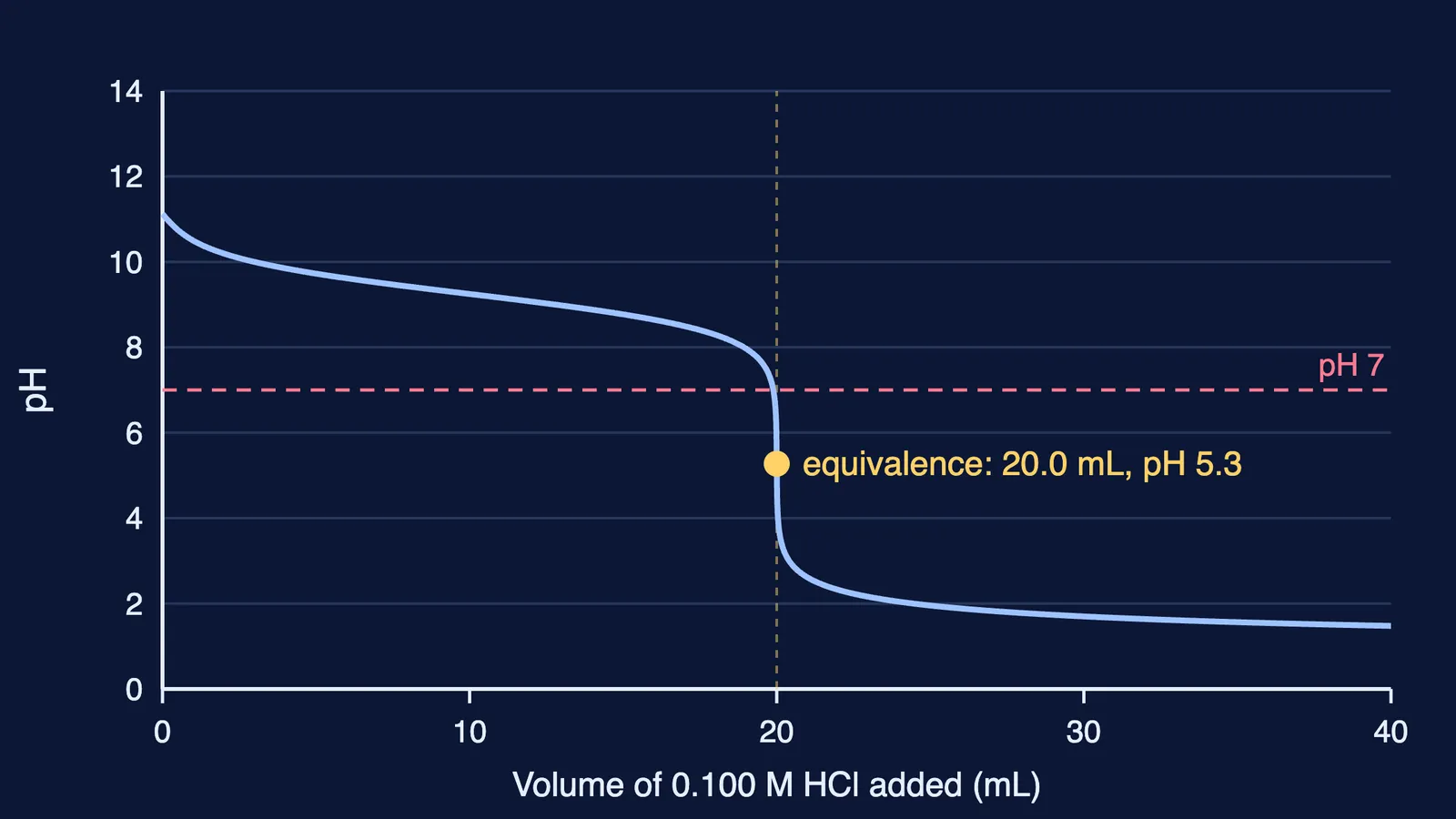
Q1 (easy). 20.0 mL of 0.100 M ammonia solution is titrated with 0.100 M HCl. Which indicator should you use?
(A) Phenolphthalein (B) Methyl orange (C) Either, equally well (D) None; the solution changes colour by itself
Answer: (B). Ammonia is a weak base and HCl a strong acid, and NCERT's Class 11 manual, Unit 6 chooses methyl orange for a strong acid against a weak base. Trap: (C) is true only for a strong acid against a strong base, such as NaOH against HCl.
Q2 (easy). A salt is warmed with NaOH solution. The gas given off forms dense white fumes with a glass rod dipped in HCl and a brown precipitate with Nessler's reagent. Which ion does the salt contain?
(A) Cl− (B) Mg2+ (C) NH4+ (D) Pb2+
Answer: (C). NaOH releases NH3, which forms white NH4Cl fumes with HCl and a brown precipitate with Nessler's reagent (Class 11 manual, Unit 7). Trap: (A) reads the white fumes as chloride in the salt.
Q3 (easy). A sodium fusion (Lassaigne's) extract of an organic compound is acidified with dilute HCl. Adding ferric chloride gives a blood-red colour. What does the compound contain?
(A) Nitrogen only (B) Sulphur only (C) Both nitrogen and sulphur (D) A halogen
Answer: (C). With both elements present, fusion can form sodium thiocyanate, and Fe3+ with SCN− is blood red. Trap: (A) expects Prussian blue for nitrogen and stops at "ferric chloride means nitrogen".
Medium: can you link a reagent to a ratio or a result?
Q4 (medium). 10.0 mL of 0.0500 M oxalic acid needs 12.5 mL of NaOH solution to reach the phenolphthalein end point. What is the molarity of the NaOH?
(A) 0.0400 M (B) 0.0625 M (C) 0.125 M (D) 0.0800 M
Answer: (D). Use a1M1V1 = a2M2V2 from the Class 11 manual, with basicity 2 for oxalic acid: 2 × 0.0500 × 10.0 = 1 × M × 12.5, so M = 0.0800 M. Trap: (A) forgets that oxalic acid gives two H+; (C) swaps the two volumes.
Q5 (medium). An aromatic compound dissolves in NaOH solution but gives no effervescence with sodium hydrogencarbonate. With neutral ferric chloride it turns violet. The compound is:
(A) Benzoic acid (B) Phenol (C) 2,4,6-Trinitrophenol (D) Benzyl alcohol
Answer: (B). NCERT's Class 12 manual, Unit 8 explains that phenols dissolve in NaOH but are not acidic enough to dissolve in NaHCO3, and phenol gives a violet complex with neutral FeCl3. Trap: (C) is a phenol, but its nitro groups make it acidic enough to dissolve in NaHCO3, which the manual notes.
Q6 (medium). A colourless salt gives no gas with dilute H2SO4. Its solution gives a white precipitate with dilute HCl; the precipitate dissolves in hot water and gives a yellow precipitate with KI. Heated with conc. H2SO4 and copper turnings, the salt gives dense brown fumes and a blue solution. The salt is:
(A) Lead chloride (B) Barium nitrate (C) Lead bromide (D) Lead nitrate
Answer: (D). A white chloride soluble in hot water with yellow PbI2 points to Pb2+ (Group I). Brown fumes made denser by copper, with a blue solution, point to nitrate. Trap: (C) bromide also gives reddish-brown fumes with conc. H2SO4, but copper and a blue solution are the nitrate signature; (A) chloride gives colourless HCl gas, not brown fumes.
Hard: can you do the calculation without a slip?
Q7 (hard). 100 mL of 0.500 M HCl and 100 mL of 0.500 M NaOH, both at the same starting temperature, are mixed in a calorimeter of water equivalent 20 g. The temperature rises by 3.10 °C. Take density 1 g mL−1 and specific heat 4.18 J g−1 K−1. The enthalpy of neutralisation is:
(A) −28.5 kJ mol−1 (B) −51.8 kJ mol−1 (C) −57.0 kJ mol−1 (D) +57.0 kJ mol−1
Answer: (C). Heat = (100 + 100 + 20) × 3.10 × 4.18 = 2851 J, from the method in NCERT's Class 12 manual, Unit 3. Water formed = 0.100 L × 0.500 M = 0.0500 mol, so ΔH = −2851/0.0500 J = −57.0 kJ mol−1, matching the manual's 57 kJ mol−1 for strong acid and base. Trap: (A) divides by 0.100 mol, adding acid and base moles; (B) leaves out the calorimeter.
Q8 (hard). 5.00 g of impure Mohr's salt, FeSO4·(NH4)2SO4·6H2O (392 g mol−1), is made up to 250.0 mL with dilute H2SO4. A 25.0 mL portion needs 18.0 mL of 0.0120 M KMnO4. What is the percentage purity?
(A) 16.9% (B) 84.7% (C) 60.0% (D) 8.47%
Answer: (B). MnO4− + 5Fe2+ + 8H+ → Mn2+ + 5Fe3+ + 4H2O (Class 12 manual, Unit 6). MnO4− used = 0.0120 × 18.0 = 0.216 mmol, so Fe2+ = 1.08 mmol in 25.0 mL and 10.8 mmol in 250.0 mL. Mass = 10.8 × 10−3 × 392 = 4.23 g, so purity = 4.23/5.00 = 84.7%. Trap: (A) uses a 1:1 ratio; (C) uses 278 g mol−1, the molar mass of FeSO4·7H2O; (D) forgets to scale from 25.0 mL to 250.0 mL.
What should you do after this set?
Sort each miss: wrong test, wrong ratio, or a missing factor.
For test misses, rewrite reagent, observation and reason from memory.
For ratio misses, rework our mole concept guide for NEET and the NEET redox guide.
If a calculation step keeps slipping, the Fermi Problem Library has worked problems with a step-by-step solver that explains the reasoning rather than printing an answer.