On this page
This set has eight original redox questions in JEE Main style, ordered from easy to hard: oxidation numbers, balancing, titrations and equivalents. Each has a worked solution and a trap line for the most tempting wrong option. Q5 and Q8 are numerical-value questions.
How should you use this redox practice set?
Unit 7 of the NTA's Syllabus for JEE (Main) - 2027 opens with electronic concepts of oxidation and reduction, oxidation number, the rules for assigning it and balancing of redox reactions. Every question below stays inside that list and Unit 7, Redox Reactions, of NCERT Class 11 Chemistry, which also covers redox titrations.
Q7 uses n-factor, the electrons transferred per formula unit. NCERT does not use the term, but counting electrons gives the same answer.
Set a 20-minute timer and work on paper.
Write every oxidation number above its symbol before you balance or calculate.
Read every trap line, even where you were right.
New to the chapter? Start with our guide on how to prepare Redox Reactions for JEE Main.
Easy: can you assign oxidation numbers correctly?
Q1 (easy). In which compound is the oxidation number of carbon zero?
(A) CH₂Cl₂
(B) CH₃OH
(C) HCOOH
(D) CHCl₃
Answer: (A). With H = +1 and Cl = −1, CH₂Cl₂ gives x + 2 − 2 = 0, so x = 0. Trap: (C), from counting only one oxygen. HCOOH has two, so x + 2 − 4 = 0 and carbon is +2.
Q2 (easy). Which of these is NOT a redox reaction?
(A) 2CrO₄²⁻ + 2H⁺ → Cr₂O₇²⁻ + H₂O
(B) Ca + H₂ → CaH₂
(C) 2FeCl₃ + SnCl₂ → 2FeCl₂ + SnCl₄
(D) 2NO₂ + 2OH⁻ → NO₂⁻ + NO₃⁻ + H₂O
Answer: (A). Chromium is +6 in both chromate and dichromate; the yellow-to-orange change is an acid-base shift, not electron transfer. Trap: (B), from assuming hydrogen is always +1. In a metal hydride it is −1, so H₂ (0) is reduced while Ca is oxidised.
Q3 (easy). Judging by nitrogen's oxidation number, which species can act only as a reducing agent?
(A) NH₃
(B) N₂H₄
(C) HNO₂
(D) NO₂
Answer: (A). Nitrogen's lowest oxidation number is −3, which it already has in NH₃, so it can only lose electrons. Trap: (B), because hydrazine is known as a reducing agent. Its nitrogen is −2, so it can still be reduced to −3.
Medium: can you balance and titrate without losing count?
Q4 (medium). In acid, dichromate oxidises methanol to CO₂ and is reduced to Cr³⁺. In the balanced equation with smallest whole-number coefficients, the coefficient of H⁺ is:
(A) 14
(B) 8
(C) 4
(D) 16
Answer: (B). Carbon goes from −2 to +4 (6e⁻ lost) and Cr₂O₇²⁻ gains 6e⁻, so the ratio is 1:1. Balancing O with water and H with H⁺ gives Cr₂O₇²⁻ + CH₃OH + 8H⁺ → 2Cr³⁺ + CO₂ + 6H₂O, with charge +6 on each side. Trap: (A), copied from the dichromate half-reaction, which forgets that the methanol oxidation half releases 6H⁺ of its own.
Q5 (medium, numerical). In basic solution, zinc reduces nitrate to ammonia: Zn + NO₃⁻ + OH⁻ + H₂O → [Zn(OH)₄]²⁻ + NH₃. What is the coefficient of OH⁻ in the balanced equation with smallest whole numbers?
Answer: 7. N falls from +5 to −3 (gains 8e⁻) and each Zn gives 2e⁻, so 4Zn per NO₃⁻. Charge: −1 − x on the left must equal −8 on the right, so x = 7. Then oxygen needs 6H₂O: 4Zn + NO₃⁻ + 7OH⁻ + 6H₂O → 4[Zn(OH)₄]²⁻ + NH₃. Trap: 8, from setting OH⁻ equal to the electrons gained instead of balancing charge.
Q6 (medium). A 0.400 g brass sample (copper and zinc) is dissolved and the solution treated with excess KI. The iodine released needs 21.0 mL of 0.120 M Na₂S₂O₃. Taking Cu = 63.5, the percentage of copper is closest to:
(A) 20.0%
(B) 40.0%
(C) 80.0%
(D) 60.0%
Answer: (B). 2Cu²⁺ + 4I⁻ → Cu₂I₂ + I₂ and I₂ + 2S₂O₃²⁻ → 2I⁻ + S₄O₆²⁻, so Cu²⁺ and S₂O₃²⁻ are 1:1. Moles = 0.0210 × 0.120 = 2.52 × 10⁻³, mass = 0.160 g, and 0.160/0.400 = 40.0%. Trap: (A), from taking one Cu²⁺ per I₂, which halves the copper.
Hard: can you handle equivalents and two titrations together?
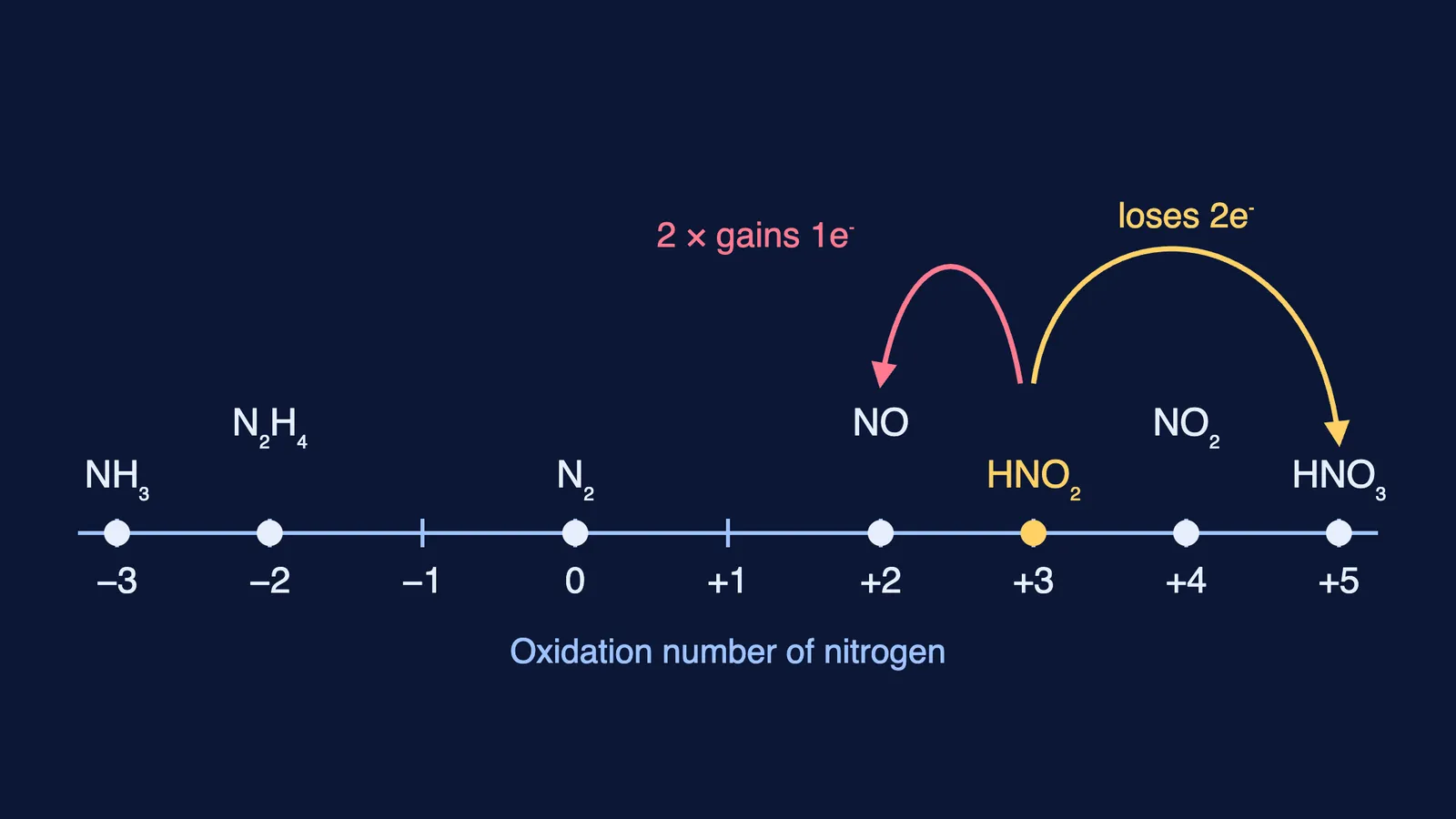
Q7 (hard). Nitrous acid disproportionates: 3HNO₂ → HNO₃ + 2NO + H₂O. Taking M(HNO₂) = 47.0 g mol⁻¹, its equivalent mass in this reaction is:
(A) 23.5
(B) 47.0
(C) 70.5
(D) 15.7
Answer: (C). Of 3 HNO₂, one loses 2e⁻ (+3 to +5) and two gain 1e⁻ each (+3 to +2). So 2 electrons move per 3 HNO₂, an n-factor of 2/3, and the equivalent mass is 47.0 ÷ (2/3) = 70.5. Trap: (A), which counts only the oxidised molecule's 2e⁻ as if every HNO₂ lost them.
Q8 (hard, numerical). A solution contains H₂C₂O₄ and NaHC₂O₄. 20.0 mL of it needs 30.0 mL of 0.100 M NaOH for neutralisation. Another 20.0 mL, acidified, needs 16.0 mL of 0.0500 M KMnO₄. The molarity of H₂C₂O₄ is x × 10⁻² M. Find x.
Answer: 5. Let a and b be millimoles of H₂C₂O₄ and HC₂O₄⁻. Acid-base: 2a + b = 3.0. Redox: MnO₄⁻ takes 5e⁻ and each oxalate gives 2e⁻, so 2(a + b) = 5 × 0.80 = 4.0 and a + b = 2.0. Then a = 1.0 mmol in 20.0 mL, or 0.050 M. Trap: 9, from taking 3e⁻ for permanganate as in neutral solution; that gives a negative b, the sign the setup is wrong.
What should you do after checking your answers?
Put each miss in one of three bins: oxidation numbers (Q1 to Q3), balancing (Q4, Q5) or stoichiometry and equivalents (Q6 to Q8). The fullest bin is this week's work. For the rules and both balancing methods, read our Redox Reactions Class 11 guide. If the molarity arithmetic in Q6 and Q8 slowed you down, try the mole concept JEE Main practice set.
When a whole method breaks down rather than one step, the Fermi Problem Library has worked problems with a step-by-step solver that explains the reasoning rather than printing an answer.
Redo your misses in two days, without the solutions.