On this page
Eight new JEE Main-style mole concept questions, from counting atoms to a carbonate mixture, each with a worked solution and the trap: the wrong option you are most likely to pick.
The official Syllabus for JEE (Main) - 2027 puts this chapter in Unit 1, Some Basic Concepts in Chemistry: atomic and molecular masses, mole concept, molar mass, percentage composition, empirical and molecular formulae, and chemical equations and stoichiometry. The same ideas fill Unit 1 of NCERT Class 11 Chemistry Part I, which also covers Avogadro's law, limiting reagent and molarity. New to the chapter? Start with our guide on how to prepare mole concept for JEE Main.
How should you use this practice set?
The JEE (Main) 2027 information bulletin gives Chemistry 20 multiple-choice questions and 5 numerical-value questions, with +4 for a correct answer and −1 for a wrong one in both sections.
Give yourself 16 minutes for all eight.
Write your answer and one line of working before reading a solution.
Q6 and Q7 are numerical: round to the nearest integer.
Use H = 1, C = 12, N = 14, O = 16, Mg = 24, P = 31, S = 32, Ca = 40, Fe = 56, Avogadro constant 6.022 × 10²³ mol⁻¹, and 22.7 L mol⁻¹ for a gas at STP.
Easy: can you move between grams, moles and atoms?
Q1 (easy). The number of hydrogen atoms in 4.9 g of H₂SO₄ is
(A) 3.01 × 10²² (B) 6.02 × 10²² (C) 1.20 × 10²³ (D) 2.11 × 10²³
Answer: (B). M(H₂SO₄) = 98 g mol⁻¹, so n = 4.9 ÷ 98 = 0.050 mol. Each molecule has 2 H atoms: 0.100 mol × 6.022 × 10²³ = 6.02 × 10²². Trap: (A) counts molecules, not H atoms. (D) counts all seven atoms in each molecule.
Q2 (easy). Which sample contains the largest number of atoms?
(A) 3.0 g of H₂ (B) 16 g of CH₄ (C) 18 g of H₂O (D) 22.7 L of O₃ at STP
Answer: (B). Moles of molecules: H₂ 1.5, CH₄ 1.0, H₂O 1.0, O₃ 1.0. Multiply by atoms per molecule: 3.0, 5.0, 3.0 and 3.0 mol of atoms. Trap: (A) has the most molecules, but each has only two atoms.
Q3 (easy). The mass percentage of oxygen in calcium nitrate, Ca(NO₃)₂, is closest to
(A) 17.1% (B) 29.3% (C) 58.5% (D) 77.4%
Answer: (C). M = 40 + 2(14 + 48) = 164 g mol⁻¹, with 6 O atoms = 96 g. 96 ÷ 164 × 100 = 58.5%. Trap: (B) counts one nitrate's oxygen (48 g). (D) is oxygen's share of the nitrate ion alone, 48 ÷ 62.
Medium: can you go from data to a formula or a limiting reagent?
Q4 (medium). An organic compound contains 48.6% C, 8.1% H and 43.2% O by mass. Its vapour is 74 times as dense as hydrogen gas at the same temperature and pressure. Its molecular formula is
(A) C₃H₆O₂ (B) C₆H₁₂O₄ (C) C₁₂H₂₄O₈ (D) C₇H₁₆O₃
Answer: (B). Moles per 100 g: C 4.05, H 8.1, O 2.70, a ratio of 1.5 : 3 : 1, so the empirical formula is C₃H₆O₂ (74 g mol⁻¹). By Avogadro's law, M = 74 × 2 = 148 g mol⁻¹ and n = 2. Trap: (A) takes 74 as the molar mass and forgets that H₂ weighs 2 g mol⁻¹. (D) has the right molar mass but the wrong percentages.
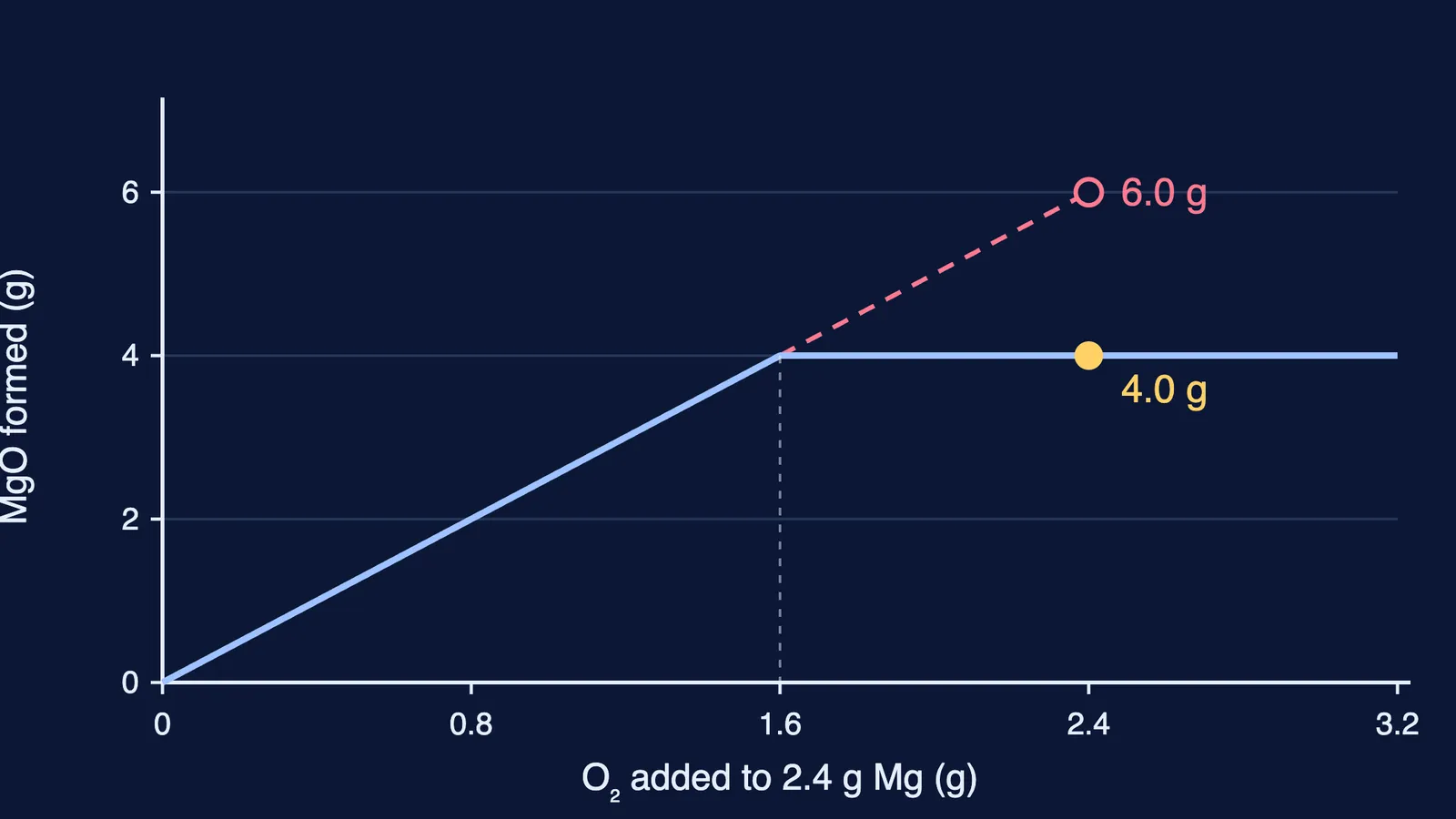
Q5 (medium). 2.4 g of magnesium is burned with 2.4 g of oxygen: 2Mg + O₂ → 2MgO. The mass of MgO formed is
(A) 3.0 g (B) 4.0 g (C) 4.8 g (D) 6.0 g
Answer: (B). Mg = 0.10 mol and O₂ = 0.075 mol. Divide by coefficients: Mg 0.050, O₂ 0.075, so magnesium is limiting. MgO = 0.10 mol × 40 = 4.0 g, and 0.80 g of O₂ is left over. Trap: (D) treats O₂ as limiting because its mole count is smaller. (C) adds the two masses as if both react fully.
Q6 (medium, numerical). What volume, in mL, of 0.25 M NaOH completely neutralises 20 mL of 0.15 M H₃PO₄ (H₃PO₄ + 3NaOH → Na₃PO₄ + 3H₂O)?
Answer: 36. Acid = 0.020 × 0.15 = 0.0030 mol, so NaOH = 3 × 0.0030 = 0.0090 mol, and V = 0.0090 ÷ 0.25 = 0.036 L = 36 mL. Trap: 12 mL uses a 1 : 1 ratio and ignores the 3 in the equation.
Hard: can you handle purity, yield and mixtures?
Q7 (hard, numerical). An iron ore is 80% Fe₂O₃ by mass. It is reduced by Fe₂O₃ + 3CO → 2Fe + 3CO₂ with a 90% yield. How many kg of iron are obtained from 1000 kg of ore?
Answer: 504. Fe₂O₃ = 800 kg ÷ 160 = 5.0 kmol, which gives 10 kmol Fe at full yield. At 90%, 9.0 kmol × 56 = 504 kg. Trap: 560 skips the yield, 630 skips the purity, and 252 forgets that each Fe₂O₃ gives two Fe.
Q8 (hard). A 9.36 g mixture of CaCO₃ and MgCO₃ is heated to constant mass, leaving 4.96 g of CaO and MgO. The mass percentage of CaCO₃ in the mixture is
(A) 60.0% (B) 64.1% (C) 35.9% (D) 67.7%
Answer: (B). Let a and b be moles of CaCO₃ and MgCO₃: 100a + 84b = 9.36 and 56a + 40b = 4.96. So a = 0.060 and b = 0.040 mol, giving CaCO₃ = 6.00 g and 6.00 ÷ 9.36 × 100 = 64.1%. Trap: (A) is the mole percentage. (C) is MgCO₃'s share. (D) is CaO's share of the residue, not CaCO₃'s share of the mixture.
What should you do after this set?
Sort your misses by trap, not by question. If Q1 to Q3 went wrong, you are mixing up molecules and atoms; slow down and write "per molecule" on each line. If Q5 to Q7 went wrong, practise the three-line method in our piece on mass-to-mass stoichiometry until dividing by coefficients is automatic.
When the method keeps going wrong, the Fermi Problem Library has worked problems with a step-by-step solver that explains the reasoning rather than printing an answer.