On this page
Coordination compounds questions in NEET reward one habit: find the metal's oxidation state and d-electron count before you read the options. These 8 original single-correct questions run from easy to hard, and every wrong option is a slip students really make.
All of them sit inside Unit 12, Co-ordination Compounds, of the NMC's NEET (UG) 2026 syllabus, which covers ligands, denticity, IUPAC naming, isomerism, valence bond theory, basic crystal field theory, colour and magnetism. Every fact used here matches Unit 5 of NCERT Class 12 Chemistry Part I, Reprint 2026-27.
How should you use this coordination compounds practice set?
Cover the solutions. NEET (UG)-2026 had 180 compulsory questions in 180 minutes, with +4 for a correct answer and −1 for a wrong one, according to the NTA information bulletin. Give each question about a minute.
For every complex, write the metal's oxidation state and dⁿ count in the margin first.
Read the trap line even when you get the question right.
Note each miss with the rule you broke and redo it after three days.
If you have not finished the chapter yet, start with our guide on how to prepare Coordination Compounds for NEET.
Easy: can you read a formula correctly?
Q1 (easy). What are the oxidation state and the coordination number of iron in K₃[Fe(C₂O₄)₂Cl₂]?
(A) +3, 4 (B) +3, 6 (C) +1, 6 (D) +6, 6
Answer: (B). Three K⁺ outside means the complex ion is −3. Two oxalates give −4 and two chlorides give −2, so Fe + (−6) = −3 and Fe is +3. Oxalate is didentate, so the donor atoms are 2 × 2 + 2 × 1 = 6. Trap: (A) counts each oxalate as one ligand position instead of two donor atoms.
Q2 (easy). What is the IUPAC name of [Co(NH₃)₃(H₂O)₂Cl]SO₄?
(A) triamminediaquachloridocobalt(III) sulfate (B) diaquatriamminechloridocobalt(III) sulfate (C) triamminediaquachloridocobaltate(III) sulfate (D) triamminediaquachloridocobalt(II) sulfate
Answer: (A). Sulfate is −2, so the complex ion is +2; chloride is −1, so cobalt is +3. NCERT's rule is to name ligands alphabetically, and the multiplying prefixes are not part of the ligand name: ammine, aqua, chlorido. Trap: (B) alphabetises "diaqua" under d; prefixes such as di and tri do not count.
Q3 (easy). A chromium(III) compound has the composition CrCl₃·5NH₃, and chromium has coordination number 6. You treat 0.0150 mol of it with excess AgNO₃ solution. What mass of AgCl (143.3 g mol⁻¹) precipitates?
(A) 2.15 g (B) 4.30 g (C) 6.45 g (D) 1.06 g
Answer: (B). Five NH₃ fill five positions, so one chloride is inside: [Cr(NH₃)₅Cl]Cl₂. Only the 2 ionisable chlorides precipitate: 0.0150 × 2 × 143.3 = 4.30 g. Trap: (C) treats all three chlorides as free, ignoring the coordination number.
Medium: can you link ligands to magnetism and colour?
Q4 (medium). What is the spin-only magnetic moment of [FeF₆]³⁻?
(A) 1.73 BM (B) 3.87 BM (C) 4.90 BM (D) 5.92 BM
Answer: (D). Fe³⁺ is 3d⁵. Fluoride is a weak-field ligand, so no pairing is forced and all five electrons stay unpaired; NCERT describes [FeF₆]³⁻ as an outer orbital complex with five unpaired electrons. μ = √(5 × 7) = 5.92 BM. Trap: (A) is the low-spin value for [Fe(CN)₆]³⁻, which has one unpaired electron.
Q5 (medium). How many stereoisomers does the octahedral ion [Cr(en)₂(H₂O)Cl]²⁺ have?
(A) 2 (B) 3 (C) 4 (D) 6
Answer: (B). With two didentate en ligands, H₂O and Cl can be trans or cis. The trans form has a mirror plane. The cis form has no mirror plane, so it exists as a non-superimposable d and l pair, as NCERT shows for cis-[PtCl₂(en)₂]²⁺. That gives 1 + 2 = 3. Trap: (A) counts only cis and trans and forgets that the cis form is chiral.
Q6 (medium). Which cobalt(III) complex absorbs light of the shortest wavelength?
(A) [CoF₆]³⁻ (B) [Co(H₂O)₆]³⁺ (C) [Co(NH₃)₆]³⁺ (D) [Co(CN)₆]³⁻
Answer: (D). NCERT's spectrochemical series places these ligands as F⁻ < H₂O < NH₃ < CN⁻. The largest Δo means the highest-energy, shortest-wavelength light is absorbed; NCERT's Table 5.3 puts [Co(CN)₆]³⁻ at 310 nm, in the ultraviolet. Trap: (A) assumes the most electronegative ligand splits the d orbitals most; fluoride is a weak-field ligand.
Hard: can you calculate and compare?
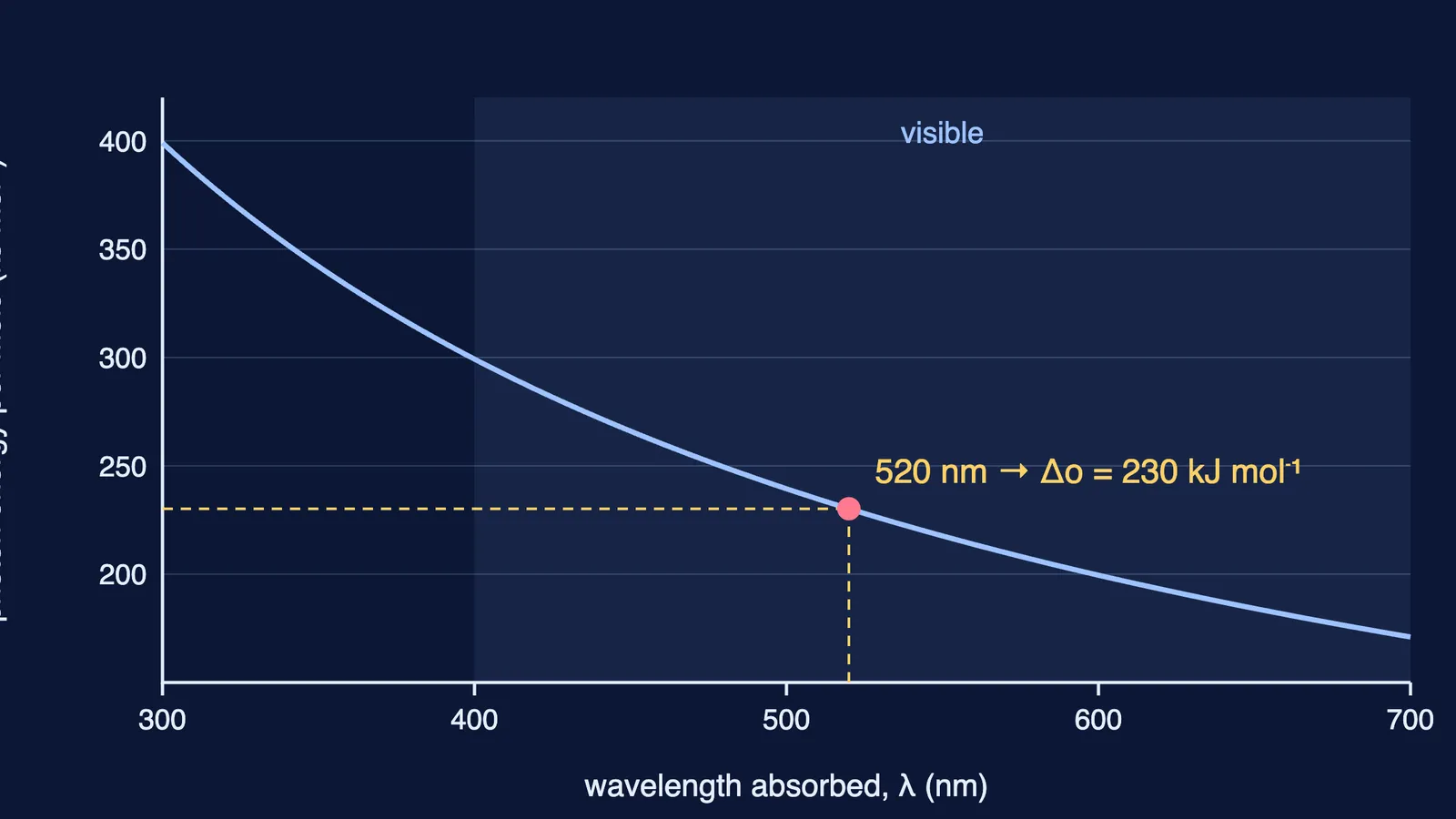
Q7 (hard). An octahedral d¹ complex shows its absorption maximum at 520 nm. Taking h = 6.626 × 10⁻³⁴ J s, c = 3.00 × 10⁸ m s⁻¹ and N_A = 6.022 × 10²³ mol⁻¹, what is Δo?
(A) 230 kJ mol⁻¹ (B) 3.82 × 10⁻¹⁹ kJ mol⁻¹ (C) 92.1 kJ mol⁻¹ (D) 138 kJ mol⁻¹
Answer: (A). For a d¹ ion, the single t₂g electron is promoted to eg, so the absorbed photon energy equals Δo, as in NCERT's [Ti(H₂O)₆]³⁺ example. E = hc/λ = 3.82 × 10⁻¹⁹ J per ion; multiplied by N_A, that is 2.30 × 10⁵ J mol⁻¹ = 230 kJ mol⁻¹. Trap: (B) stops at the energy per ion (in joules) and never converts to a molar value.
Q8 (hard). Which species has the same number of unpaired electrons as tetrahedral [NiCl₄]²⁻?
(A) [Ni(CN)₄]²⁻ (B) [Ni(H₂O)₆]²⁺ (C) [Fe(CN)₆]³⁻ (D) [CoF₆]³⁻
Answer: (B). NCERT gives [NiCl₄]²⁻ two unpaired electrons. Ni²⁺ in octahedral [Ni(H₂O)₆]²⁺ is t₂g⁶ eg², which leaves two unpaired electrons whatever the ligand. [Fe(CN)₆]³⁻ has one and [CoF₆]³⁻ has four. Trap: (A) has the same Ni²⁺, but NCERT describes square planar [Ni(CN)₄]²⁻ as dsp² and diamagnetic.
What should you do after this set?
Score yourself. If Q1 to Q3 went wrong, redo oxidation states and naming. If Q4 to Q6 did, revise valence bond theory and the spectrochemical series. If Q7 and Q8 did, practise d-electron counting with units written out.
For worked problems where each step is explained rather than just the answer, the Fermi Problem Library has a step-by-step solver. Coordination compounds lean on the transition metals, so revise d- and f-block elements for NEET next, then try the chemical bonding NEET practice questions for hybridisation and shapes.