On this page
This unit rewards recall more than long calculation. Most questions turn on one small step: counting unpaired electrons, balancing redox electrons, or knowing which ion is coloured. Make those steps automatic.
What does the NEET syllabus include in d- and f-Block Elements?
In the NMC "NEET (UG)-2026" syllabus, Unit 11 of Chemistry has two parts. Transition elements: general introduction, electronic configuration, occurrence and characteristics, and trends in the first-row elements (physical properties, ionization enthalpy, oxidation states, atomic radii, colour, catalytic behaviour, magnetic properties, complex formation, interstitial compounds, alloy formation), plus preparation, properties and uses of K2Cr2O7 and KMnO4. Inner transition elements: lanthanoids (electronic configuration, oxidation states, lanthanoid contraction) and actinoids (electronic configuration and oxidation states).
In the 2026-27 reprint of NCERT Class 12 Chemistry Part I, this is Unit 4, sections 4.1 to 4.7. The current Unit 4 text still contains every NMC sub-topic, including both preparations. It also covers oxides, a lanthanoid-actinoid comparison and applications (4.7), which the NMC list does not name; read those once.
How are NEET questions on this unit asked?
In NEET-UG 2026, Chemistry had 45 questions, and the paper had 180 compulsory questions in 180 minutes, according to the NTA information bulletin. Every question was a multiple-choice question with four options and one correct or best answer; a correct answer earned +4 and a wrong one cost 1 mark. That is about a minute per question. NEET-UG 2027 details had not been posted when we checked; follow neet.nta.nic.in.
Use elimination. A spin-only moment must equal √(n(n+2)) for a whole number n, so an option like 4.2 BM cannot be spin-only. An ion with an empty or full d subshell (d0 or d10) is colourless and has no spin-only moment.
Worked examples, solved the NEET way
Example 1: identify the ion from its moment. A 3d metal ion with a +2 charge has a spin-only moment of 4.90 BM. Which is it: V2+, Mn2+, Fe2+ or Ni2+? Square it: 4.90² ≈ 24 = n(n+2), so n = 4. They have 3, 5, 4 and 2 unpaired electrons, so only Fe2+ (3d6) fits. NCERT gives the spin-only formula and a table of these moments. Trap: Cr2+ (3d4) also gives 4.90 BM; the options decide.
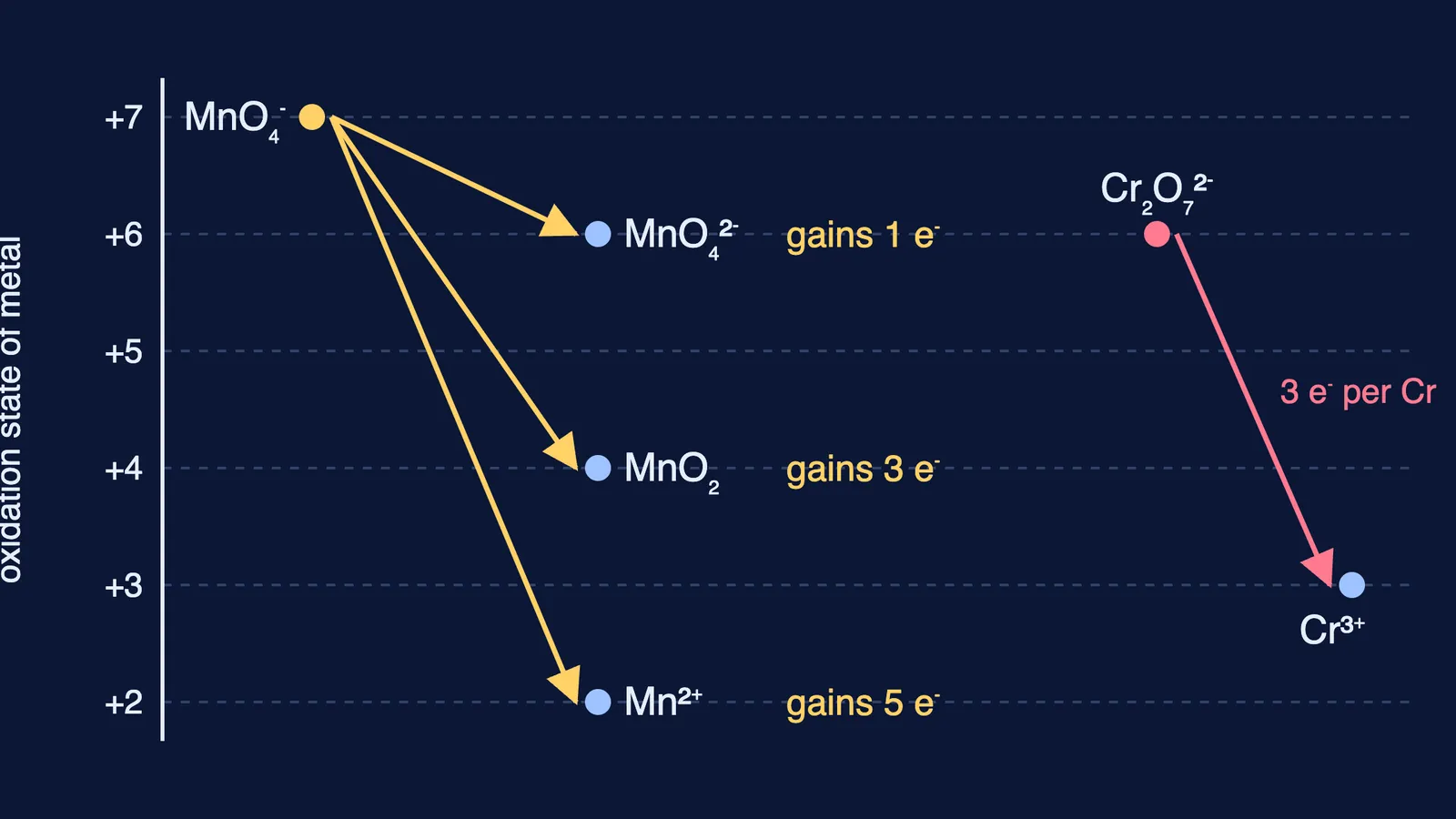
Example 2: KMnO4 against K2Cr2O7. How much 0.020 M KMnO4 oxidises 25.0 mL of 0.10 M Fe2+ in acid? Fe2+ is 2.5 × 10⁻³ mol, and each Fe2+ gives one electron. In acid, MnO4⁻ takes five electrons and becomes Mn2+, so you need 5.0 × 10⁻⁴ mol, which is 25.0 mL. Dichromate in acid takes six electrons per ion (three per Cr, +6 to +3), per the NCERT half-reactions. So 0.020 M K2Cr2O7 needs 4.17 × 10⁻⁴ mol, or 20.8 mL.
Example 3: odd oxidation states of lanthanoids. Terbium (Z = 65, 4f9 6s2) shows +4 in its oxide TbO2. Why? Tb4+ is 4f7, a half-filled f subshell, so it forms, but it is an oxidant. Eu2+ is also 4f7, which is why europium shows +2, while Ce4+ is the empty-subshell (4f0) case. NCERT links this to the extra stability of empty, half-filled and filled f subshells.
Which traps cost marks in this unit?
Removing 3d electrons before 4s when writing ions: Fe2+ is 3d6, not 3d4 4s2.
Using the total d count instead of unpaired electrons in √(n(n+2)).
Thinking chromium's oxidation state changes when chromate becomes dichromate: it is +6 in both.
Forgetting the catalysts NCERT names: V2O5 (Contact process), iron (Haber process), nickel (hydrogenation).
Thinking lanthanoid contraction makes the third transition series bigger: NCERT gives Zr at 160 pm and Hf at 159 pm.
Assuming actinoids all show +3 only: Np reaches +7.
A six-day plan and practice set
Day 1: atom and ion configurations, including Cr and Cu.
Day 2: trends in radii, ionization enthalpy, oxidation states.
Day 3: magnetism and colour; build a d0 to d10 table.
Day 4: K2Cr2O7 and KMnO4 preparations and redox equations.
Day 5: lanthanoids and actinoids; catalysts, interstitial compounds and alloys.
Day 6: 45 timed mixed MCQs, then review every miss.
Stuck on a step? The Fermi Problem Library has worked problems with a step-by-step solver that explains the reasoning rather than printing an answer. If an idea such as lanthanoid contraction is the gap, the Fermi Concept Library covers every concept in physics, chemistry, biology, mathematics and computing, each with its own lesson and its place in the map.
Try these (one minute each):
What is the spin-only moment of Ni2+?
Which aquated ion is colourless: Zn2+, Ni2+, Cu2+ or Fe2+?
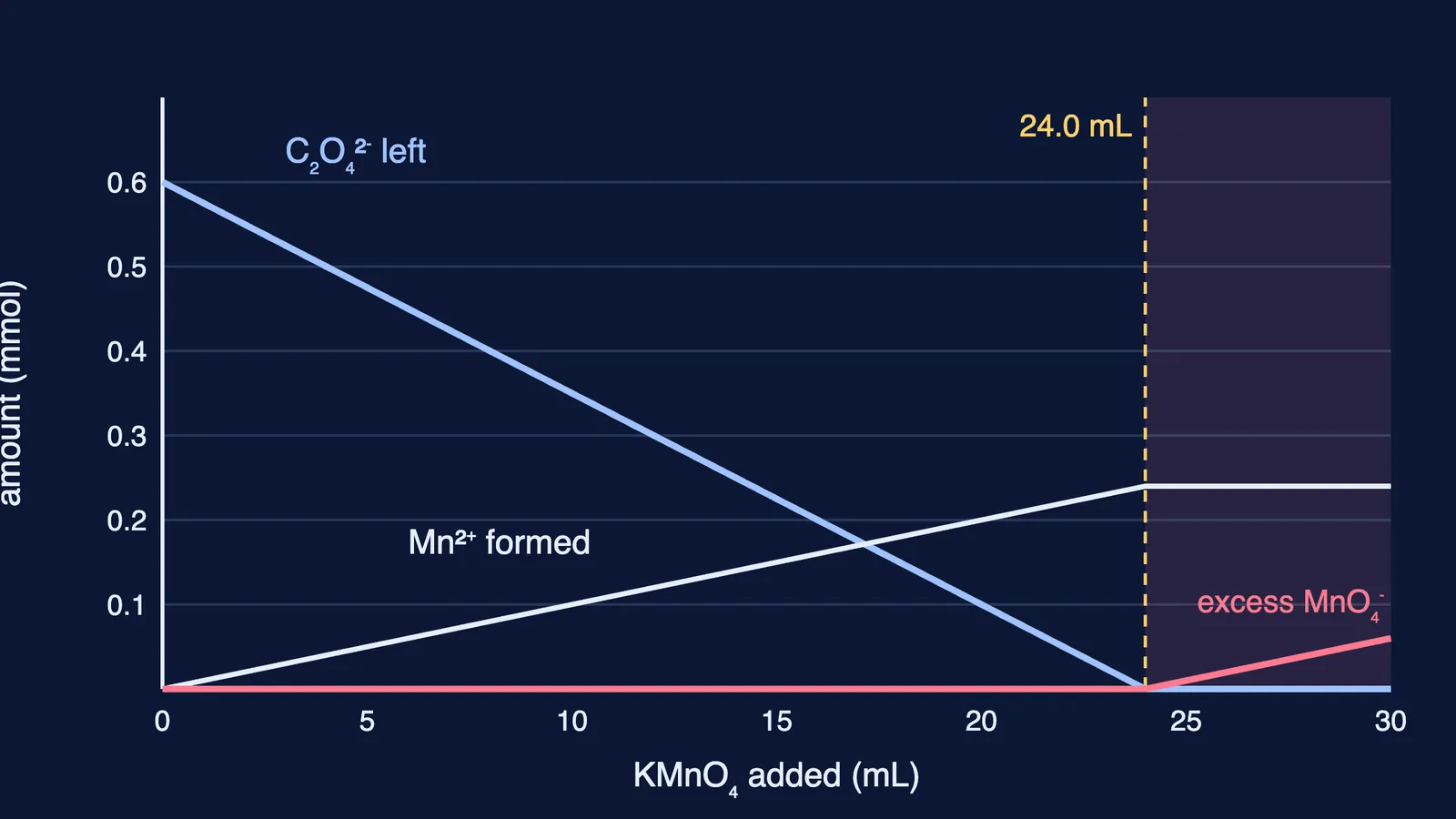
What volume of 0.010 M KMnO4 in acid oxidises 10.0 mL of 0.050 M oxalic acid?
What is the oxidation state of chromium in CrO4²⁻ and in Cr2O7²⁻?
Which is diamagnetic: manganate (MnO4²⁻) or permanganate (MnO4⁻)?
Answers: 2.83 BM; Zn2+; 20.0 mL; +6 in both; permanganate.
For more depth, see our d- and f-Block Elements guide for JEE Main. For written answers, use the Class 12 board plan for d and f block elements, and continue with Coordination Compounds for NEET.