On this page
Experimental Skills is the Physics unit you prepare from lab work, not one chapter. Below: the official list, NCERT map, solved readings and a plan.
Which experiments are in the NEET Experimental Skills syllabus?
Unit 20 of the NMC NEET (UG)-2026 syllabus asks for "familiarity with the basic approach and observations" of these experiments:
Vernier calipers: diameters and depth of a vessel.
Screw gauge: thickness or diameter of a thin sheet or wire.
Simple pendulum: energy dissipation (amplitude² against time).
Metre scale: mass by the principle of moments.
Young's modulus of a metallic wire.
Surface tension of water by capillary rise; effect of detergents.
Viscosity from a sphere's terminal velocity.
Speed of sound with a resonance tube.
Specific heat of a solid and a liquid by mixtures.
Resistivity with a metre bridge.
Resistance using Ohm's law.
Galvanometer resistance and figure of merit (half deflection).
Focal length of convex and concave mirrors and a convex lens, by parallax.
Prism: deviation against incidence.
Glass slab refractive index (travelling microscope).
p-n junction diode characteristics.
Zener diode characteristics and reverse breakdown voltage.
Identifying a diode, LED, resistor and capacitor.
Where is each experiment in NCERT for 2026-27?
The theory sits in the 2026-27 NCERT chapters: Class 11 Chapters 6 (moments), 8 (Young's modulus), 9 (surface tension, viscosity), 10 (specific heat) and 14 (resonance tube); Class 12 Chapters 3 (metre bridge, Ohm's law), 4 (galvanometer), 9 (mirrors, lens, prism, slab) and 14 (diodes).
Four gaps: the 2026-27 Units and Measurement chapter does not teach vernier calipers or the screw gauge. Class 11 Chapter 13 no longer teaches damped oscillations. The Class 12 Semiconductor Electronics chapter stops at the rectifier, with no Zener diode. Neither textbook has the half-deflection method. Use the NCERT Physics laboratory manuals for Class 11 and 12 for these; the Class 11 manual's opening chapter covers least count and zero error.
How are experiments asked in NEET?
As in NEET-UG 2026, the paper had 180 multiple-choice questions in 180 minutes, each with four options and one correct or best answer, marked +4 for correct and −1 for wrong, per the NTA information bulletin. That is about a minute a question, so read scales and graphs fast. More in the NEET-UG paper pattern.
Worked examples: reading instruments
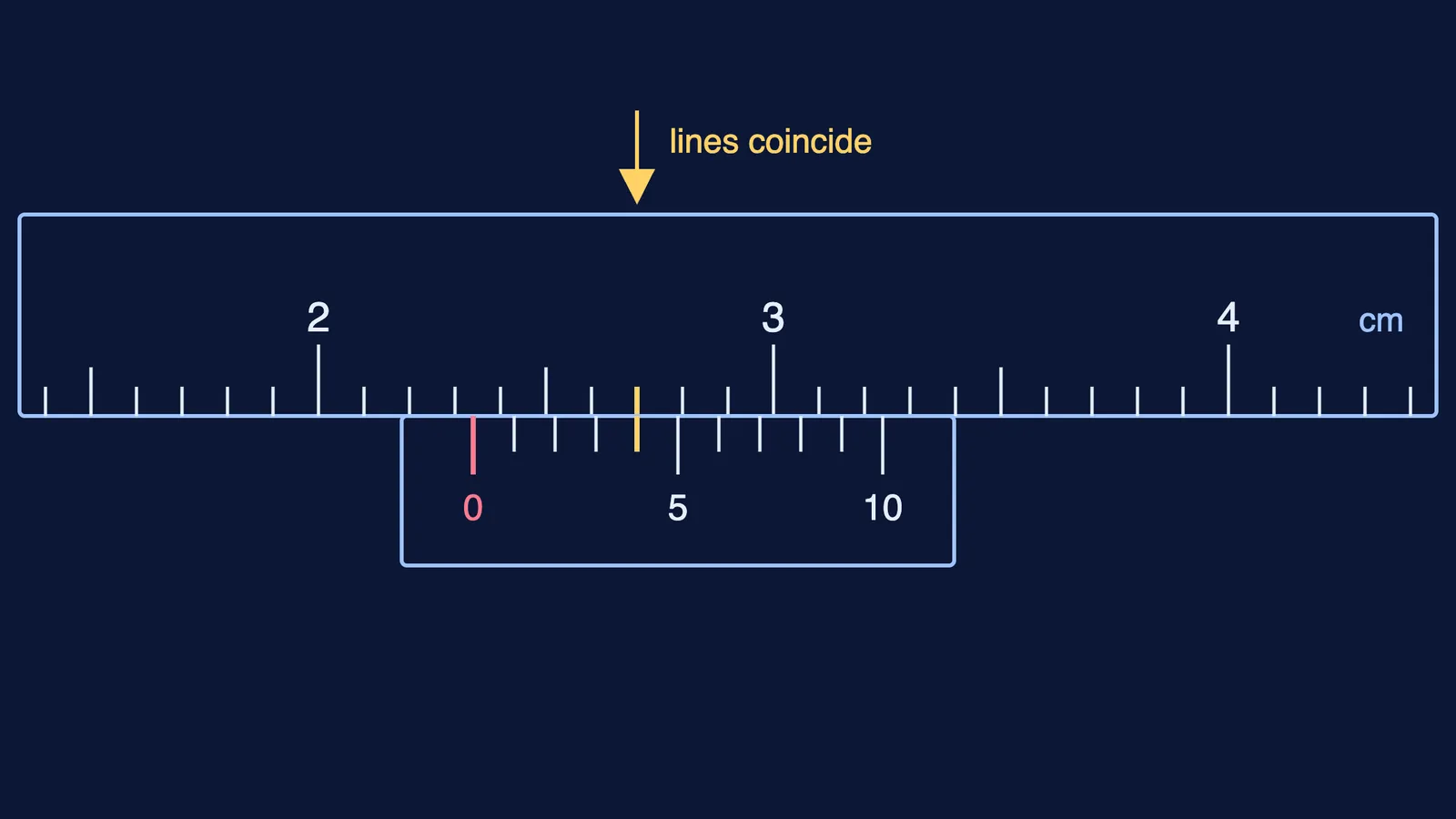
1. Vernier with a negative zero error. 50 vernier divisions equal 49 main-scale divisions of 1 mm. Least count = 1 − 49/50 = 0.02 mm. Jaws closed, the vernier zero lies left of the main zero and the 46th division coincides, so zero error = −(50 − 46) × 0.02 = −0.08 mm. A rod reads 24 mm with the 17th division coinciding: 24 + 17 × 0.02 = 24.34 mm. Corrected value = 24.34 − (−0.08) = 24.42 mm.
2. Screw gauge and percentage error. Pitch 0.5 mm, 50 circular divisions, so least count = 0.01 mm. Zero error is +0.03 mm. A wire shows 1.5 mm on the main scale and 27 on the circular scale: 1.5 + 0.27 = 1.77 mm, corrected to 1.74 mm. Area goes as d², so its percentage error is 2 × (0.01/1.74) × 100 ≈ 1.15%.
3. Metre scale by moments. A metre scale balances on a pivot at its 50.0 cm mark. An unknown mass at 30.0 cm balances 40 g at 74.0 cm. Moments: m × 20.0 = 40 × 24.0, so m = 48 g.
Stuck on a step? The Fermi Problem Library has worked problems with a step-by-step solver that explains the reasoning rather than printing an answer.
Which mistakes cost marks in Experimental Skills?
Adding a zero error instead of subtracting it.
Forgetting that area goes as d², which doubles the percentage error.
Mixing up diode graphs: forward current rises sharply after a knee; a Zener's reverse current stays near zero until breakdown.
The prism graph: deviation falls to a minimum, then rises.
Can't picture these curves? The Fermi Simulation Lab has interactive simulations for the ideas that are easier to see than to read.
How should you practise Experimental Skills for NEET?
A two-week plan, about 40 minutes a day:
Days 1-3: vernier, screw gauge and zero error; ten readings a day.
Days 4-6: Class 11 experiments; note each formula and plot.
Days 7-9: Class 12 experiments; sketch every graph from memory.
Days 10-12: timed sets of 15 single-correct questions, a minute each.
Days 13-14: redo every miss and label it reading, sign, formula or graph.
Try these:
A screw gauge has pitch 0.5 mm and 100 circular divisions, with zero error −0.020 mm. It reads 2.5 mm and 38 divisions. Find the corrected diameter.
A vernier (least count 0.1 mm) reads 42.7 mm across the outside of a tube and 38.3 mm inside. Find the wall thickness.
V = 4.0 ± 0.1 V and I = 2.0 ± 0.1 A. Find R and its percentage error.
Answers: 2.71 mm; 2.2 mm; 2.0 Ω, 7.5%.
For the JEE angle, read experimental skills in the JEE Main physics syllabus, and revise errors and significant figures with our Units and Measurements Class 11 guide.