On this page
Units and Measurements opens NCERT Class 11 Physics Part I and sets habits you need for two years: giving answers with the right digits, attaching an uncertainty, and checking a formula before trusting it. Here is the 2026-27 syllabus, the marks, four worked examples and exam-style practice.
What does Units and Measurements cover in Class 11 for 2026-27?
The CBSE Physics curriculum for 2026-27 puts the chapter in Unit I: units and systems of units, SI base and derived units, significant figures, the uncertainty in a result, and dimensional analysis.
Marks: Units I, II and III (Chapters 1 to 4) share 23 of the 70 theory marks. There is no separate figure for this chapter.
The practical exam carries 30 marks, and its first two Section A experiments use vernier callipers and a screw gauge, so lab work leans on this chapter too.
The current NCERT text, Chapter 1, Units and Measurement (Reprint 2026-27), has six sections: introduction, the SI, significant figures, dimensions, dimensional formulae, and dimensional analysis. It has no section on types of error or measuring large distances; uncertainty sits inside 1.3.3, so skip parallax or mean-error theory from older guides. Preparing for JEE too? Our Units and Measurements for JEE Main guide covers how to prepare for that exam.
How do significant figures and rounding work?
NCERT gives two rules. In multiplication or division, keep as many significant figures as the least precise number. In addition or subtraction, keep as many decimal places as the number with the fewest.
Worked example 1. A plate measures 12.4 cm by 3.65 cm.
Area: 12.4 × 3.65 = 45.26 cm²; both numbers have three significant figures, so 45.3 cm².
Sum of sides: 12.4 + 3.65 = 16.05 cm, kept to one decimal place.
The sum is the trap. NCERT's convention: when the dropped digit is 5, keep an even preceding digit and raise an odd one. Here the preceding digit is 0, so the answer is 16.0 cm, not 16.1 cm.
How do you find the uncertainty in a result?
For a product or quotient, add the relative (percentage) errors, as NCERT section 1.3.3 shows.
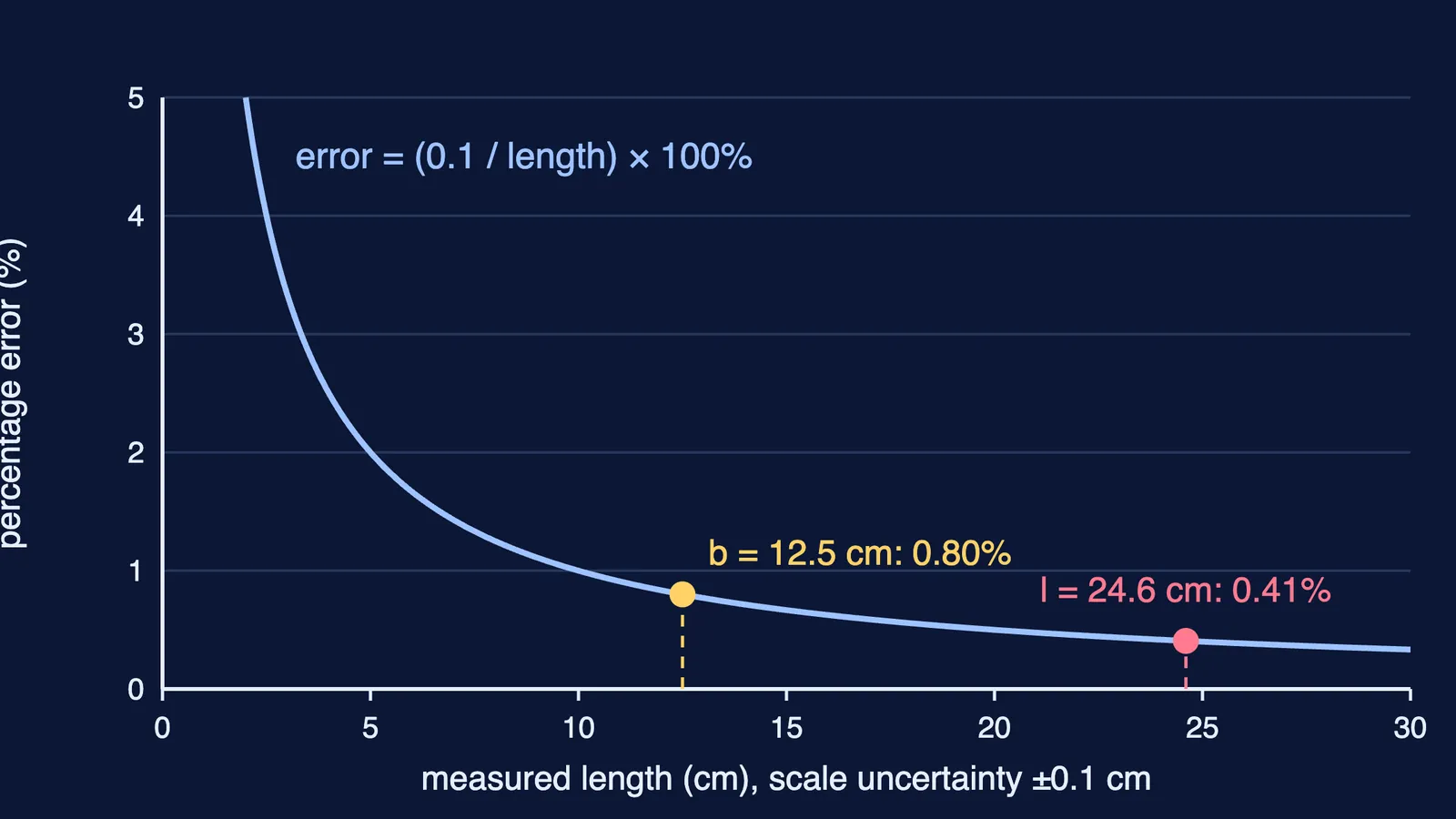
Worked example 2. A ruler reads to ±0.1 cm. A notebook cover measures l = 24.6 ± 0.1 cm and b = 12.5 ± 0.1 cm.
Area: 24.6 × 12.5 = 307.5 cm², or 308 cm² to three significant figures (7 is odd, so it rises).
Relative errors: 0.1/24.6 = 0.41% and 0.1/12.5 = 0.80%.
Total: 0.41% + 0.80% = 1.21%, about 1.2%.
Absolute error: 307.5 × 0.0121 = 3.7, which rounds to 4 cm².
Answer: area = 308 ± 4 cm². The graph above shows why the shorter side gives nearly twice the percentage error: the same ±0.1 cm is a bigger share of a smaller length.
How do you check a formula with dimensional analysis?
You can only add or equate quantities with the same dimensions (NCERT's principle of homogeneity). Passing the test does not prove a formula right; failing proves it wrong.
Worked example 3. Is v = u + at² correct? [v] = [u] = [L T⁻¹], but [at²] = [L T⁻²][T²] = [L]. The terms do not match, so it is wrong; the correct form is v = u + at.
Worked example 4. Let the frequency f of a mass m on a spring depend on m and spring constant k, where [k] = [M T⁻²] from F = kx. Write f = C mˣ kʸ:
[T⁻¹] = [M]ˣ [M T⁻²]ʸ
T: −1 = −2y, so y = 1/2
M: x + y = 0, so x = −1/2
So f = C √(k/m). Dimensions cannot give C; that needs Chapter 13.
Practice questions in exam style
(1 mark) How many significant figures are in 0.04050 m?
(2 marks) A trolley covers 2.48 m in 1.6 s. Find its average speed.
(2 marks) Add 2.36 m, 14.1 m and 0.008 m.
(3 marks) The side of a cube is 4.00 ± 0.02 cm. Find the percentage error in its volume.
(3 marks) The speed v of a wave on a string depends on tension F and mass per unit length μ. Use dimensions to find the relation.
Answers: (1) four; (2) 1.6 m s⁻¹ (2.48/1.6 = 1.55; the dropped 5 follows an odd digit, so it rises); (3) 16.5 m; (4) 3 × 0.5% = 1.5%; (5) v = k √(F/μ).
How should you revise this chapter?
Day 1: SI base quantities and significant-figure rules, with five rounding drills.
Day 2: uncertainty in a product and in a power (like the cube above).
Day 3: dimensional formulae for ten quantities, then check three formulas.
In the lab: record every reading with the right number of digits.
For a weekly rhythm across the year, see our research-based study plan for Class 11 physics. Stuck on a step? Fermi's AI tutor can work out what you already know and build a plan for the session, so you start from a clear next step.