On this page
Atoms and Nuclei is a short list of relations used fast and exactly. Here are the syllabus, three solved problems, the traps and a plan.
What does the NEET syllabus include in Atoms and Nuclei?
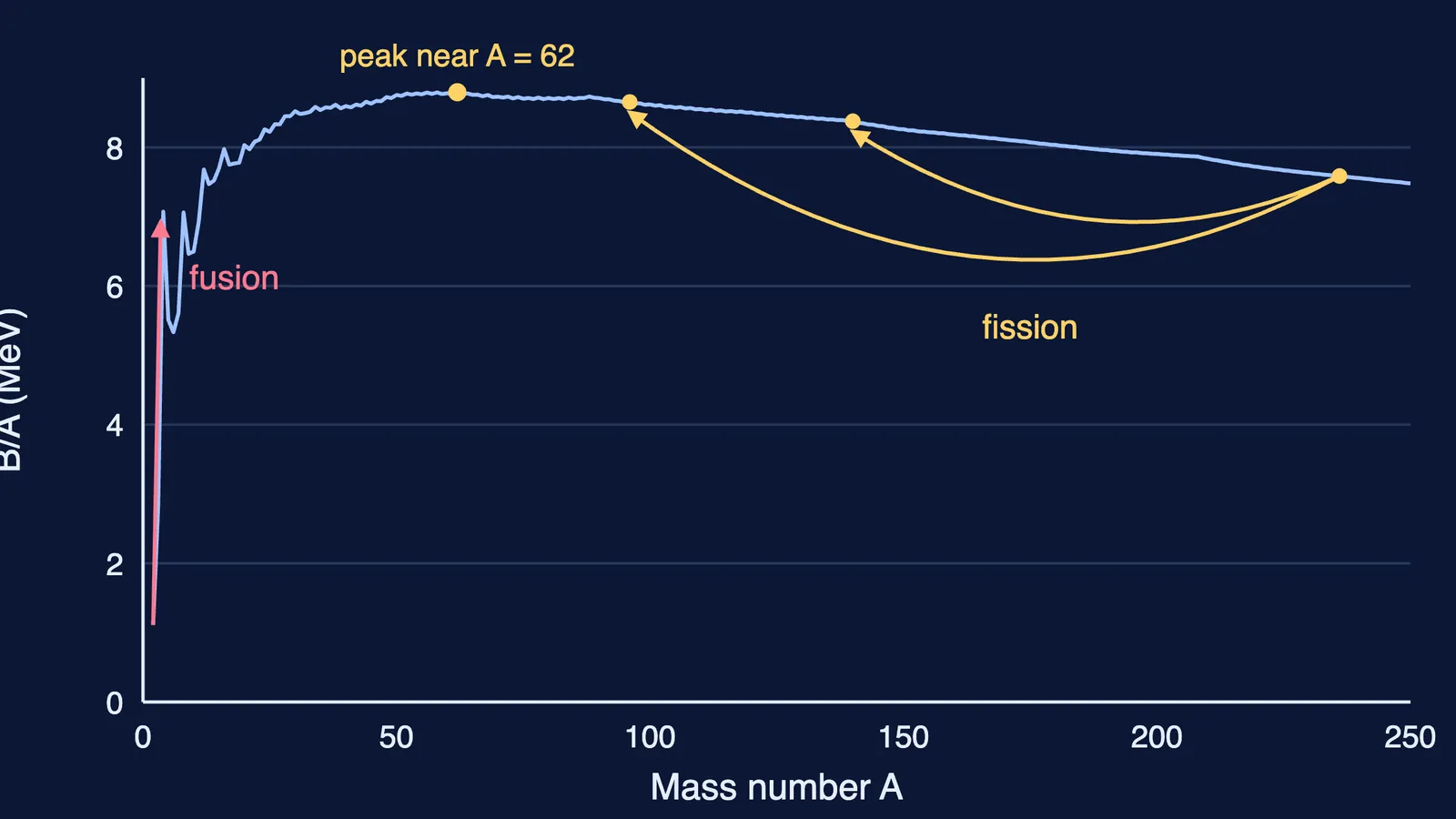
The NMC's updated syllabus for NEET (UG)-2026 lists Unit 18, Atoms and Nuclei, as: alpha-particle scattering experiment; Rutherford's model of atom; Bohr model, energy levels, hydrogen spectrum; composition and size of nucleus, atomic masses, mass-energy relation, mass defect; binding energy per nucleon and its variation with mass number; nuclear fission and fusion.
In the 2026-27 reprint this is two chapters of NCERT Class 12 Physics Part II, Chapter 12, Atoms and Chapter 13, Nuclei. Two gaps:
The Atoms chapter does not set out the Lyman, Balmer or Paschen series or a Rydberg formula (Balmer appears only in a historical note). It gives hν = E(initial) − E(final), which with the energy levels yields any hydrogen line.
Radioactivity is not in the NMC unit. NCERT keeps only a short descriptive section (13.6) on alpha, beta and gamma decay.
Chemistry also uses Bohr's model, with the focus on quantum numbers and orbitals (see Atomic Structure for NEET); physics adds scattering, the nucleus and nuclear energy.
How is Atoms and Nuclei asked in NEET?
In NEET-UG 2026, physics had 45 of the 180 questions, all answered in 180 minutes, with +4 for a correct answer and −1 for a wrong one, according to the NTA information bulletin for NEET (UG)-2026. Each was a multiple-choice question with four options and a single correct or best answer. That is about a minute a question, so three habits matter:
Formula recall in seconds, from one card: E_n = −13.6/n² eV; r_n ∝ n²; v_n ∝ 1/n; R = R₀A^(1/3) with R₀ = 1.2 fm; 1 u = 931.5 MeV/c² (all in NCERT Chapter 12 and Chapter 13).
Unit checks to strike out options: nuclear radii are a few femtometres (1 fm = 10⁻¹⁵ m), nuclear energies are MeV.
Close reading of NCERT lines, so a single changed word in an option stands out.
Worked examples: three NEET-style problems
1. A hydrogen transition. An electron in hydrogen drops from n = 6 to n = 3. Find the photon energy, wavelength and orbit change.
ΔE = 13.6(1/3² − 1/6²) = 13.6 × 3/36 ≈ 1.13 eV. With hc ≈ 1240 eV nm, λ ≈ 1094 nm: infrared, not visible. The radius scales as n², so it shrinks to a quarter; the speed scales as 1/n, so it doubles.
2. Nuclear size. Compare nuclei with A = 64 and A = 216.
A^(1/3) is 4 and 6, so R = 4.8 fm and 7.2 fm (ratio 2 : 3). Volume goes as A, so density is the same for both. Strike any option saying the heavier nucleus is denser.
3. Mass defect and fission energy. (a) A nucleus with A = 50 has a mass defect of 0.42 u. B = 0.42 × 931.5 ≈ 391 MeV, or about 7.82 MeV per nucleon.
(b) A nucleus with A = 236 and 7.5 MeV per nucleon splits into fragments with A = 140 (8.3 MeV per nucleon) and A = 96 (8.6 MeV per nucleon). Nucleons are conserved (140 + 96 = 236), so Q = 140 × 8.3 + 96 × 8.6 − 236 × 7.5 = 1162 + 825.6 − 1770 ≈ 218 MeV.
Stuck on a step? The Fermi Problem Library has worked problems with a step-by-step solver that explains the reasoning rather than printing an answer.
Which mistakes cost marks in Atoms and Nuclei?
Sign slips in Bohr energies: E is negative, and a higher n means a less negative energy.
Mixing emission and absorption: a photon is emitted going down in n, absorbed going up.
Judging stability by total binding energy instead of binding energy per nucleon.
Using R ∝ A instead of R ∝ A^(1/3).
Applying 931.5 to kilograms instead of atomic mass units.
Hard to picture an idea in this unit? The Fermi Simulation Lab has interactive simulations for the ideas that are easier to see than to read.
How should you practise Atoms and Nuclei for NEET?
A two-week plan, about an hour a day:
Days 1-3: NCERT Atoms, sections 12.2 to 12.6. Put every relation and unit on one card.
Days 4-6: NCERT Nuclei, sections 13.2 to 13.7; sketch the binding-energy curve from memory.
Days 7-9: 20 mixed single-correct questions a day, a minute each.
Days 10-12: label each wrong answer as recall, sign, unit or reading.
Days 13-14: a timed 15-question set; redo the misses a day later.
Try these:
In hydrogen, find r₄/r₂ and E₄/E₂.
An alpha particle with 4.0 MeV of kinetic energy heads straight at a nucleus with Z = 50. Taking e²/4πε₀ = 1.44 MeV fm, find the distance of closest approach.
Find the radius of a nucleus with A = 27.
Answers: 4 and 1/4; 36 fm; 3.6 fm.
Next, see how to write Nuclei answers in the Class 12 board exam or Atoms and Nuclei for JEE Main, with numericals.