On this page
Bohr radii, spectral lines, de Broglie wavelengths and electron counts all come from a handful of relations, and the configurations here return in bonding and the periodic table.
What does the NEET-UG syllabus include in Atomic Structure?
The NEET-UG syllabus from the National Medical Commission, posted by NTA, lists Unit 2, Atomic Structure, under Physical Chemistry (NEET-UG syllabus, NTA). It covers:
nature of electromagnetic radiation, the photoelectric effect and the spectrum of the hydrogen atom
the Bohr model of hydrogen: postulates, energy and radius relations, limitations
dual nature of matter, de Broglie's relationship and the Heisenberg uncertainty principle
the quantum mechanical model, orbitals as one-electron wave functions, and ψ and ψ² against r for 1s and 2s
quantum numbers, shapes of s, p and d orbitals, and electron spin
Aufbau, Pauli and Hund's rules, configurations, and the extra stability of half-filled and filled orbitals
This maps to Unit 2, Structure of Atom, in the NCERT Class 11 Chemistry Part I textbook, Reprint 2026-27 (NCERT Unit 2). One gap: the syllabus asks for the derivation of Bohr's energy and radius relations, but NCERT states only the results. Learn the short derivation from mvr = nh/2π and the Coulomb force separately.
How is Atomic Structure tested in NEET?
In NEET-UG 2026, the paper had 180 compulsory questions in 180 minutes, 45 of them in Chemistry, all multiple-choice with four options and a single correct or best answer, marked +4 correct and -1 wrong (NEET-UG 2026 information bulletin, NTA). That is about a minute per question, with no numerical-answer section, so practise single-correct questions against the clock.
Which formulas should you have at your fingertips?
Bohr orbits for one-electron species: r = 52.9 n²/Z pm and E = -13.6 Z²/n² eV (NCERT writes -2.18 × 10⁻¹⁸ J for n = 1, Z = 1).
Electron speed in an orbit scales as Z/n.
de Broglie: λ = h/mv. Uncertainty: Δx · mΔv ≥ h/4π.
Nodes: radial = n - l - 1, angular = l.
Most lines from level n₂ down to n₁: (n₂ - n₁)(n₂ - n₁ + 1)/2.
Worked example 1: matching levels. Which He⁺ orbit has the same energy as hydrogen's n = 3 level, and how big is it? Energy matches when Z²/n² = 1/9; with Z = 2, n = 6, so E = -13.6 × 4/36 = -1.51 eV. Its radius is 52.9 × 36/2 = 952 pm, twice hydrogen's 476 pm for n = 3: same energy, not the same size.
Worked example 2: wavelength meets uncertainty. An electron has a de Broglie wavelength of 0.20 nm. Its speed is v = h/mλ = 6.626 × 10⁻³⁴ / (9.109 × 10⁻³¹ × 2.0 × 10⁻¹⁰) = 3.64 × 10⁶ m/s. If that speed is known to 1%, Δv = 3.64 × 10⁴ m/s, so Δx ≥ h/(4πmΔv) = 1.6 × 10⁻⁹ m, about eight times the wavelength: no definite orbit can be traced.
Worked example 3: counting electrons. Iron (Z = 26) is 1s² 2s² 2p⁶ 3s² 3p⁶ 3d⁶ 4s². Electrons with n + l = 4 are in 3p and 4s: 6 + 2 = 8. For Fe³⁺, remove the two 4s electrons first, then one 3d electron: 3d⁵, with five unpaired electrons.
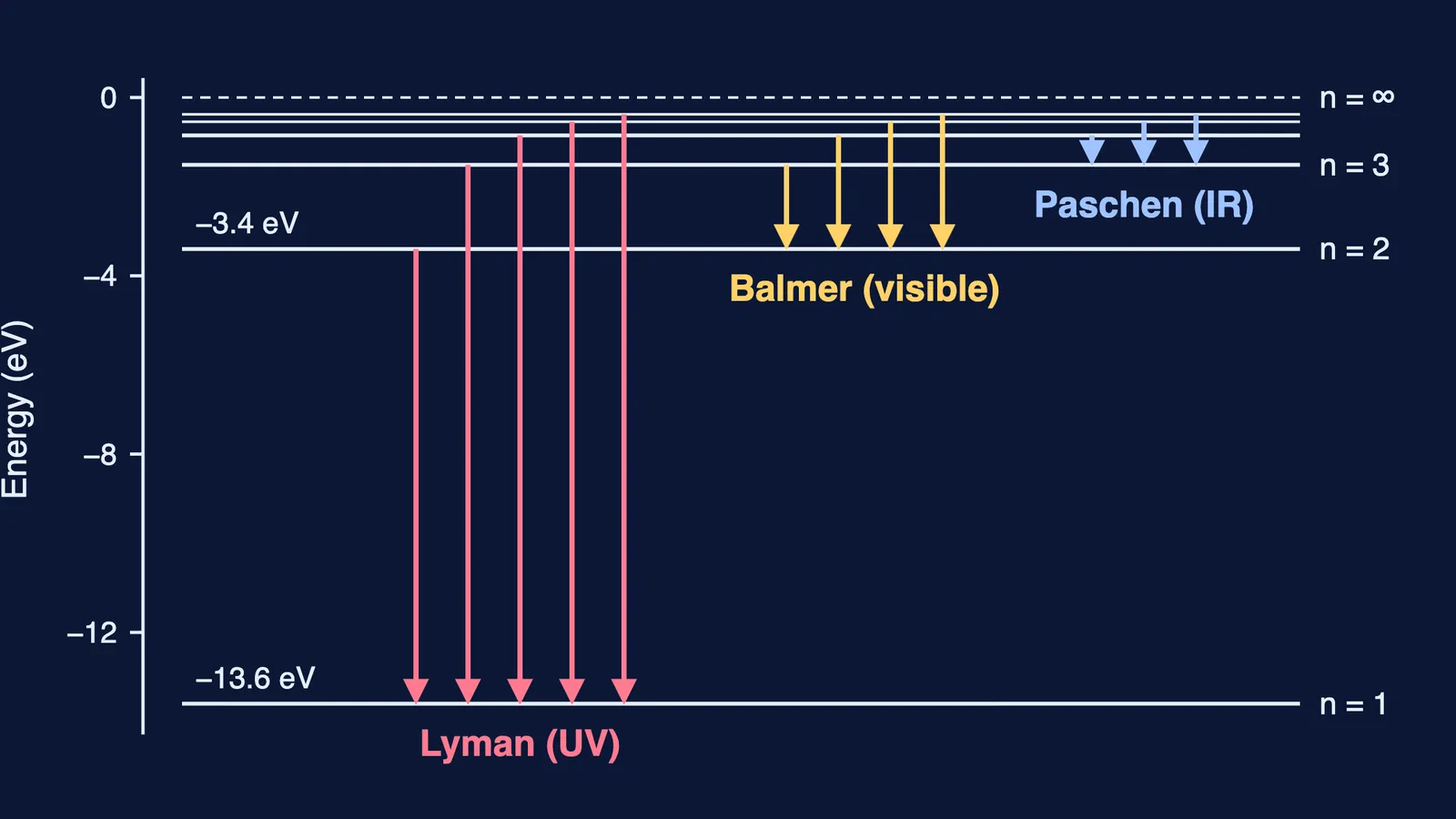
The diagram at the top plots E = -13.6/n² eV for hydrogen: gaps shrink as n grows, so Lyman lines (to n = 1) are ultraviolet and Paschen lines (to n = 3) infrared.
Hard to picture? The Fermi Simulation Lab has interactive simulations for the ideas that are easier to see than to read.
What are the common traps in Atomic Structure?
Using Bohr's formulas for neutral helium or lithium. They hold only for one-electron species.
Mixing up nodes: a 3p orbital has one radial and one angular node.
Forgetting chromium (3d⁵ 4s¹) and copper (3d¹⁰ 4s¹), explained by half-filled and filled subshell stability.
Unit slips: nm against pm, J against eV.
A two-week practice plan
Days 1-3: read NCERT Unit 2 line by line and rewrite its tables from memory. Our guide on how to study NCERT for NEET explains the method.
Days 4-6: Bohr and spectrum drills for H, He⁺, Li²⁺ and Be³⁺, using ratios.
Days 7-8: photoelectric, de Broglie and uncertainty problems, units written out.
Days 9-11: quantum numbers, nodes, and configurations of the first 30 elements and common ions.
Days 12-14: timed mixed sets, 20 questions in 20 minutes; tag each miss with the rule you broke.
Stuck on a step? The Fermi Problem Library has worked problems with a step-by-step solver that explains the reasoning rather than printing an answer.
Try these: (a) how many radial and angular nodes does a 5d orbital have? (b) how many lines can appear as hydrogen electrons fall from n = 7 to n = 3? (c) what is the ratio of electron speed in He⁺'s third orbit to hydrogen's first? Answers: 2 radial and 2 angular; 10; 2 : 3.
For board answers, see our Class 11 Structure of Atom guide; for JEE, see how to prepare Atomic Structure for JEE Main.