On this page
Electronic Devices is a short unit with a catch: the NEET syllabus asks for more than the current NCERT chapter teaches. Here is what to cover and how to practise it.
What does the NEET syllabus include in Electronic Devices?
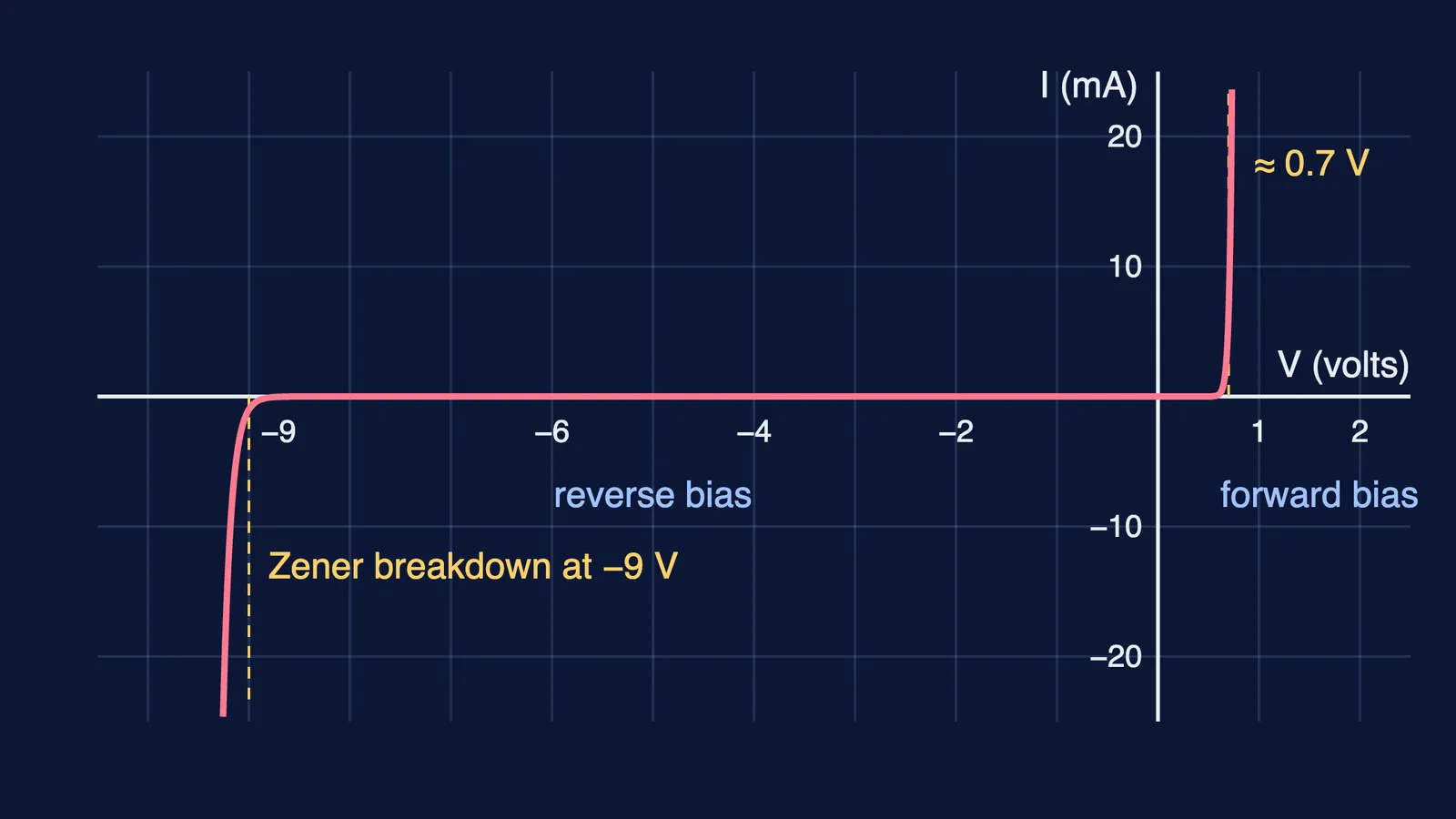
The NMC "NEET (UG)-2026" syllabus lists Electronic Devices as Unit 19. It covers semiconductors; the semiconductor diode and its I-V characteristics in forward and reverse bias; the diode as a rectifier; the I-V characteristics of the LED, photodiode, solar cell and Zener diode; the Zener diode as a voltage regulator; and logic gates (OR, AND, NOT, NAND and NOR).
Unit 20, Experimental Skills, adds the diode and Zener characteristic curves and identifying a diode, LED, resistor and capacitor from a mixed collection.
Which NCERT chapter covers it, and what is missing?
The unit maps to Chapter 14, Semiconductor Electronics: Materials, Devices and Simple Circuits, in NCERT Class 12 Physics Part II. The current copy runs from energy bands, doping and the p-n junction to diode characteristics and rectifiers with a capacitor filter, then stops.
Our semiconductors, diodes and logic gates guide works through the Zener regulator and logic gates; this post is the NEET plan.
How are Electronic Devices questions asked in NEET?
As in NEET-UG 2026, the NTA information bulletin set 45 physics questions out of 180, all multiple choice with four options and a single correct or best answer, in a 180-minute paper. A correct answer earns +4, a wrong one costs 1 and a blank scores 0. That is about a minute per question, so each idea below must become a reflex.
Worked examples
1. Centre-tap rectifier. In a lab, a 400 Hz signal generator drives a transformer whose secondary gives 36 V peak across its full winding, with a centre tap. In the centre-tap full-wave circuit each ideal diode conducts across only half the winding, so the output peak is 18 V; both halves of the cycle give a pulse, so the output repeats at 800 Hz. The diode that is off must withstand the full 36 V in reverse. One diode across the full winding (half-wave) gives a 36 V peak, but pulses at only 400 Hz.
2. Zener regulator and its limit. A 9.0 V Zener sits across a 450 Ω load, fed from 15 V through a 125 Ω series resistor. Series current = (15 − 9)/125 = 48 mA. Load current = 9/450 = 20 mA. Zener current = 48 − 20 = 28 mA. Lower the load resistance and, at 9/0.048 ≈ 190 Ω, the load takes all 48 mA and regulation ends.
3. A gate puzzle. Inputs A and B go to an OR gate and a NAND gate, and both outputs feed an AND gate. Row by row: 00 gives OR = 0, so Y = 0; 01 and 10 give OR = 1 and NAND = 1, so Y = 1; 11 gives NAND = 0, so Y = 0. Y is 1 only when the inputs differ: XOR behaviour from syllabus gates.
Stuck on a step? The Fermi Problem Library has worked problems with a step-by-step solver that explains the reasoning rather than printing an answer.
What are the common traps in NEET Electronic Devices?
Calling n-type silicon negatively charged: a doped crystal stays neutral overall.
Drawing the Zener in forward bias; it regulates only in reverse breakdown.
Doubling the output frequency for a half-wave rectifier; only full-wave doubles it.
Forgetting that the photodiode is used in reverse bias, the LED in forward bias, and that a solar cell has no external bias.
Expecting an LED or photodiode to work with photons below the band gap: use E (eV) ≈ 1240/λ (nm).
Mixing up NAND and NOR truth tables.
Hard to picture what bias does to the junction? The Fermi Simulation Lab has interactive simulations for the ideas that are easier to see than to read.
A ten-day practice plan
Days 1-2: read Chapter 14 line by line; write true/false statements on bands, doping and the junction.
Days 3-4: diode I-V curves and rectifiers; sketch both waveforms from memory.
Days 5-6: LED, photodiode, solar cell and Zener from your second source; draw each I-V curve with its bias.
Day 7: Zener regulator sums with changing loads and supplies.
Day 8: truth tables for all five gates, then two-gate combinations.
Days 9-10: 20 mixed MCQs in 20 minutes daily; log and redo every error.
Quick check (answers below):
A red LED emits at 650 nm. What is its band gap, roughly?
For which single input pair does a NOR gate give 1?
A photodiode has a band gap of 1.4 eV. Will it respond to 1000 nm light?
Answers: 1. About 1.9 eV. 2. A = 0, B = 0. 3. No; each photon carries only about 1.24 eV.
For the JEE angle, see how to prepare Semiconductors for JEE Main; for boards, the Class 12 semiconductor electronics board-exam guide.