On this page
Almost every organic question in NEET leans on this unit. Spot hybridisation, push electrons the right way and name structures without hesitating, and later chapters become pattern recognition.
What does the NEET (UG)-2026 syllabus include in GOC?
The NMC NEET (UG)-2026 syllabus lists Unit 14, Some Basic Principles of Organic Chemistry, in the chemistry section (NEET (UG) syllabus, NTA). NTA's bulletin says NMC notified it, unchanged from the previous year (NEET (UG)-2026 information bulletin, NTA). The unit covers:
tetravalency of carbon, shapes of simple molecules and hybridisation (s and p)
classification by functional group, homologous series, and structural and stereoisomerism
trivial and IUPAC nomenclature
homolytic and heterolytic fission; free radicals, carbocations and carbanions; stability of carbocations and free radicals; electrophiles and nucleophiles
inductive, electromeric, resonance and hyperconjugation effects
substitution, addition, elimination and rearrangement reactions
Your textbook is Unit 8 of NCERT Class 11 Chemistry Part II, 2026-27 reprint, sections 8.1 to 8.7 (NCERT Unit 8). Sections 8.8 to 8.10 (purification, qualitative and quantitative analysis) belong to Unit 13. One gap: NCERT gives stereoisomerism a short paragraph naming geometrical and optical isomerism without working through either, though the syllabus lists it, so get the basic idea of each from your teacher.
How is GOC tested in NEET-UG?
In NEET-UG 2026, the paper had 180 compulsory questions in 180 minutes, 45 of them in Chemistry, each a multiple-choice question with four options and a single correct answer, marked +4 for a correct answer and -1 for a wrong one (NEET (UG)-2026 information bulletin, NTA). NEET 2027 is not yet notified, so plan on that pattern. About a minute a question, with no numerical-answer section, rewards quick counting rules and elimination.
How do you find hybridisation and count bonds fast?
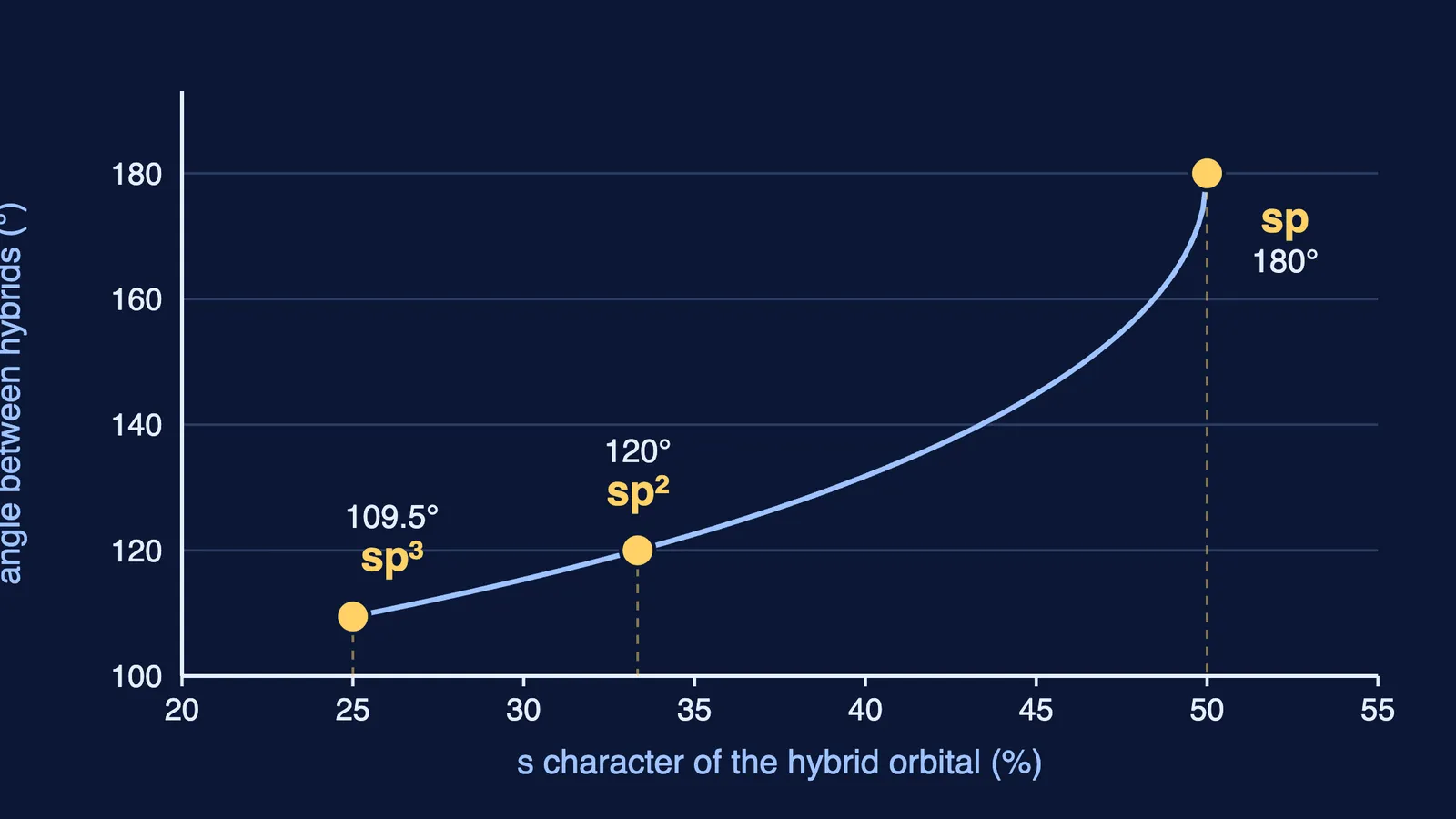
For a carbon with no lone pair, count the atoms it is sigma-bonded to: four means sp³, three means sp², two means sp. NCERT notes that an sp carbon, with 50% s character, is more electronegative than an sp² or sp³ carbon (NCERT Unit 8). The chart above shows how the angle between equivalent hybrids widens from 109.5° (sp³) through 120° (sp²) to 180° (sp).
Worked example 1. CH₂=C=CH–CH₂–C≡CH, which has the same formula as benzene, C₆H₆.
Hybridisation, left to right: C1 has three neighbours (sp²), C2 two (sp), C3 three (sp²), C4 four (sp³), C5 and C6 two each (sp).
Bonds: 6 C–H and 5 C–C sigma bonds make 11 σ; the two double bonds add 1 π each and the triple bond adds 2, so 4 π.
Name: numbering from the left gives multiple-bond locants 1, 2, 5; from the right, 1, 4, 5. The lower set wins: hexa-1,2-dien-5-yne.
How do electronic effects rank acids and intermediates?
The inductive effect is a permanent shift of electrons along sigma bonds, and NCERT notes it becomes vanishingly small after three bonds (NCERT Unit 8). The electromeric effect appears only while a reagent attacks a multiple bond. Resonance spreads charge through pi bonds and lone pairs; hyperconjugation spreads it from neighbouring C–H bonds.
Worked example 2. Rank by acid strength: CH₃CH₂COOH, CH₃CHFCOOH, FCH₂CH₂COOH and CH₃CF₂COOH.
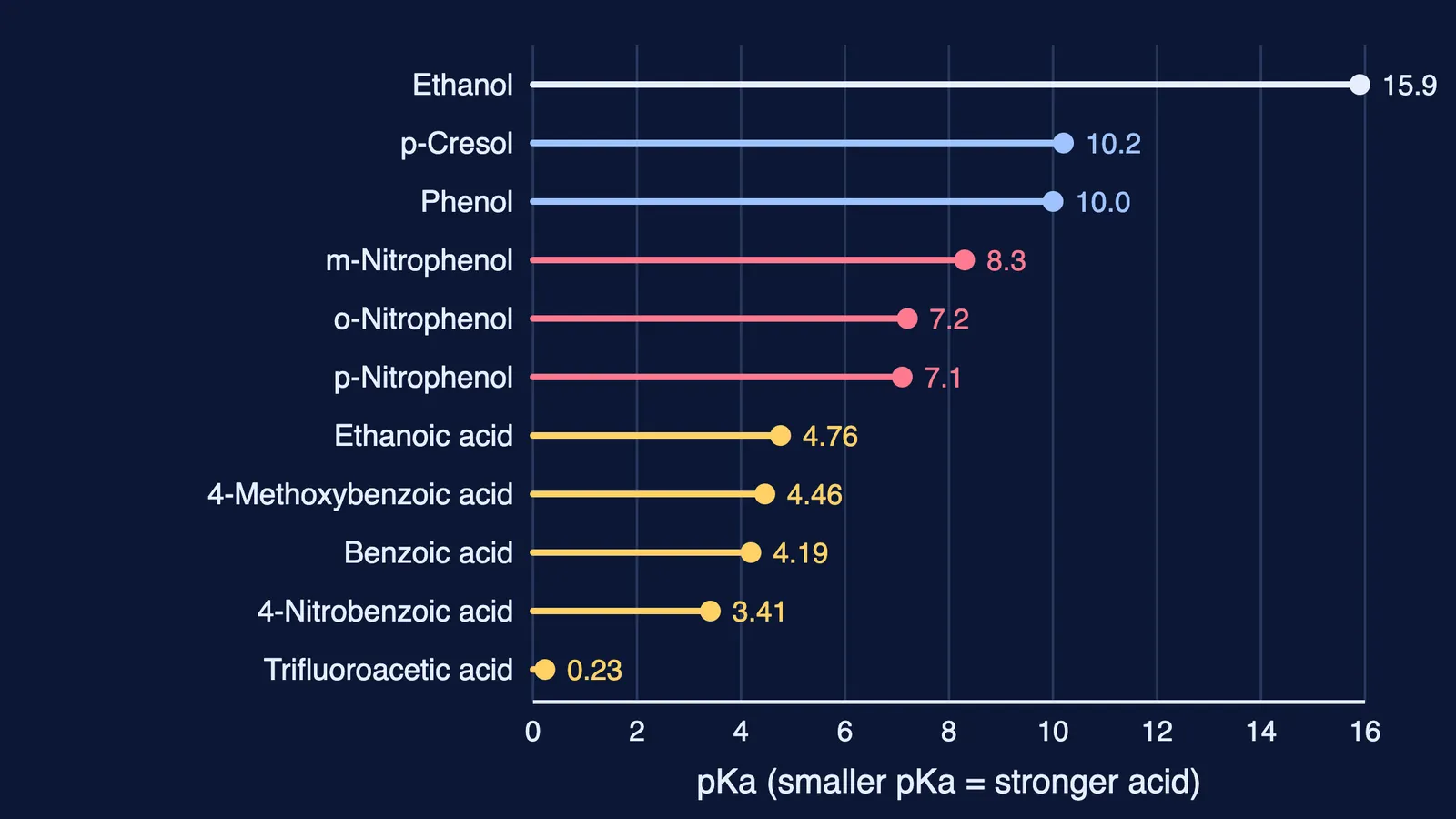
Fluorine pulls electrons (-I) and stabilises the carboxylate ion, so more fluorine means a stronger acid.
The pull fades with distance: fluorine on C2 helps more than fluorine on C3.
Order: CH₃CF₂COOH > CH₃CHFCOOH > FCH₂CH₂COOH > CH₃CH₂COOH.
Stuck on a step? The Fermi Problem Library has worked problems with a step-by-step solver that explains the reasoning rather than printing an answer.
What are the common traps in GOC?
Carbocations and free radicals get more stable from methyl to 3°; carbanions run the other way, because alkyl groups push more electrons onto a carbon that already has too many.
Resonance structures differ only in where electrons sit; if an atom moves, it is a different compound.
Charge does not decide the role: neutral NH₃ and H₂O are nucleophiles, and neutral BF₃ and AlCl₃ are electrophiles.
In names, the carbon of –CHO, –COOH or –C≡N is C1 of the main chain.
A two-week practice plan
Days 1-3: read NCERT sections 8.1 to 8.7; redo every solved problem unaided.
Days 4-5: name 15 structures a day and draw 15 from names.
Days 6-8: timed hybridisation and bond counts on unfamiliar molecules.
Days 9-11: rank acids, bases and intermediates, noting the effect you used.
Days 12-14: mixed sets of 30 questions in 30 minutes, then rework every miss.
If a whole idea is shaky, the Fermi Concept Library covers every concept in physics, chemistry, biology, mathematics and computing, each with its own lesson and its place in the map.
Try these: (a) how many alpha hydrogens can take part in hyperconjugation in (CH₃)₂C=CH–CH₃? (b) name (CH₃)₂CH–CH₂–CH₂–C≡N; (c) how many sp³ carbons are in 4-methylpent-2-yne? Answers: 9, 4-methylpentanenitrile, 4.
For board-style answers, see our Class 11 guide to organic chemistry basic principles; if you also write JEE, compare how to prepare GOC for JEE Main; then carry these effects into Hydrocarbons for NEET.