On this page
Unit 8 of CBSE Class 11 Chemistry is where organic chemistry starts: how carbon bonds, how compounds are named, why reactions happen and how compounds are purified and analysed. This guide is for school exams. If you are also preparing for JEE Main, read our separate guides to GOC for JEE Main and purification and characterisation for JEE Main.
How many marks is organic chemistry basic principles worth in Class 11?
The CBSE Chemistry curriculum for 2026-27 gives Unit 8, Organic Chemistry: Some Basic Principles and Techniques, 11 of the 70 theory marks, the most of any Class 11 unit. Its question paper design adds that no chapter-wise weightage is provided, so treat 11 as the unit's syllabus share, not a fixed count on every school paper. It splits each paper into 28 marks of remembering and understanding, 21 of applying and 21 of analysing, evaluating and creating.
The curriculum lists every section of the NCERT unit, from tetravalence of carbon to quantitative analysis. Study from the current text: Unit 8 of NCERT Chemistry Part II (Reprint 2026-27). In this reprint, stereoisomerism gets only a short definition naming geometrical and optical isomerism.
What does the Class 11 chapter cover?
Shapes and formulas: sp³, sp² and sp carbon; complete, condensed and bond-line structures.
Classification and IUPAC names: functional groups, homologous series and naming rules.
Isomerism: chain, position, functional group and metamerism.
Reaction mechanism: heterolytic and homolytic fission, nucleophiles and electrophiles, curved arrows, and four electronic effects: inductive, resonance, electromeric and hyperconjugation.
Purification: sublimation, crystallisation, distillation (simple, fractional, under reduced pressure, steam), differential extraction and chromatography.
Analysis: Lassaigne's test for nitrogen, sulphur and halogens; estimation of carbon, hydrogen, nitrogen (Dumas and Kjeldahl), halogens (Carius), sulphur, phosphorus and oxygen.
Why is a tertiary carbocation more stable than a methyl cation?
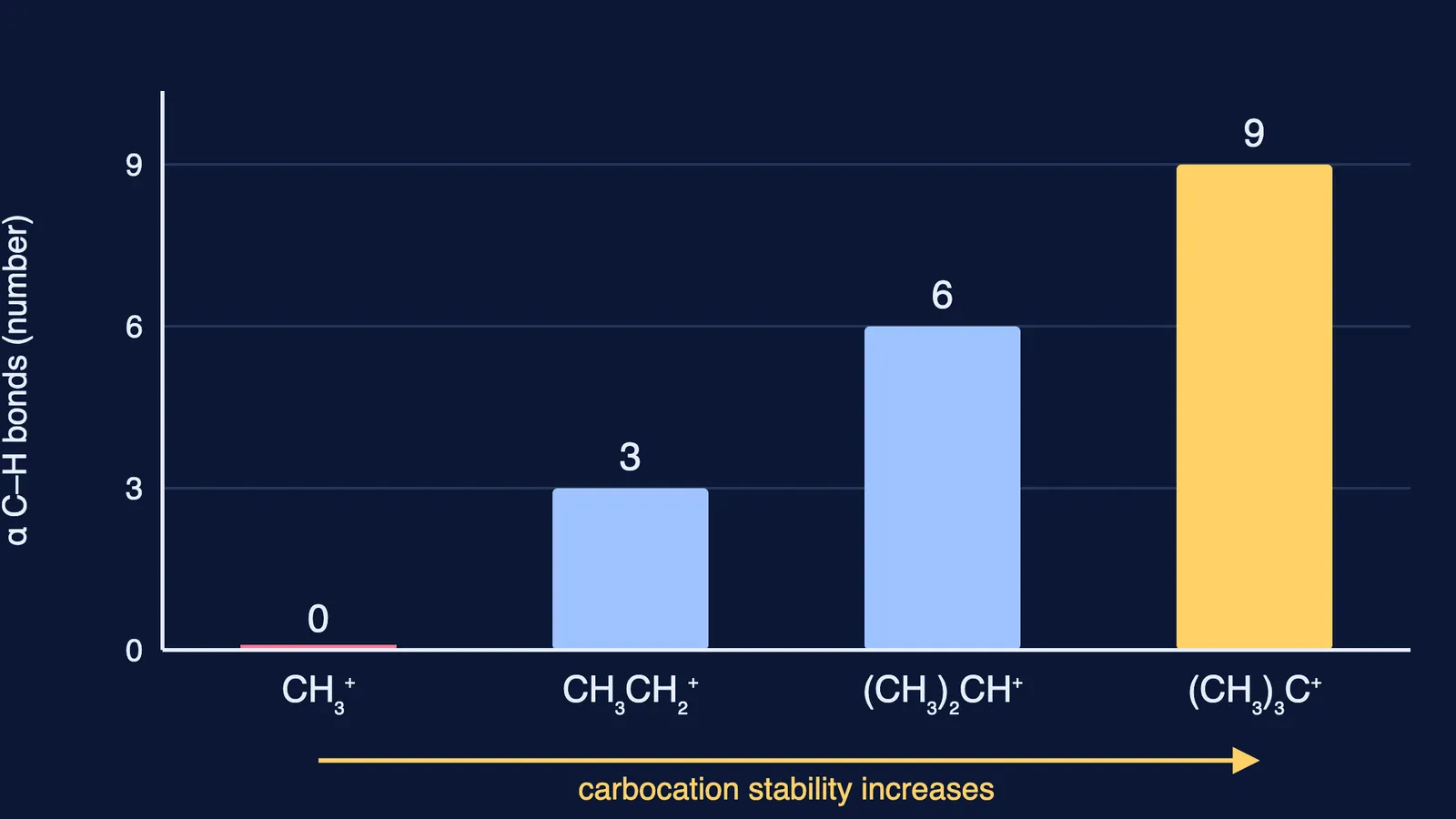
NCERT gives the carbocation order as CH₃⁺ < CH₃CH₂⁺ < (CH₃)₂CH⁺ < (CH₃)₃C⁺ and explains it with the inductive effect and hyperconjugation (NCERT Unit 8). Count the C–H bonds on carbons next to the positive carbon: 0, 3, 6 and 9. More such bonds means more hyperconjugation and a more stable ion, as the chart above shows. Alkyl free radicals follow the same order. A carbocation is sp² hybridised and trigonal planar; a carbanion is generally sp³ with a distorted tetrahedral shape.
How do you calculate percentage composition?
Use NCERT's formulas from section 8.10 (NCERT Unit 8), with C = 12, H = 1, O = 16.
Worked example 1 (combustion). 0.240 g of a compound containing C, H and O gives 0.352 g of CO₂ and 0.144 g of H₂O.
Percentage of carbon = (12 × 0.352 × 100) / (44 × 0.240) = 40.0%
Percentage of hydrogen = (2 × 0.144 × 100) / (18 × 0.240) = 6.67%
Oxygen by difference = 100 − 40.0 − 6.67 = 53.3%
Mole ratio C : H : O = 40.0/12 : 6.67/1 : 53.3/16 = 3.33 : 6.67 : 3.33 = 1 : 2 : 1, so the empirical formula is CH₂O.
Worked example 2 (Kjeldahl). Ammonia from 0.300 g of a compound is passed into 30.0 mL of 0.200 M H₂SO₄. The leftover acid needs 36.0 mL of 0.200 M NaOH.
Acid left = V₁/2 = 18.0 mL, so acid used = V − V₁/2 = 12.0 mL.
Percentage of N = 1.4 × M × 2(V − V₁/2) / m = 1.4 × 0.200 × 2 × 12.0 / 0.300 = 22.4%
Check: 2.40 mmol of H₂SO₄ neutralises 4.80 mmol of NH₃, which holds 0.0672 g of nitrogen; 0.0672/0.300 = 22.4%.
What questions can you expect in a school exam?
CBSE publishes sample papers for Class XII, not Class XI. The Class XII Chemistry sample paper 2026-27 uses questions of 1, 2, 3, 4 (case-based) and 5 marks. The mark labels below are our suggestion, not CBSE's.
(1 mark) Which is more stable, CH₃CH₂CH₂⁺ or (CH₃)₂CH⁺?
(2 marks) Give IUPAC names: CH₃CH(CH₃)CH₂CH₂OH and CH₃CH₂COCH(CH₃)₂.
(2 marks) Name the isomerism between ethoxypropane and methoxybutane, and between hexane and 2,3-dimethylbutane.
(3 marks) In a Carius estimation, 0.250 g of a compound gives 0.470 g of AgBr. Find the percentage of bromine.
(3 marks) A sodium fusion extract gives a blood red colour with Fe³⁺ but no Prussian blue. Which elements are present, which ion gives the colour, and why no Prussian blue?
Answers: 1. (CH₃)₂CH⁺, with six hyperconjugating C–H bonds against two. 2. 3-methylbutan-1-ol; 2-methylpentan-3-one. 3. Metamerism; chain isomerism. 4. (80 × 0.470 × 100)/(188 × 0.250) = 80.0%. 5. Nitrogen and sulphur; [Fe(SCN)]²⁺; no free cyanide ions remain.
When one step keeps going wrong, Fermi's AI tutor works out what you already know and builds a plan for the session, so you start from the gap rather than the whole chapter. Hydrocarbons comes next; our hydrocarbons guide for JEE Main previews its reactions.