On this page
Hydrocarbons is the chapter where organic chemistry stops being theory and starts being reactions you must predict. This guide covers the syllabus, the reactions that trip students up, and a two-week plan.
What does the JEE Main syllabus include in Hydrocarbons?
Hydrocarbons is Unit 15 of the chemistry section in NTA's official Syllabus for JEE (Main) - 2027, linked from the JEE Main website. The unit lists four blocks:
Alkanes: conformations of ethane in Sawhorse and Newman projections, and the mechanism of halogenation.
Alkenes: geometrical isomerism, the mechanism of electrophilic addition, addition of hydrogen, halogens, water and hydrogen halides (Markovnikov's rule and the peroxide effect), ozonolysis and polymerisation.
Alkynes: acidic character, addition of hydrogen, halogens, water and hydrogen halides, and polymerisation.
Aromatic hydrocarbons: nomenclature, the structure and aromaticity of benzene, the mechanism of electrophilic substitution, halogenation, nitration, Friedel-Crafts alkylation and acylation, and the directing influence of a group already on the ring.
In the 2026-27 NCERT books, this matches Unit 9, Hydrocarbons, of Class 11 Chemistry Part II. Read that chapter once end to end before you touch a question bank. If inductive effect, resonance and hyperconjugation still feel shaky, fix them first with our guide to organic chemistry basics (GOC) for JEE Main, because the addition rules below are really statements about carbocation or radical stability.
Which alkene and alkyne reactions should you master first?
Work these four with propene and propyne, then repeat them with a new alkene each day.
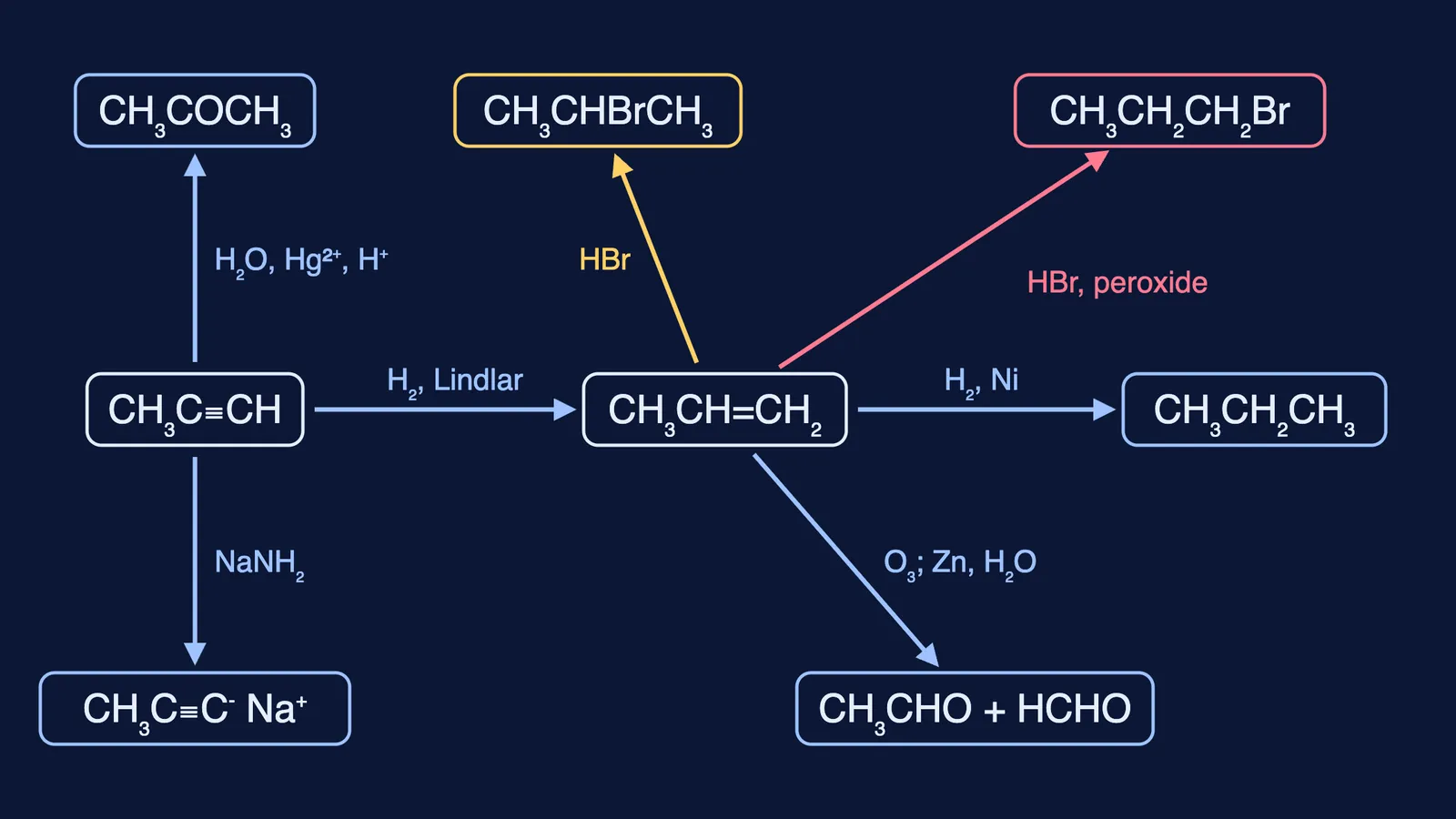
HBr alone (Markovnikov). Propene takes up H+ at the CH2 end, which leaves the more stable secondary carbocation. Bromide then joins the middle carbon, giving 2-bromopropane.
HBr with a peroxide (anti-Markovnikov). Now a bromine radical adds first, to the CH2 end, so the more stable secondary radical forms. The product is 1-bromopropane. The NCERT chapter notes that this effect is not seen with HCl or HI, a favourite trap.
Ozonolysis (O3, then Zn and water). Cut the double bond and put an oxygen on each carbon. Propene gives ethanal and methanal; 2-methylpropene gives propanone and methanal. Expect to work backwards from the products to the double bond.
Terminal alkynes are weak acids. A hydrogen on an sp carbon (50% s character) leaves as a proton more easily than one on an sp2 or sp3 carbon, so propyne reacts with sodium amide and but-2-yne, which has no such hydrogen, does not.
Two more to know cold: Lindlar's catalyst stops an alkyne at the cis alkene, and an alkyne with water over Hg2+ and acid gives a carbonyl compound (propyne gives propanone).
How do you check aromaticity and predict substitution in benzene?
Hückel's rule, as the NCERT chapter states it, needs three things: the ring must be flat, its pi electrons must be spread all the way round it, and their number must fit (4n + 2). Count them every time:
Benzene: planar, 6 pi electrons (n = 1). Aromatic.
Cyclooctatetraene: 8 pi electrons and not planar. Not aromatic.
Cyclopentadiene: one sp3 CH2 breaks the loop. Not aromatic. Remove a proton and the anion has 6 pi electrons over a planar ring, so it is aromatic.
For substitution, ask whether the group already on the ring pushes electrons in or pulls them out. Groups such as -OH, -NH2 and -CH3 activate the ring and send the new group to ortho and para positions, so nitrating toluene gives a mix of 2- and 4-nitrotoluene. Groups such as -NO2, -CHO, -COOH and -CN deactivate it and direct meta, so nitrating nitrobenzene gives 1,3-dinitrobenzene. Halogens are the odd case: they slow the reaction but still direct ortho and para. If the electron-pushing part feels like memorising, our chemical bonding preparation guide covers the resonance picture underneath it.
What are the common traps in Hydrocarbons questions?
Applying the peroxide effect to HCl or HI.
Forgetting that methanal appears when a terminal CH2 is cut in ozonolysis.
Calling every cyclic, conjugated ring aromatic without checking planarity and the electron count.
Treating halogens as meta directors because they deactivate.
In Newman projections, mixing up which conformation of ethane is lower in energy: staggered is.
How should you plan practice for Hydrocarbons?
Days 1-3: read the NCERT chapter and redraw the reaction map above from memory, first with propene, then with but-1-ene.
Days 4-6: 10 reaction-prediction questions a day, writing the intermediate before the product.
Days 7-9: ozonolysis in reverse and alkyne distinction questions.
Days 10-12: aromaticity counting and directing effects on disubstitution.
Days 13-14: timed past-paper questions, then log every miss by trap type. Our post on how to use previous year questions shows how to turn that log into the next week's work.
When you get the product wrong and cannot see why, the Fermi Problem Library has worked problems with a step-by-step solver that explains the reasoning rather than printing an answer. For a gap like hyperconjugation, the Fermi Concept Library covers every concept in physics, chemistry, biology, mathematics and computing, each with its own lesson and its place in the map.
Start today with propene and four reagents; the rest of the chapter follows the same logic.