On this page
This chapter is small, factual and full of short numericals, so a tidy method beats long hours.
What does Unit 13 of the JEE Main syllabus cover?
The NTA "Syllabus for JEE (Main) - 2027" (from jeemain.nta.nic.in) lists Chemistry Unit 13 as Purification and Characterisation of Organic Compounds: purification methods and their principles, detection of N, S, P and halogens, estimation of C, H, N, halogens, S and P, and empirical and molecular formula numericals.
In the 2026-27 reprint of NCERT Class 11 Chemistry, Unit 8, that is sections 8.8, 8.9 and 8.10. The rest of Unit 8 is in our guide to GOC for JEE Main.
How do you choose the right purification method?
Each method in NCERT 8.8 exploits one difference between compound and impurity. Ask which one you have:
Crystallisation: a solid sparingly soluble in a solvent when cold, fairly soluble when hot. Activated charcoal removes colour; impurities of similar solubility need repeated crystallisation.
Sublimation: a solid that vaporises without melting, mixed with one that does not.
Simple distillation: a volatile liquid from a non-volatile impurity, or boiling points far apart (chloroform, 334 K, and aniline, 457 K).
Fractional distillation: boiling points close together, as in crude oil.
Distillation under reduced pressure: very high boiling points, or liquids that break down before they can boil normally (glycerol from spent-lye).
Steam distillation: steam-volatile and immiscible with water, such as aniline. The mixture boils when the two vapour pressures add up to atmospheric pressure, so below 373 K.
Differential extraction: a compound more soluble in an organic solvent immiscible with water.
Chromatography: components adsorbed or partitioned to different extents.
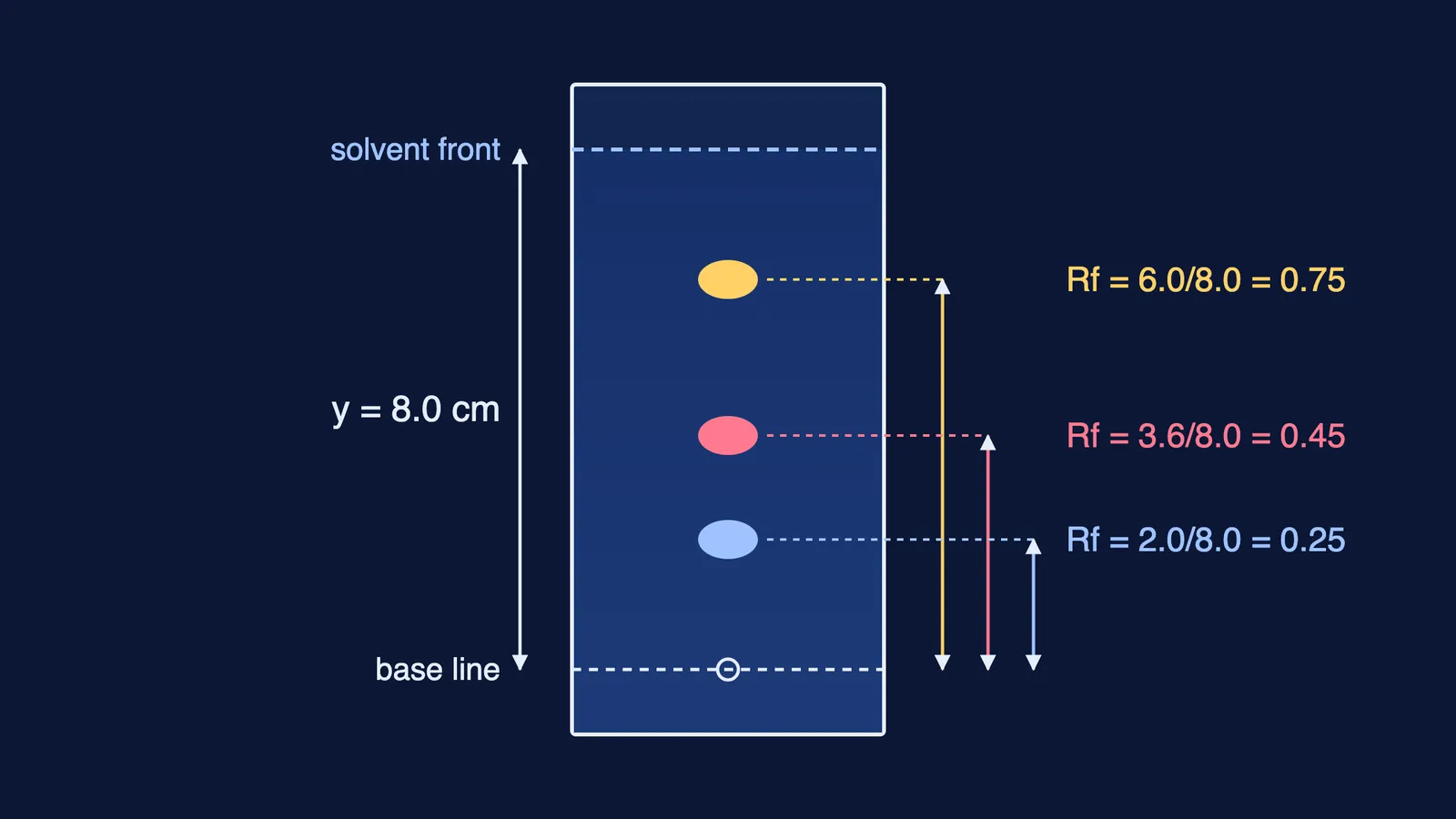
For chromatography, the retardation factor is Rf = distance moved by the substance from the base line ÷ distance moved by the solvent from the base line (NCERT, section 8.8.5). With the solvent front 8.0 cm above the base line, spots at 6.0, 3.6 and 2.0 cm give Rf values of 0.75, 0.45 and 0.25. Measure from the base line, never the plate's edge; Rf can never exceed 1. For choosing a technique, see TLC vs column vs paper chromatography.
What colours does Lassaigne's test give?
Fusing with sodium turns N, S and halogens into NaCN, Na2S and NaX, extracted into water (NCERT, section 8.9.2):
Nitrogen: boil with iron(II) sulphate, then acidify with concentrated sulphuric acid. Prussian blue, iron(III) hexacyanidoferrate(II), confirms it.
Sulphur: acetic acid and lead acetate give black PbS; sodium nitroprusside gives violet.
Nitrogen and sulphur together: sodium thiocyanate gives blood red with Fe³⁺ and no Prussian blue, because no free cyanide is left. Excess sodium breaks thiocyanate into cyanide and sulphide.
Halogens: acidify with nitric acid (boil with concentrated nitric acid first if N or S is present, to destroy cyanide and sulphide), then add silver nitrate. White, soluble in ammonia: chlorine. Yellowish, sparingly soluble: bromine. Yellow, insoluble: iodine.
Phosphorus: heat the compound with sodium peroxide to form phosphate; nitric acid and ammonium molybdate then give yellow.
How do you solve Dumas, Kjeldahl and Carius numericals?
These follow NCERT section 8.10, where 22400 mL of N2 at STP weighs 28 g:
Dumas: 0.25 g gives 40.0 mL of moist N2 at 300 K and 747 mm (aqueous tension 27 mm), so dry pressure = 720 mm. Volume at STP = 273 × 720 × 40.0 ÷ (300 × 760) = 34.5 mL. Mass of N2 = 28 × 34.5 ÷ 22400 = 0.0431 g, so N = 17.2%.
Kjeldahl: ammonia from 0.40 g enters 25.0 mL of 0.50 M H2SO4; leftover acid takes 30.0 mL of 0.50 M NaOH. NaOH = 0.015 mol, so 0.0075 mol acid was unused and 0.0050 mol reacted, giving NH3 = 0.010 mol, N = 0.14 g and N = 35.0%.
Carius, halogen: 0.20 g gives 0.287 g AgCl (143.5 g/mol). Cl = 35.5 × 0.287 ÷ 143.5 = 0.071 g, so Cl = 35.5%.
Carius, sulphur: 0.32 g gives 0.466 g BaSO4 (233 g/mol). S = 32 × 0.466 ÷ 233 = 0.064 g, so S = 20.0%.
How do you get an empirical formula from combustion data?
0.22 g of a C, H, O compound (molar mass 88 g/mol) gives 0.44 g CO2 and 0.18 g H2O.
C = 12 × 0.44 × 100 ÷ (44 × 0.22) = 54.5%; H = 2 × 0.18 × 100 ÷ (18 × 0.22) = 9.1%; O = 36.4% by difference.
Mole ratio 4.55 : 9.09 : 2.27 = 2 : 4 : 1.
Empirical formula C2H4O (44 g/mol); 88 ÷ 44 = 2, so the molecular formula is C4H8O2.
A two-week practice plan
Days 1-3: write the "which difference?" list and the Lassaigne colours from memory; check against NCERT.
Days 4-7: five numericals a day, one per method, with units.
Days 8-10: timed mixed sets; log each error as concept or arithmetic. In Kjeldahl, check that one H2SO4 takes two NaOH.
Days 11-14: redo logged errors, then one final timed set.
When a numerical goes wrong, the Fermi Problem Library has worked problems with a step-by-step solver that explains the reasoning rather than printing an answer.