

On this page
All three techniques work the same way. You put the mixture on a stationary phase, let a solvent (the mobile phase) move over it, and the components separate because each is held back by a different amount. The NCERT Class 11 Chemistry textbook, Unit 8 sorts them into two families: adsorption chromatography (column and TLC) and partition chromatography (paper).
What is the difference between TLC, column and paper chromatography?
The difference is what does the holding back, and how big the job is. The details below come from NCERT Unit 8.
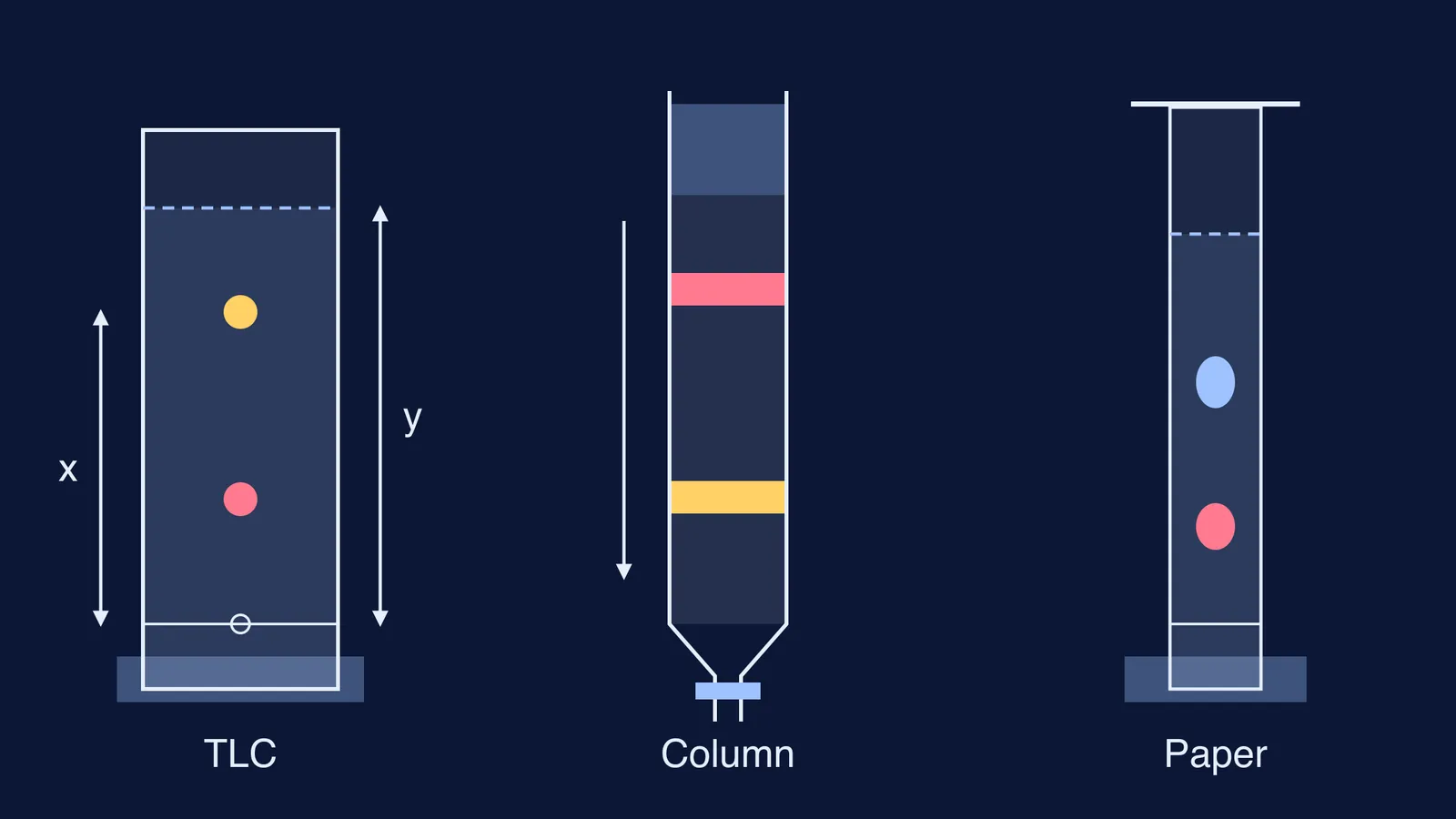
Column chromatography: the stationary phase is an adsorbent such as silica gel or alumina, packed in a glass tube with a stopcock at the bottom. A liquid eluant flows down slowly, and the components come down as separate bands.
Thin layer chromatography (TLC): the same kind of adsorbent, spread as a layer about 0.2 mm thick on a glass plate. The mixture goes on as a small spot about 2 cm above one end, and the solvent rises up the plate.
Paper chromatography: a special chromatography paper. The paper holds water, and that water is the stationary phase. The solvent rises up the paper by capillary action.
So TLC and column share a principle (adsorption on a solid), and paper uses partition. Chemguide describes paper's stationary phase as cellulose fibres with a very thin layer of water molecules bound to the surface.
How do the components actually move?
On an adsorbent, a compound that sticks strongly moves slowly, and one that sticks weakly travels further with the solvent. In a column, NCERT says the most readily adsorbed substances stay near the top while the others move down to different distances. On a TLC plate the same thing happens, just upwards.
On silica, polarity decides most of it. LibreTexts notes that a compound with a lower Rf tends to have more polar functional groups/02%3A_Chromatography/2.03%3A_Thin_Layer_Chromatography_(TLC)/2.3D%3A_Separation_Theory) than one with a higher Rf, and that making the mobile phase more polar makes every compound travel further.
On paper, NCERT explains, each component is held back according to how it partitions between the water in the paper and the moving solvent.
How do you calculate an Rf value?
NCERT defines the retardation factor as Rf = distance moved by the substance from the base line ÷ distance moved by the solvent from the base line. Because the solvent front is always ahead of every spot, Rf falls between 0 and 1.
Worked example (the TLC plate in the image above). A mixture of two compounds is run on a silica plate. The solvent front is 8.0 cm above the base line. Spot A is 6.0 cm up and spot B is 2.4 cm up.
Rf of A = 6.0 ÷ 8.0 = 0.75
Rf of B = 2.4 ÷ 8.0 = 0.30
B is held more strongly by the silica, so B is likely the more polar compound.
On a silica column with a similar solvent, you would expect A to come off first while B stays higher up the column.
Treat Rf as a guide, not a fingerprint. LibreTexts warns that Rf values should always be regarded as approximate/02%3A_Chromatography/2.03%3A_Thin_Layer_Chromatography_(TLC)/2.3C%3A_The_Retention_Factor), because ruler error and water in the plate change the result. Compare Rf values from the same plate and solvent.
If you keep getting a step like this wrong, the Fermi Problem Library has worked problems with a step-by-step solver that explains the reasoning rather than printing an answer.
When do you choose TLC, column or paper chromatography?
Is this sample pure, or is my reaction finished? Use TLC. It is used to assess purity and monitor a reaction/02%3A_Chromatography/2.03%3A_Thin_Layer_Chromatography_(TLC)/2.3B%3A_Uses_of_TLC), and the same page says that with a low-polarity solvent a plate can be complete in under 5 minutes.
I need to collect the pure compound. Use a column. It separates the mixture into fractions you can collect, and LibreTexts notes that a TLC is always run before a column/02%3A_Chromatography/2.04%3A_Column_Chromatography) to choose the solvent ratio.
I'm separating coloured dyes or amino acids. Use paper. For spots that still overlap, Chemguide describes two-way chromatography: turn the dried paper 90° and run it again in a second solvent.
Exam checklist: mistakes that cost marks
Measure both distances from the base line, not from the edge of the plate or paper.
If your Rf comes out above 1, you have swapped the two distances.
Don't call paper chromatography adsorption chromatography. It is partition.
Don't give an Rf value for column chromatography. In a column you collect bands.
Name the stationary phase correctly: silica gel or alumina for TLC and column, water in the paper for paper chromatography.
For the other purification methods in this unit, see our explainers on differential extraction with a separating funnel, distillation under reduced pressure and choosing a separation method for each mixture. If adsorption and partition still blur together, the Fermi Concept Library gives each concept its own lesson and its place in the map.


