

On this page
You have an organic compound dissolved in water and you want it back. Differential extraction is the Class 11 answer.
What is differential extraction?
NCERT defines it in section 8.8.4 of the Class 11 chemistry chapter Organic Chemistry: Some Basic Principles and Techniques: an organic compound in an aqueous medium is separated by shaking it with an organic solvent in which it is more soluble than in water. The two liquids must be immiscible, so they form two distinct layers that a separatory funnel can split. The solvent is then removed by distillation or evaporation to get the compound back.
If the compound is less soluble in the organic solvent, NCERT notes, a very large quantity of solvent would be needed, so continuous extraction reuses the same solvent again and again.
How do you use a separating funnel, step by step?
The routine below follows the step-by-step extraction procedure in Nichols' Organic Chemistry Lab Techniques/04:_Extraction/4.06:_Step-by-Step_Procedures_For_Extractions):
With the stopcock closed, pour in the aqueous solution and then the organic solvent. Put the stopper in.
Turn the funnel upside down and swirl gently.
Vent at once: with the funnel still inverted, open the stopcock briefly to release the pressure from evaporating solvent.
Shake gently for about 10 to 20 seconds, venting in between. Dichloromethane forms emulsions if shaken too hard.
Clamp the funnel upright and let the layers settle.
Remove the stopper so air can get in; otherwise the liquid will not drain.
Run the bottom layer out through the stopcock. Pour the top layer out through the neck.
For the funnel basics, see our explainer on separating oil and water with a separating funnel.
Why are several small extractions better than one big one?
The key quantity is the partition coefficient, K_D, the ratio of the compound's concentration in the organic layer to that in the water at equilibrium, as set out in David Harvey's Analytical Chemistry 2.1 chapter on liquid-liquid extractions/07:_Obtaining_and_Preparing_Samples_for_Analysis/7.07:_Liquid-Liquid_Extractions). For a compound that does not ionise, the same chapter gives the fraction left in the water after one extraction as V_aq ÷ (K_D × V_org + V_aq). After n extractions with fresh, equal portions, you raise that fraction to the power n, so the leftovers shrink geometrically.
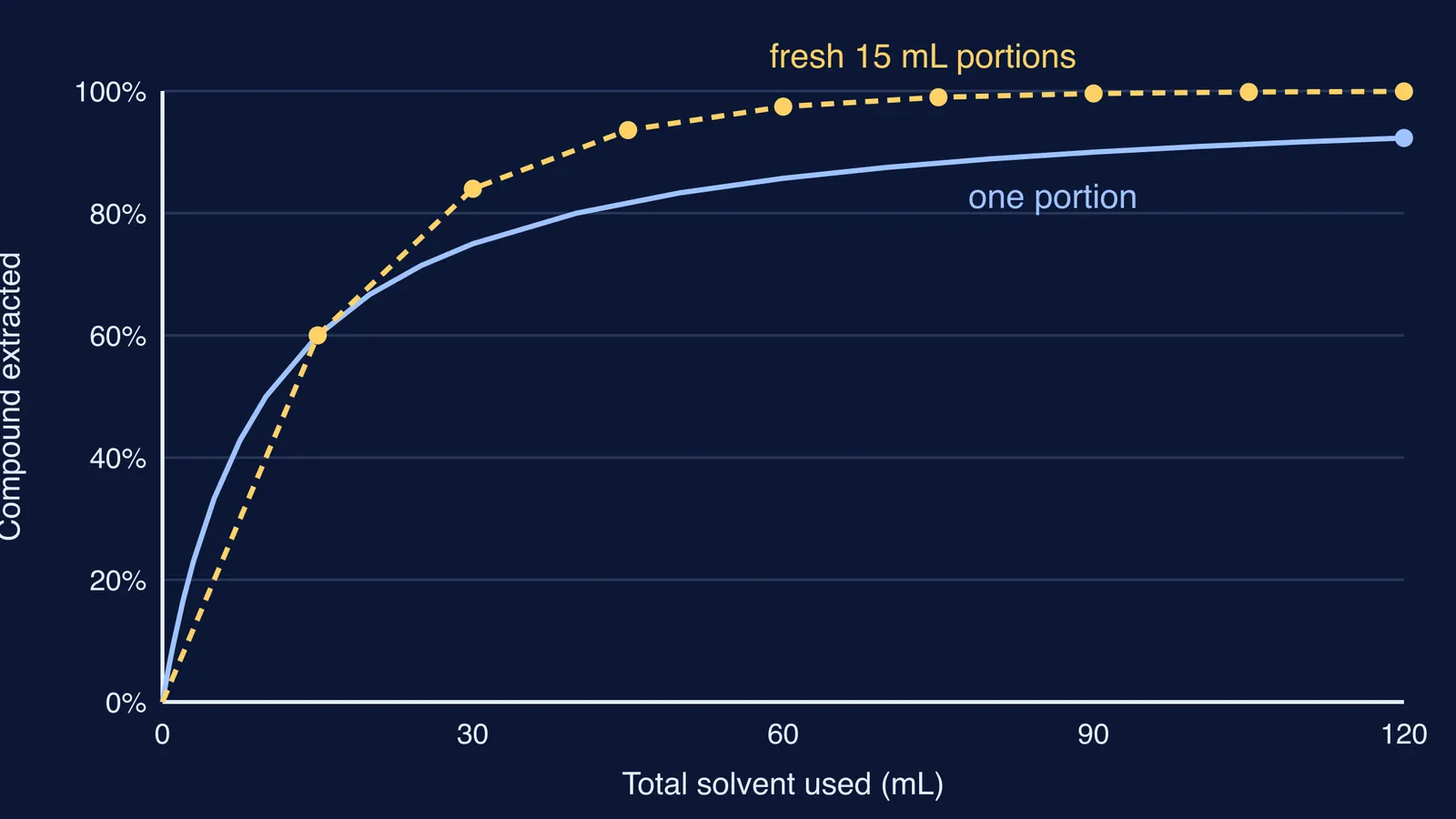
Harvey's worked example uses 50 mL of water, chloroform as the solvent and K_D = 5. The 5 mL and 45 mL lines are our own calculations.
One 15 mL portion: fraction left = 50 ÷ (5 × 15 + 50) = 0.4, so 60% is extracted.
The same 15 mL as three 5 mL portions: each leaves 50 ÷ 75 = 2/3. After three, (2/3)³ ≈ 0.30 is left, so about 70% is extracted. Same solvent, 10 more percentage points.
One 45 mL portion: 50 ÷ 275 ≈ 0.18 left, so about 82% is extracted.
Three 15 mL portions (45 mL in total): 0.4³ = 0.064 left, so 93.6% is extracted.
The gap widens at the top end. With 15 mL portions, eight extractions (120 mL in total) take out more than 99.9%. To reach 99.9% in a single step, the same formula needs about 9,990 mL of chloroform (Harvey's page prints 999 mL, but its own equation works out to 9,990 mL).
Harvey notes there is usually little improvement after five or six extractions.
How do you choose the extraction solvent?
Run through this checklist, using the NCERT criteria above and the layer guide in Nichols' lab techniques/04:_Extraction/4.04:_Which_Layer_is_Which):
Does the compound dissolve better in it than in water? A higher K_D means fewer rounds.
Is it immiscible with water? NCERT requires the two liquids to be immiscible; a solvent that mixes with water cannot form a second layer.
Is it easy to remove afterwards? The compound is recovered by distillation or evaporation, so a volatile solvent helps.
Will it sit on top or at the bottom? Diethyl ether has a density of 0.713 g/mL and floats on water; dichloromethane is 1.33 g/mL and sinks. Most non-halogenated solvents float; halogenated ones usually sink.
pH matters too. For a weak acid, Harvey uses a distribution ratio, D, in place of K_D: the acid extracts well when the pH is below its pKa and hardly at all well above it. Our post on separating benzoic acid, phenol, aniline and toluene by extraction uses exactly this idea.
How to practise this for exams
Write the fraction-left formula from memory, then rework the example with K_D = 2 and K_D = 10 and see how the advantage of splitting changes. If partition equilibrium feels shaky, the Fermi Concept Library has its own lesson for each chemistry concept. For numericals, the Fermi Problem Library has worked problems with a step-by-step solver that explains the reasoning rather than printing an answer.
Next, drill method choice with our guide to asking AI which method separates each mixture, then checking it.


