

On this page
When you mix oil and water, they refuse to blend, forming two distinct layers instead. These are called immiscible liquids. While you could try to carefully pour or skim the top layer off, that method is slow and rarely clean. For a precise separation, chemists use a simple but highly effective piece of glassware called a separating funnel.
This technique is not just for oil and water; it is a foundational skill in the chemistry lab, often appearing in Class 9 science and Class 11 organic chemistry under differential extraction.
How Does a Separating Funnel Work?
The principle behind a separating funnel is simple: immiscible liquids separate into layers based on their relative densities. Gravity does most of the heavy lifting.
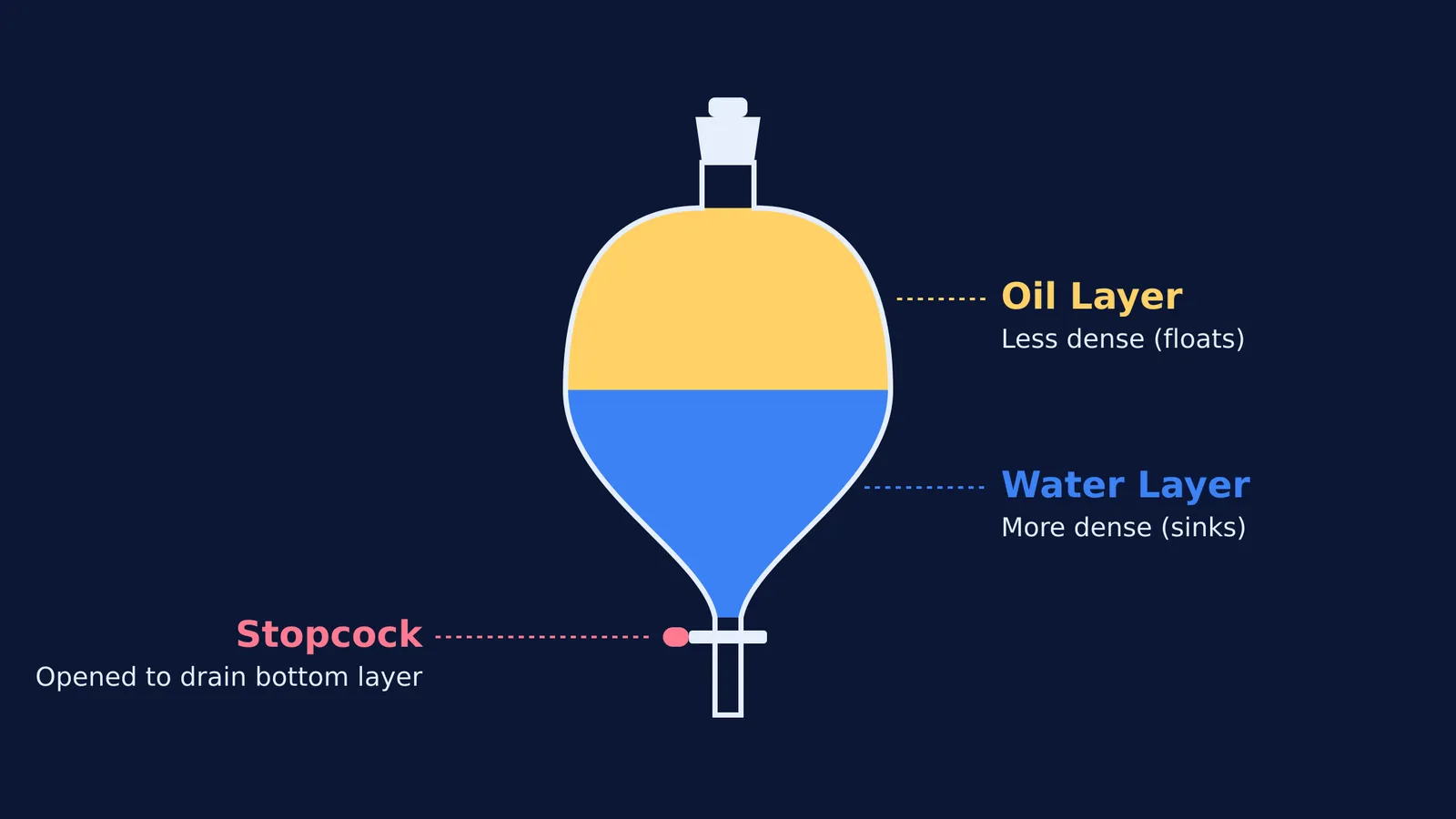
A separatory funnel is used in liquid-liquid extractions to separate the components of a mixture into two immiscible solvent phases of different densities. Because water is denser than most common oils and organic solvents (like ether or benzene), it sinks and forms the lower layer. The less dense oil forms the upper layer.
The funnel itself is shaped like an inverted teardrop or pear, wide at the top and tapering to a narrow tube at the bottom. This narrow stem is fitted with a stopcock—a small valve that can be opened to let liquid flow out and closed to stop it instantly.
How to Separate Oil and Water?
The process is straightforward, but timing is everything. Here is how it is done:
Fill and settle: Pour the oil and water mixture into the separating funnel (with the stopcock closed, of course). Let it stand undisturbed in a ring stand. Within a few minutes, the liquids will completely separate into two clear layers.
Drain the heavier liquid: Place a beaker under the stem and carefully open the stopcock. The heavier water layer at the bottom will begin to drain out.
Close at the boundary: Watch the interface (the line where the oil and water meet) closely as it travels down the funnel. Just as the last drop of water passes through the stopcock, close it.
Collect the lighter liquid: The water is now in the beaker, and the pure oil remains in the funnel, ready to be poured out from the top into a separate container.
What is Differential Extraction?
In Class 11 organic chemistry, this exact apparatus is used for differential extraction. This is a method used to separate an organic compound from an aqueous (water-based) solution by shaking it with an organic solvent in which the compound is more soluble.
For example, if you have an organic compound dissolved in water, you might add an immiscible organic solvent like chloroform or ether to the separating funnel. You stopper the funnel and shake it vigorously. The organic compound partitions or moves from the water into the organic solvent because it prefers to dissolve there.
After shaking, you let the funnel rest. The two liquids separate based on density, and you can drain the lower layer off. By evaporating the organic solvent later, you are left with the pure organic compound. This same reliance on density for separation isn't limited to glassware; it scales up to industrial levels, such as when lighter liquid slag is drained away from heavier molten iron (a concept explored further in Extracting metals for Class 10: roasting, calcination and reduction).
How Are Separating Funnels Tested in Exams?
Questions about separating funnels usually test your understanding of density and solubility. Use this checklist when tackling these problems:
Are they immiscible? The method only works if the liquids do not dissolve in each other. How soaps clean: micelles and hard water in Class 10 carbon is a great reminder of what happens when oil and water *are* forced to mix.
Which is denser? Always identify the denser liquid. It will be the bottom layer and the first to drain out. If you want to practice the physics of how such liquids balance against each other, try working through problems like Two immiscible liquids in a manometer: finding the unknown density.
What is the goal? Are you just separating two bulk liquids, or are you extracting a solute from one into the other (as in differential extraction)?
If you are studying extraction processes and want to test your understanding of fluid densities, the Fermi Problem Library has worked examples that guide you through the reasoning step-by-step. For a broader look at how physical properties drive separation techniques, you can explore the Fermi Concept Library.
Whether you are purifying an organic synthesis product or just looking at salad dressing, the separating funnel remains one of the most elegant and visual tools in chemistry.


