

On this page
You meet this method in Class 11 organic chemistry, in the chapter on purification techniques, and it turns up in entrance exams. In the JEE Main 2025 paper of 2 April, Shift 2, one matching question paired glycerol from spent lye with vacuum distillation. The whole idea rests on one fact about boiling, and once you have it you can answer these questions without memorising them.
What is distillation under reduced pressure?
A liquid boils when its vapour pressure equals the pressure pressing down on its surface. Lower that outside pressure and the liquid reaches it at a lower temperature, so it boils cooler.
The LibreTexts organic lab textbook puts it plainly: if the applied pressure is reduced, the boiling point of the liquid decreases/05:_Distillation/5.04:_Vacuum_Distillation/5.4A:_Overview_of_Vacuum_Distillation). The same page says vacuum distillation is used for compounds with a normal boiling point above 150 °C that may decompose if heated that far. Its everyday example: water boils at 100 °C at 760 mm Hg but at about 50 °C at 100 mm Hg.
In practice, you connect a vacuum source to an ordinary simple or fractional distillation set-up, and the liquid distils at a temperature it can survive.
Why is glycerol distilled under reduced pressure?
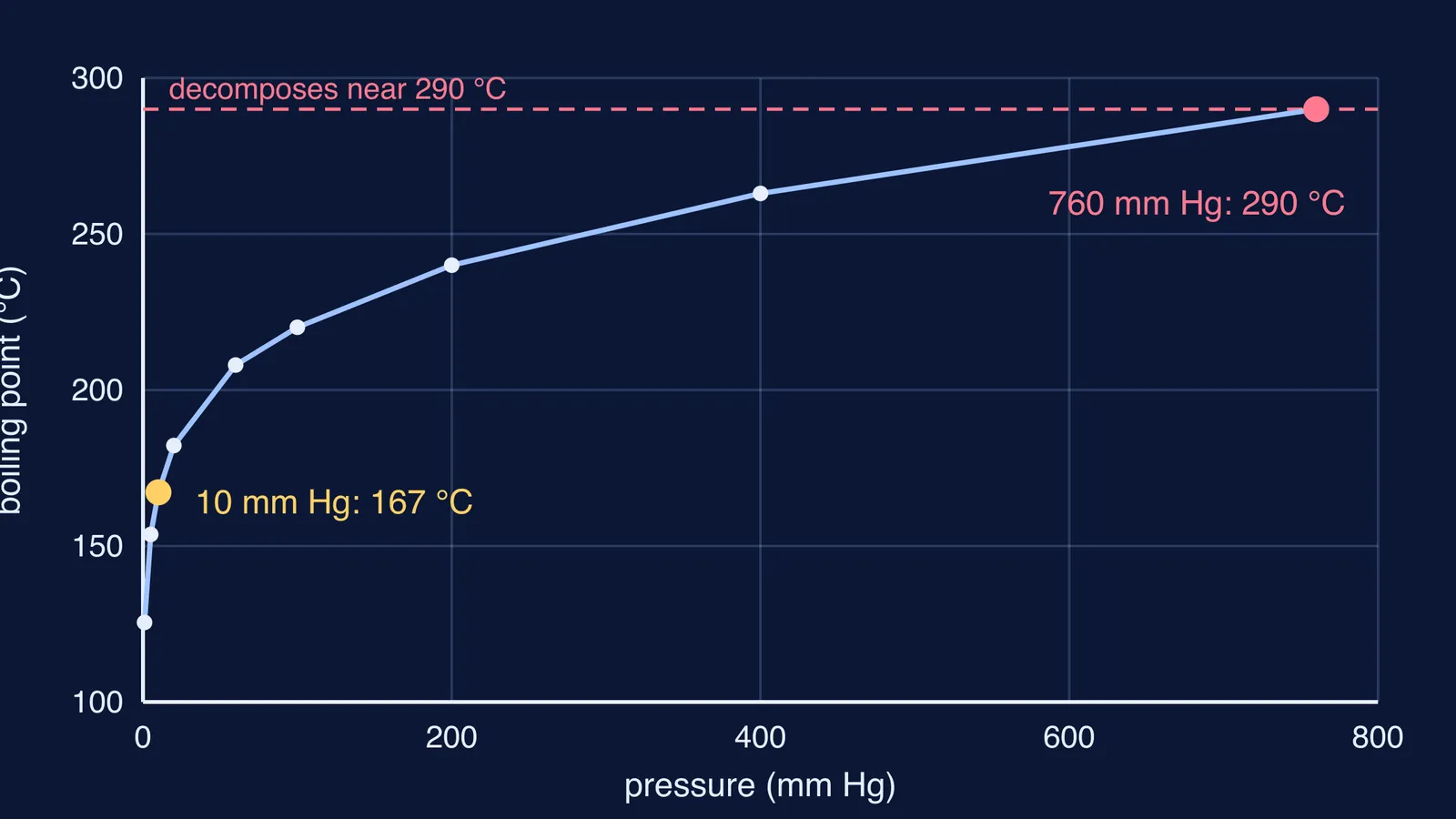
Glycerol has a boiling point of 290 °C, and the Merck Index marks it as decomposing at that temperature, as listed on PubChem's glycerol record. Heat it to its normal boiling point and part of what you wanted to purify breaks down.
The same PubChem record lists Merck Index boiling points for glycerol at lower pressures:
760 mm Hg (normal atmosphere): 290 °C, with decomposition
100 mm Hg: 220.1 °C
20 mm Hg: 182.2 °C
10 mm Hg: 167.2 °C
1 mm Hg: 125.5 °C
That is the reason soap makers recover glycerol from spent lye, the liquid left over after soap-making, by vacuum distillation, the pairing the JEE question tested.
How do you estimate the boiling point at a lower pressure?
You can predict the new boiling point with the Clausius–Clapeyron equation: ln(P1/P2) = (ΔH/R)(1/T2 − 1/T1), where ΔH is the enthalpy of vaporisation and temperatures are in kelvin. Here is a worked example using the Merck Index values from PubChem.
Take two known points: 760 mm Hg at 290 °C (563.15 K) and 100 mm Hg at 220.1 °C (493.25 K).
Work out the reciprocals: 1/563.15 = 0.0017757 and 1/493.25 = 0.0020274 per kelvin. The difference is 0.00025165.
Find ΔH/R: ln(760/100) = ln 7.6 = 2.028, and 2.028 ÷ 0.00025165 gives about 8059 K. Multiply by R = 8.314 J/(mol K) and ΔH comes out near 67 kJ/mol.
Predict the boiling point at 20 mm Hg: 1/T = 0.0017757 + ln(38) ÷ 8059 = 0.0017757 + 0.0004514 = 0.0022271, so T is about 449 K, or 176 °C.
Compare with the measured value: 182.2 °C. You are within about 6 °C.
The gap is worth noticing. The equation assumes ΔH stays constant, which is only roughly true across a range of more than 100 °C. For an exam, the method is what earns marks; for a real distillation, chemists read measured values or a pressure–temperature chart.
To practise more numericals like this, the Fermi Problem Library has worked problems with a step-by-step solver that explains the reasoning rather than printing an answer.
Vacuum, steam or fractional distillation: which one?
The JEE Main question above is a good checklist, because it set four mixtures against four methods:
Two liquids with boiling points far apart, such as chloroform and aniline: simple distillation.
Liquids with close boiling ranges, such as petrol and diesel: fractional distillation.
A liquid that does not mix with water but is volatile in steam, such as aniline with water: steam distillation.
A liquid with a high boiling point that decomposes near it, such as glycerol from spent lye: distillation under reduced pressure.
Steam distillation also lets a liquid distil below its normal boiling point, but for a different reason, which we explain in the principle of steam distillation. The pressure side is easiest to see in why water boils at a lower temperature in the mountains and in why water boils when a flask is cooled under reduced pressure.
Those steps come from the LibreTexts vacuum distillation summary/07%3A_Technique_Summaries/7.23%3A_Vacuum_Distillation). Try them only with your teacher in a school lab.
If vapour pressure itself still feels shaky, start there: the Fermi Concept Library covers every concept in physics, chemistry, biology, mathematics and computing, each with its own lesson. Then come back to glycerol, and the method will read as one sentence: lower the pressure, lower the boiling point, keep the molecule whole.


