

On this page
What is the principle of steam distillation?
When purifying organic compounds, standard distillation separates liquids by boiling them until their vapour pressure matches the surrounding atmosphere. However, many valuable organic substances decompose, polymerise, or oxidise well before reaching their normal boiling points. When reviewing laboratory separation techniques from distillation to chromatography, chemists turn to steam distillation for compounds that are insoluble in water but possess appreciable vapour pressure at temperatures near 100 °C.
According to the official NCERT Class 11 Chemistry curriculum, steam distillation operates on a simple thermodynamic foundation: the behaviour of immiscible liquids. Unlike miscible solutions, where solute-solvent interactions lower each component's escaping tendency according to Raoult’s law, immiscible liquids do not dissolve in each other. Each liquid exists as an independent phase and evaporates into the common vapour space as if the other liquid were completely absent.
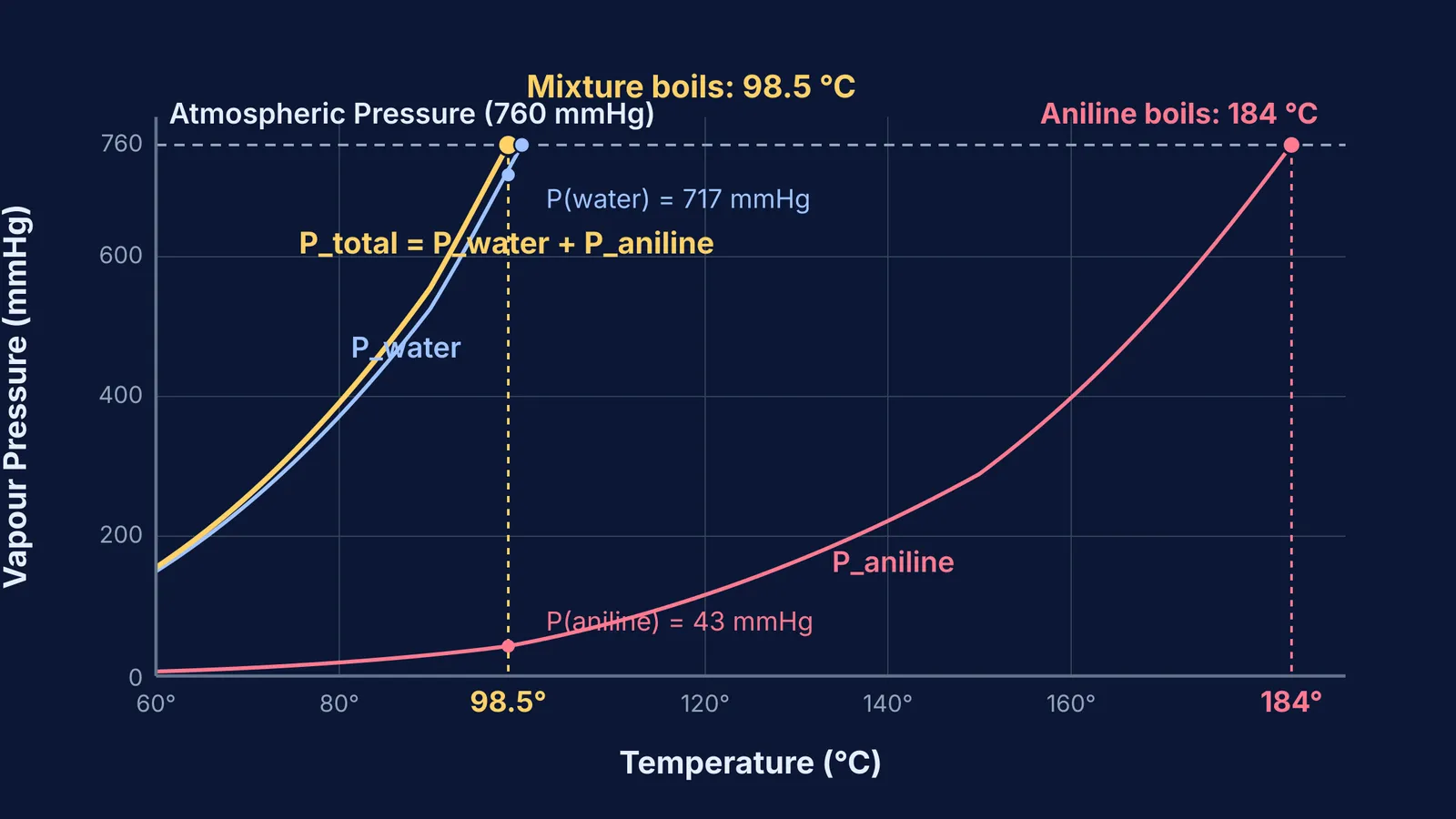
By Dalton’s law of partial pressures, the total vapour pressure (P_total) above the heterogeneous boiling mixture equals the direct sum of the individual saturated vapour pressures:
P_total = P_water + P_organic
Boiling begins the moment P_total equals the external atmospheric pressure (760 mmHg at sea level). Because both water and the organic liquid contribute positive vapour pressures to the shared headspace, the mixture reaches atmospheric pressure at a temperature strictly below the boiling point of pure water (100 °C) and far below the boiling point of the organic substance.
Why does the mixture boil below 100 °C?
To understand why the boiling point drops below 100 °C, consider what happens when water boils by itself. According to thermochemical data from the NIST Chemistry WebBook for Water, pure water must be heated to 100 °C (373.15 K) for its vapour pressure to reach 760 mmHg. If you heat pure aniline instead, data from the NIST Chemistry WebBook for Aniline shows its normal boiling point is 184.1 °C (457.1 K). Heating aniline to 184.1 °C in air triggers severe oxidation and thermal decomposition, turning the clear liquid into dark resinous tars.
In steam distillation, water and aniline are heated together. As the temperature rises toward 98.5 °C, water generates a vapour pressure of approximately 717 mmHg. Simultaneously, aniline exerts its own saturated vapour pressure of approximately 43 mmHg. When you sum these two pressures:
717 mmHg + 43 mmHg = 760 mmHg
The total vapour pressure reaches 760 mmHg at 98.5 °C. Because bubbles of vapour can now overcome atmospheric pressure, the mixture vigorously boils and co-distils at 98.5 °C. Aniline is carried over in the vapour phase at a temperature 85.6 °C below its normal boiling point, completely shielded from thermal degradation. If you want to visualize how vapour pressure curves intersect total pressure thresholds across multicomponent systems, the Fermi Concept Library maps every concept in physics, chemistry, biology, mathematics and computing, each with its own lesson and its place in the map.
How do you calculate the distillate composition?
A frequent question in competitive examinations is determining the ratio of the organic substance to water in the collected distillate. Because both components exist as ideal gases in the shared vapour phase, the mole ratio of the two substances in the vapour equals the ratio of their partial pressures:
n_organic / n_water = P_organic / P_water
Since number of moles equals mass (m) divided by molar mass (M), this relationship transforms into a practical mass ratio:
(m_organic / M_organic) / (m_water / M_water) = P_organic / P_water
Rearranging gives the standard mass ratio equation:
m_organic / m_water = (P_organic × M_organic) / (P_water × M_water)
Using vapour pressure data from the NIST Chemistry WebBook, let us calculate the exact distillate composition for the aniline-water system at 98.5 °C:
Identify the partial pressures: P_water = 717 mmHg and P_aniline = 43 mmHg.
Note the molar masses: M_water = 18.02 g/mol and M_aniline = 93.13 g/mol.
Compute the mass ratio: m_aniline / m_water = (43 × 93.13) / (717 × 18.02) = 4004.6 / 12920.3 ≈ 0.31.
Calculate water required: m_water / m_aniline ≈ 12920.3 / 4004.6 ≈ 3.23.
Determine the mass percentage: (1 / (1 + 3.23)) × 100% ≈ 23.6% aniline by mass.
Even though aniline provides only about 5.7% of the total vapour pressure (43 mmHg out of 760 mmHg), its high molar mass (93.13 g/mol compared to water's 18.02 g/mol) compensates significantly. Each 3.23 g of steam carries roughly 1.0 g of aniline into the condenser. The Fermi Problem Library provides worked problems with a step-by-step solver that explains the reasoning rather than printing an answer, helping students master these multi-step stoichiometry calculations.
When should you use steam distillation instead of other methods?
Not every water-insoluble compound is suitable for steam distillation. In laboratory practice and chemical education literature, such as studies published in the Journal of Chemical Education, steam distillation requires strict boundary conditions.
Use this 4-step checklist when evaluating whether steam distillation applies to a given mixture:
Immiscibility with water: The target compound must be practically insoluble in water. If it dissolves, Raoult's law applies, raising the boiling point.
Steam volatility: The compound must exert a meaningful vapour pressure (generally at least 5 to 10 mmHg) near 95 °C to 100 °C. Without this pressure, thousands of grams of steam would be needed to carry a single gram of product.
High normal boiling point: The compound should boil well above 100 °C, especially if it tends to decompose at its boiling point.
Non-volatile impurities: The crude material must contain non-volatile or water-soluble impurities that remain trapped in the boiling flask while steam carries the pure compound over.
In standard synthetic preparations, such as reducing nitrobenzene to aniline, steam distillation isolates the aniline product directly from iron sludge and acidic salts. Once condensed, aniline forms a distinct oily layer beneath the water that is cleanly separated using a separating funnel. The same physical principle explains why intramolecular hydrogen bonding allows ortho-nitrophenol to steam-distil rapidly while intermolecularly bonded para-nitrophenol remains behind in the flask.


