

On this page
If you boil water in a round-bottom flask, remove the heat, seal the neck tightly with a rubber stopper, and let it stand, bubbling stops. As documented in classic demonstration studies by Isay Balinkin in the American Journal of Physics, the water cools slightly below 100 °C into a quiet liquid. But if you invert the flask and pour cold water or place ice over the glass dome, the liquid inside suddenly begins to boil vigorously again.
This counterintuitive demonstration, historically known as Franklin's flask, challenges the common assumption that boiling requires heating. Most expect cold water to chill the liquid and halt motion. Instead, large steam bubbles roil to the surface, distinct from the dissolved gas pockets examined in our guide on why small bubbles appear before boiling.
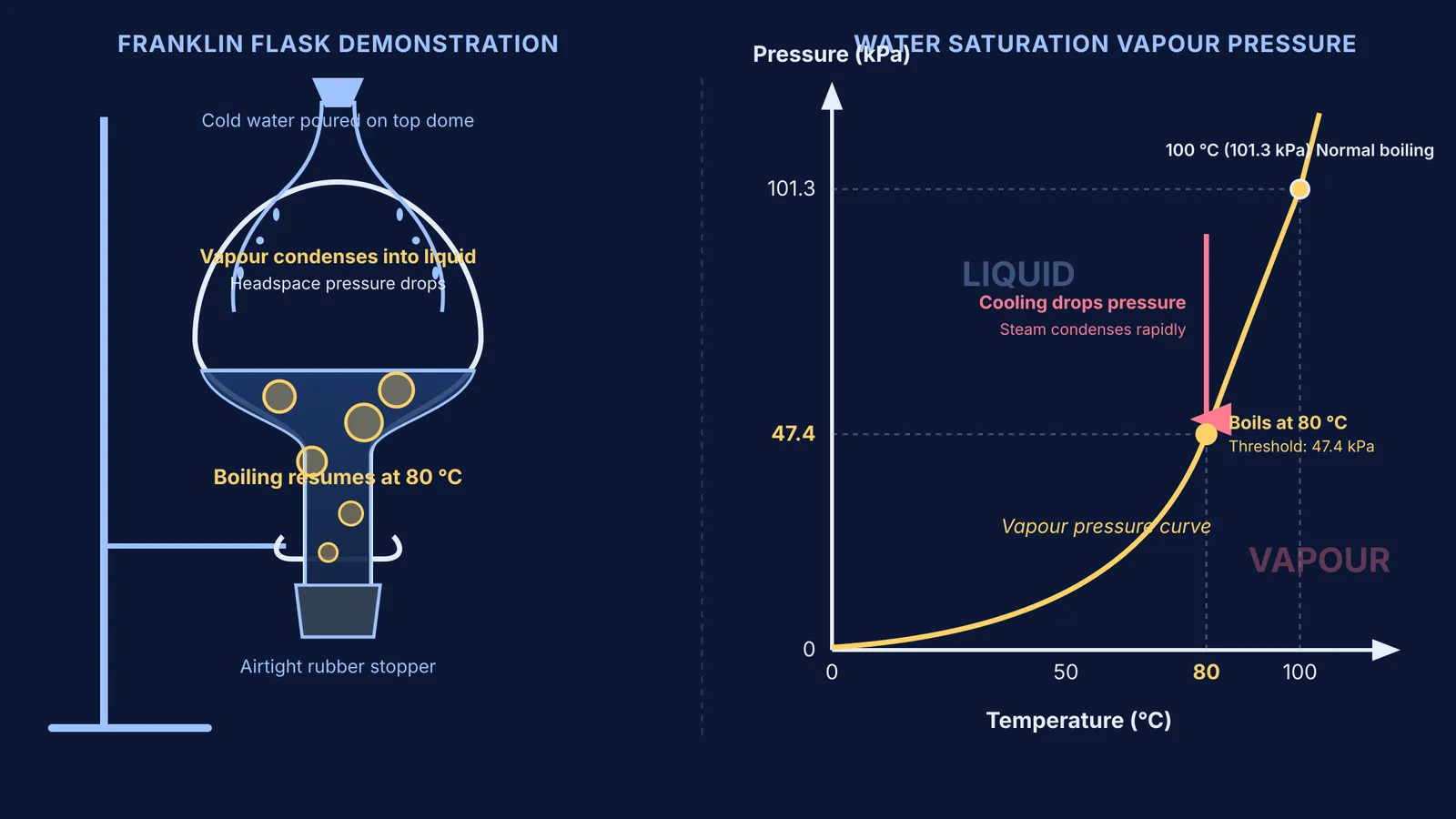
The reaction occurs because cold water chills the vapor space rather than the liquid bulk. Before sealing, boiling water drove out atmospheric air, leaving the flask headspace filled with pure water vapor. When cold water contacts the outside glass, this trapped steam rapidly condenses into liquid droplets. Because steam at atmospheric pressure occupies over 1,600 times the volume of liquid water—meaning the condensed liquid occupies less than 0.1% of the original steam volume, according to thermophysical data in the NIST Chemistry WebBook—rapid condensation creates a partial vacuum that drops internal pressure in seconds, following the vapor-liquid phase equilibrium described in OpenStax Chemistry 2e.
Why does lower pressure cause water to boil at cooler temperatures?
Boiling is not defined by temperature alone. According to OpenStax Chemistry 2e, boiling occurs when the equilibrium vapor pressure of a liquid equals the external pressure exerted on its surface by the surrounding gas.
At sea level, the standard atmospheric pressure is 101.325 kPa, and water reaches an equilibrium vapor pressure of 101.325 kPa at 100 °C, establishing its normal boiling point as documented in the NIST Chemistry WebBook. At higher elevations where atmospheric pressure is lower, water boils at reduced temperatures, as detailed in our guide on how air pressure falls with altitude.
The saturation properties of water trace a steep thermodynamic curve:
At 100 °C, water vapor pressure is 101.3 kPa, as recorded in the NIST Chemistry WebBook.
At 80 °C, water vapor pressure drops to 47.4 kPa, according to thermophysical data in the NIST Chemistry WebBook.
At 60 °C, water vapor pressure is 19.9 kPa.
At 25 °C, water vapor pressure is 3.17 kPa.
When the sealed flask cools to 80 °C, boiling ceases because trapped headspace pressure initially exceeds 47.4 kPa. When cold water poured onto the glass drops headspace pressure below 47.4 kPa, the liquid's vapor pressure immediately overcomes overhead pressure. Bubbles of steam form spontaneously throughout the liquid bulk, boiling the water while it continues to cool.
How can you test the pressure drop step by step?
You can examine this pressure drop through a structured four-step procedure:
Displace all non-condensable air. Boil roughly 150 ml of water in a 500 ml round-bottom borosilicate flask for two minutes so vigorous steam sweeps out atmospheric nitrogen and oxygen. This fills the headspace with pure water vapor rather than non-condensable gases, fulfilling the vapor-pressure equilibrium conditions described in OpenStax Chemistry 2e and the apparatus protocol documented by Isay Balinkin in the American Journal of Physics. If air remains trapped, cooling cannot generate a strong vacuum.
Seal and record the baseline. Insert a solid rubber stopper firmly into the neck, remove the heat, and invert the flask on a ring stand. As the water cools to roughly 85 °C, boiling stops because its vapor pressure (57.8 kPa according to the NIST Chemistry WebBook) cannot overcome the enclosed headspace pressure.
Apply localized cooling to the headspace. Pour a stream of 15 °C water or apply ice specifically over the inverted bulb, leaving the lower liquid undisturbed. Watch the inner dome: steam condenses into micro-droplets, causing internal pressure to drop toward the saturation pressure of cold glass.
Observe bubble nucleation and renewed boiling. As internal pressure plunges below 57.8 kPa, vigorous boiling resumes at 85 °C. Boiling continues until evaporating steam restores pressure or latent heat loss cools the water below the new equilibrium threshold, a balance identical to subtracting water vapour pressure in closed systems.
Why should you predict the outcome before running the experiment?
Watching a demonstration without active thinking rarely produces lasting comprehension. In a landmark physics education study published in the American Journal of Physics, researchers Catherine Crouch, Adam Fagen, J. Paul Callan, and Eric Mazur found that students who passively observed classroom demonstrations understood underlying concepts no better than students who saw no demonstration at all. In contrast, students who were required to write down their predictions before observing the demonstration demonstrated significantly higher conceptual understanding on subsequent evaluations.
Committing to a prediction forces you to expose implicit mental models. If you instinctively assume that boiling always requires adding heat, predicting the effect of cold water reveals the gap between heat transfer and pressure equilibrium.
For students exploring thermodynamics and phase transitions, visual tools bridge this gap between abstract equations and physical phenomena. The Fermi Simulation Lab provides interactive simulations for the ideas that are easier to see than to read, helping learners test predictions about pressure, phase transitions, and boiling before watching the outcome.
To build deeper problem-solving mastery across related topics in kinetic theory and states of matter, the Fermi Concept Library offers lessons covering every concept in physics, chemistry, biology, mathematics and computing, each with its own lesson and its place in the map.


