

On this page
When you place a pot of cold tap water on the stove, you do not have to wait for it to boil to see action. Long before the water reaches a rolling boil, tiny bubbles appear and cling to the sides of the pot.
Many people assume these early bubbles are steam, but they are actually pockets of air. The sequence of events in a heating pot is a perfect demonstration of two physical principles: the changing solubility of gases, and the exponential rise of vapour pressure.
Why does air escape as water warms?
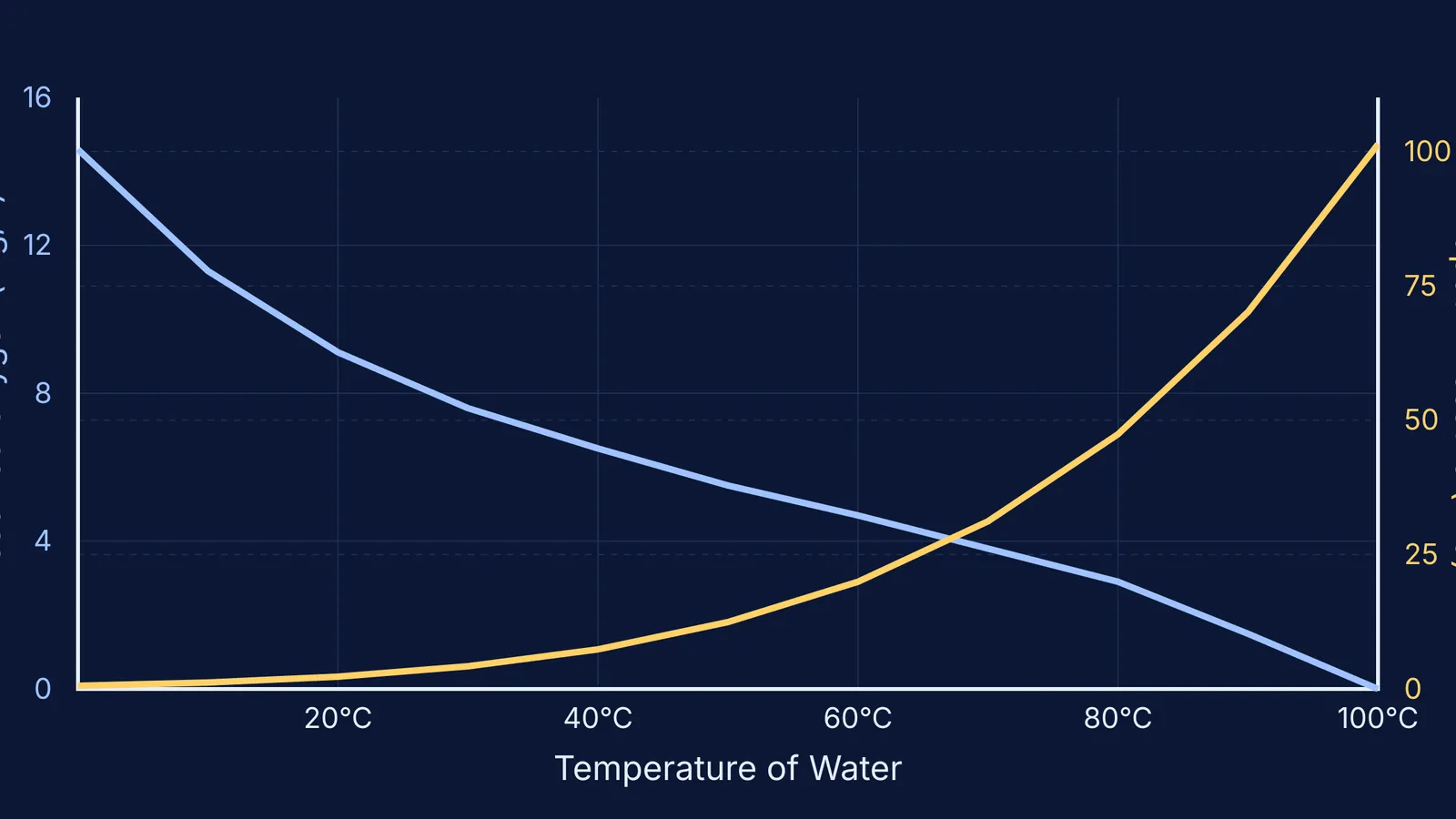
Cold water from your tap holds dissolved atmospheric gases, primarily nitrogen and oxygen. According to data from the Engineering ToolBox, freshwater at 20 °C holds about 9.1 mg/L of dissolved oxygen (source).
As the water's temperature rises, the water molecules gain kinetic energy. They move faster and jostle more violently, making it harder for the dissolved gas molecules to stay trapped in the liquid. By the time the water reaches 40 °C, its capacity to hold oxygen drops to 6.5 mg/L.
The air that can no longer remain dissolved is forced out of the solution. It collects at microscopic scratches and imperfections on the pot's inner surface, known as nucleation sites. These early, stationary bubbles are simply the trapped air making its escape. This behaviour follows the same rules taught in Henry's law and the solubility of gases, which dictates how pressure and temperature govern dissolved gases.
This temperature dependence is also why warming bodies of water can be dangerous for aquatic life. As rivers and lakes heat up during the summer, they hold less dissolved oxygen, making it harder for fish to breathe. In your kitchen pot, you are seeing this same principle play out as a physical demonstration.
The hissing stage: what are the next bubbles?
As the water continues to heat and nears its boiling point, a second type of bubble begins to form. These originate at the very bottom of the pot, directly over the heat source.
These bubbles are indeed water vapour (steam). The metal at the bottom of the pot is much hotter than the water above it, so the water in direct contact reaches the boiling point locally. Steam bubbles form and detach, but as they rise into the slightly cooler water above, they cannot survive.
The vapour inside them cools, condenses back into liquid water, and the bubble collapses violently. This rapid formation and implosion of steam bubbles creates the characteristic hissing or singing sound a kettle makes just before it fully boils.
When does water truly boil?
A liquid only boils when its vapour pressure—the outward push of its molecules trying to become a gas—equals the atmospheric pressure pushing down on it from the air above.
At room temperature (20 °C), water's vapour pressure is a mere 2.3 kPa, according to the Engineering ToolBox (source). The atmosphere pushes down with a much heavier 101.3 kPa, keeping the liquid firmly in place. However, vapour pressure rises sharply with temperature.
At exactly 100 °C, the vapour pressure of water reaches 101.3 kPa. The push from the water vapour now perfectly balances the atmospheric pressure pushing down. At this point, steam bubbles can form anywhere in the bulk of the liquid and survive the entire journey to the surface.
This is why a rolling boil is so turbulent. The water is converting to gas rapidly, and because the internal pressure of each bubble is equal to the pressure of the room, they do not collapse. They expand as they rise and burst at the surface, releasing steam into the air. If you were to carry your pot up a mountain where the atmospheric pressure is lower, the vapour pressure would overcome it at a lower temperature—a classic scenario in ideal gas problems.
Picturing phase changes
Transitions from dissolved gas escaping to local cavitation and finally a rolling boil are fundamental to thermodynamics. For students trying to master phase changes and vapour pressure, seeing the graphs move and the pressures balance can be more powerful than reading a textbook page.
The Fermi Simulation Lab has interactive simulations for the ideas that are easier to see than to read. You can raise the heat, watch the vapour pressure climb, and see exactly when it overcomes atmospheric pressure.


