On this page
Physics and Measurement opens NEET physics and supplies the toolkit for every later unit. Here is the syllabus, the NCERT map (with its gaps), three worked examples and a two-week plan.
What does the NEET syllabus include in Physics and Measurement?
The NMC's NEET (UG)-2026 syllabus, sent to medical colleges on 22-12-2025, lists Physics Unit 1, Physics and Measurement, as: units of measurement, system of units, SI units, fundamental and derived units, least count, significant figures, errors in measurements, dimensions of physical quantities, dimensional analysis and its applications. Vernier calipers and the screw gauge sit in Unit 20, Experimental Skills. No 2027 syllabus is on the NTA NEET site yet, so check there before you lock your plan.
Where is it in the 2026-27 NCERT book, and what is missing?
It maps to Chapter 1, Units and Measurement of NCERT Class 11 Physics Part I (Reprint 2026-27).
Two syllabus items have no section of their own there:
Least count gets one passing mention in Section 1.3 and no explanation. Learn it from your practicals: it is the smallest value an instrument can read.
Errors in measurement appear only as the rules in Section 1.3.3: relative error, and how errors combine in a product. Practise absolute, relative and percentage error anyway.
How is Physics and Measurement tested in NEET?
As in NEET-UG 2026, the NTA information bulletin set 180 compulsory questions in 180 minutes, with 45 Physics questions worth 180 marks. Each question is a multiple-choice question with four options and a single correct or best answer, marked +4 if right, -1 if wrong and 0 if left blank.
That is about a minute per question: recall dimensional formulae instantly and strike out options that fail a dimension check.
How do you solve these questions fast?
Example 1: dimensions of a ratio. A force on a bead is F = k v² + c/x, where v is speed and x is distance. What are the dimensions of c/k? Options: [L³ T⁻²], [M L² T⁻²], [L T⁻²], [M L⁻¹].
Each term in a sum has the dimensions of F, [M L T⁻²]. So k = F/v² = [M L⁻¹] and c = F x = [M L² T⁻²], giving c/k = [L³ T⁻²]. The trap is [M L² T⁻²], which is c alone.
Example 2: maximum percentage error. A metal rod's density is found from ρ = 4m / (π d² L). Mass m = 10.0 g (±0.1 g), diameter d = 4.00 mm from a screw gauge of least count 0.01 mm, length L = 10.00 cm from a vernier of least count 0.01 cm. Maximum percentage error in ρ? Options: 1.35%, 1.6%, 2.1%, 2.6%.
Percentage errors add, each multiplied by its power: 1% from mass, 2 × 0.25% = 0.5% from diameter, 0.1% from length. Total: 1.6%. If you forget the square on d you get 1.35%, the trap. Constants like 4 and π add no error.
Example 3: significant figures in two operations. A tray measures 2.48 m by 1.2 m. Its area is 2.976 m², reported as 3.0 m², because the answer keeps the fewest significant figures (two). Add 12.43 m and 0.6 m and you get 13.03 m, reported as 13.0 m, because a sum keeps the fewest decimal places (one).
What are the common traps?
Counting zeros: leading zeros in 0.0405 are not significant; trailing zeros after a decimal point are.
Mixing rules: multiplication keeps significant figures, addition keeps decimal places.
Subtracting errors: in a quotient or difference, errors still add.
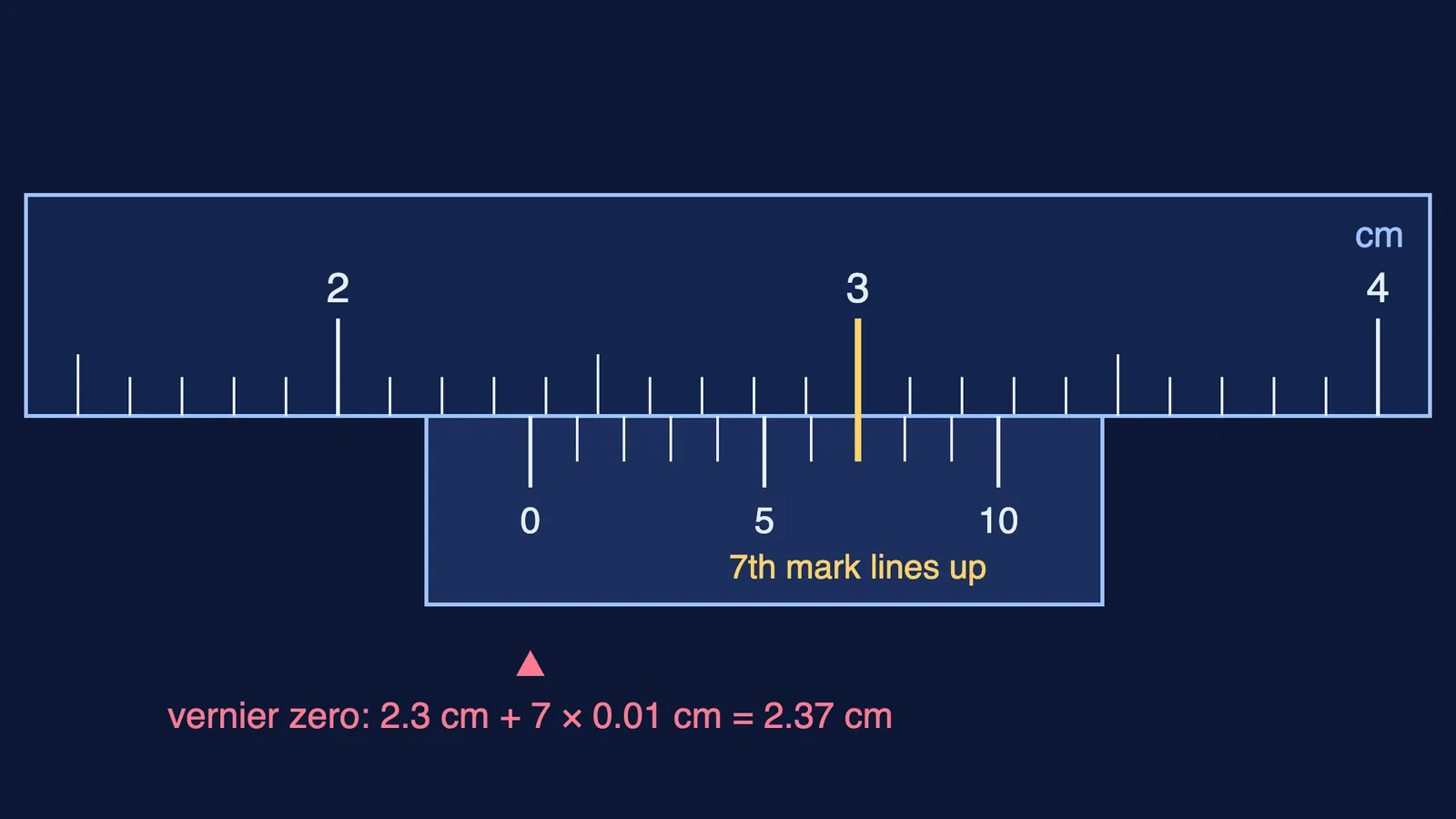
Zero error sign: corrected reading = observed reading minus zero error, so a negative zero error is added back.
Stuck on a step? The Fermi Problem Library has worked problems with a step-by-step solver that explains the reasoning rather than printing an answer.
What is a good two-week plan for this unit?
Days 1-3: read NCERT Chapter 1 line by line; make a one-page table of dimensional formulae.
Days 4-6: significant figures and rounding; least count and zero error on vernier and screw-gauge readings.
Days 7-9: percentage error for products, quotients and powers.
Days 10-12: dimensional analysis: checking equations, dimensions of constants, unit conversion.
Days 13-14: 40 timed questions at one minute each; log every wrong answer by trap type.
Practice questions:
Find the dimensions of (energy × time) / (mass × length).
How many significant figures does 0.04050 kg have?
Convert 3 × 10⁵ Pa into a system whose units of mass, length and time are 10 g, 10 cm and 0.1 s.
A vernier with least count 0.01 cm reads 3.1 cm on the main scale with the 4th vernier mark aligned, and has a zero error of -0.02 cm. What is the corrected reading?
Answers: [L T⁻¹], the dimensions of velocity; 4; 3 × 10⁴ units; 3.16 cm.
Going further? Read our Units and Measurements Class 11 guide, the rules for significant figures and the Units and Measurements guide for JEE Main.