On this page
Periodicity turns configurations into predictions: which atom is bigger, which loses an electron more easily, which oxide is basic. Learn the reasons behind a few trends and their exceptions, and most questions become a short chain of logic.
What does the NEET syllabus include in this unit?
The NMC "NEET (UG)-2026" syllabus lists Unit 9, Classification of Elements and Periodicity in Properties, under Inorganic Chemistry (NMC, NEET (UG)-2026 syllabus). It covers:
modern periodic law and present form of the periodic table
s, p, d and f block elements
periodic trends in atomic and ionic radii, ionization enthalpy and electron gain enthalpy
valence, oxidation states and chemical reactivity
This maps to Unit 3 of NCERT Class 11 Chemistry Part I, Reprint 2026-27 (NCERT Unit 3). NCERT also covers Dobereiner and Mendeleev, the naming of elements above Z = 100 and electronegativity, which the syllabus wording does not name. Read them anyway; electronegativity explains the metallic trend.
How is this unit tested in NEET?
NEET 2027 has not been notified yet. As in NEET-UG 2026, the paper had 180 compulsory questions in 180 minutes, 45 of them in Chemistry, all multiple-choice with four options and a single correct or best answer, marked +4 for correct and -1 for wrong (NEET-UG 2026 information bulletin, NTA). If 2027 keeps that pattern, that is about a minute a question, with no numerical-answer section, so aim to place an element and name its trend in seconds, then use elimination on the options.
Which rules should you have at your fingertips?
Period = highest principal quantum number in the configuration.
Group: s-block = number of ns electrons; p-block = 10 + ns + np electrons; d-block = (n-1)d + ns electrons.
Across a period, radius falls and ionization enthalpy rises; down a group, the reverse.
Isoelectronic ions: more protons, smaller ion.
A big jump between successive ionization enthalpies marks the end of the valence electrons.
Worked example 1: place the element. Z = 52 is [Kr] 4d¹⁰ 5s² 5p⁴. The highest n is 5, so period 5; the last electron enters 5p, so p-block; group = 10 + 2 + 4 = 16. Z = 25 is [Ar] 3d⁵ 4s²: period 4, d-block, group 5 + 2 = 7.
Worked example 2: read the jump. A made-up element X has successive ionization enthalpies of 610, 1230, 2010 and 9850 kJ/mol. The ratios are 2.0, 1.6 and 4.9; the big jump comes after the third electron, so X has three valence electrons, sits in group 13, and forms XCl₃ and X₂O₃.
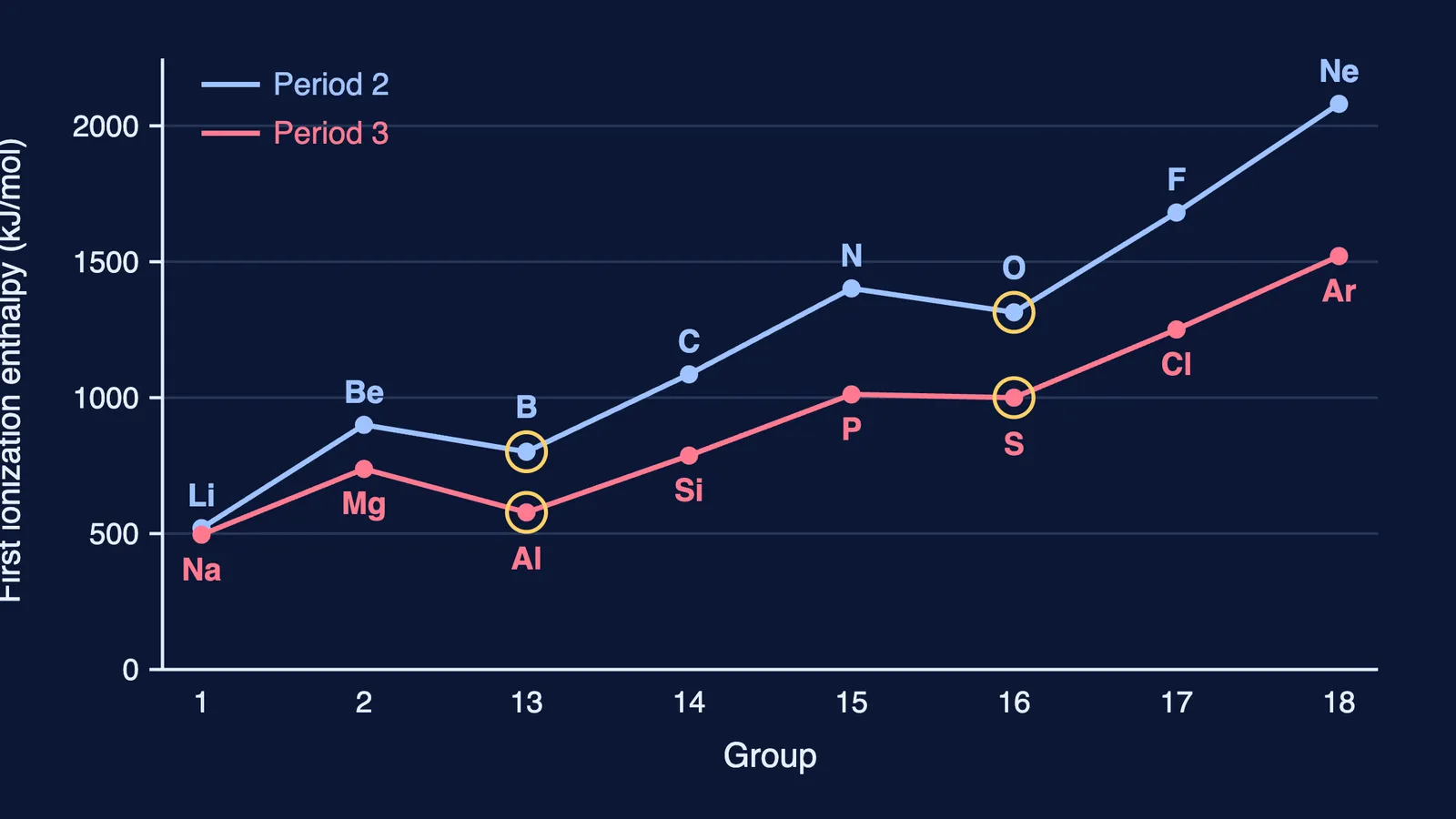
Worked example 3: judge a statement. "Sulphur has a lower first ionization enthalpy than phosphorus because its fourth 3p electron shares an orbital." True: phosphorus's 3p³ has three singly filled orbitals, while sulphur's 3p⁴ has one pair whose repulsion makes removal easier. NIST's ionization energies, converted to kJ/mol, give 1012 for P and 1000 for S (NIST Atomic Spectra Database).
The diagram at the top plots these values for periods 2 and 3. Both rows dip at group 13 (a 2p or 3p electron is easier to remove than an s electron) and at group 16 (paired-electron repulsion); NCERT explains both for period 2 and lists group 13 values of 577 kJ/mol for Al and 579 for Ga.
What are the common traps in periodicity?
Ranking all radii by period alone. Cations are smaller and anions larger than their parent atoms.
Calling B or O "irregular" without a reason. Name the cause: p electron shielded by s electrons, or a paired electron.
Confusing valence with oxidation state. Valence counts bonds; oxidation state is a signed charge.
Placing d-block elements by ns electrons alone. Add the (n-1)d electrons.
Unsure why shielding changes the trend? The Fermi Concept Library has every concept in physics, chemistry, biology, mathematics and computing, each with its own lesson and its place in the map.
A two-week practice plan
Days 1-3: read NCERT Unit 3 line by line; redraw the block layout of the table from memory. Revise configurations with our Atomic Structure for NEET guide.
Days 4-6: placing elements from Z, ten a day, including d-block cases.
Days 7-9: radius and ionization enthalpy orders, saying the reason for each exception aloud.
Days 10-11: electron gain enthalpy, valence, oxidation states and oxide character.
Days 12-14: timed mixed sets of 20 questions in 20 minutes; tag every miss with the rule you broke.
Stuck on a step? The Fermi Problem Library has worked problems with a step-by-step solver that explains the reasoning rather than printing an answer.
Try these: (a) give the period, block and group of Z = 33; (b) a made-up element Y has successive ionization enthalpies of 470, 3900, 5200 and 7100 kJ/mol: what is the formula of its oxide? (c) for Z = 34, what is the highest oxidation state? Answers: period 4, p-block, group 15; Y₂O; +6.
For board answers, see our Class 11 guide to classification of elements; for JEE, see periodic trends for JEE Main.