On this page
Most marks in this unit rest on three skills: ranking bases, telling primary, secondary and tertiary amines apart, and picking the right reagent for a diazonium salt. The rest is careful NCERT reading.
What does the NEET syllabus include for nitrogen compounds?
In the NMC NEET (UG)-2026 syllabus, Unit 18 of Chemistry, Organic Compounds Containing Nitrogen, lists general methods of preparation, properties, reactions and uses; amines (nomenclature, classification, structure, basic character, and identification of primary, secondary and tertiary amines); and diazonium salts and their importance in synthetic organic chemistry.
In the 2026-27 reprint of NCERT Class 12 Chemistry Part II, this is Unit 9, Amines, with sections 9.1 to 9.10: structure, classification, nomenclature, preparation, physical properties and reactions of amines, then preparation, properties, reactions and synthetic importance of diazonium salts. Every item on the NMC list maps to a section of the current NCERT unit; we found no cuts.
How are NEET questions on amines asked?
In NEET-UG 2026, Chemistry had 45 multiple-choice questions with four options and a single correct answer, inside a 180-question paper of 180 minutes, according to the NTA information bulletin. A correct answer earned +4 and a wrong one cost 1 mark. That is about a minute per question, with no numerical-value section. NEET 2027 is not yet notified; check the official site.
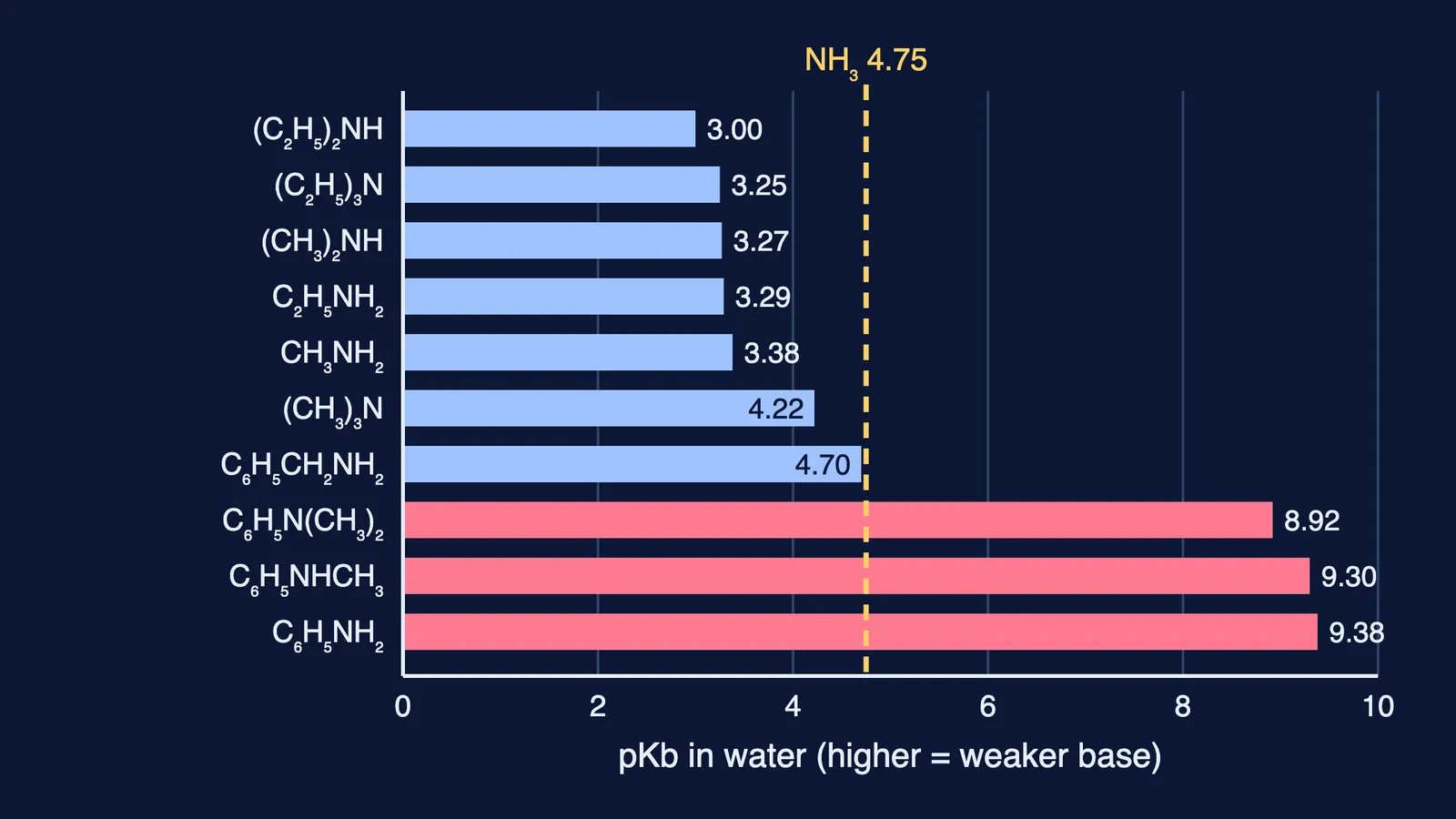
Use the minute well. Anchor basicity on two numbers from NCERT Table 9.3: ammonia has pKb 4.75, and aniline 9.38. Any option calling an arylamine a stronger base than ammonia can go at once.
Worked examples, solved the NEET way
Example 1: a Kb you have not seen. An amine has Kb = 5.0 × 10^-4 in water. pKb = -log(5.0 × 10^-4) = 3.30. That is below ammonia's 4.75, so it is the stronger base, by a factor of 10^(4.75 - 3.30), about 28 in Kb. Against aniline (9.38) the factor is about 1.2 × 10^6.
Example 2: three unlabelled bottles. P, Q and R hold pentan-1-amine, N-methylbutan-1-amine and N,N-dimethylpropan-1-amine, in some order. P gives a foul smell when heated with chloroform and ethanolic KOH. Q reacts with benzenesulphonyl chloride, but the product does not dissolve in alkali. R does not react with it at all. Per NCERT section 9.6, the carbylamine test marks a primary amine, an alkali-insoluble sulphonamide marks a secondary amine, and no reaction marks a tertiary one. So P is pentan-1-amine, Q is N-methylbutan-1-amine, R is N,N-dimethylpropan-1-amine.
Now add nitrous acid to 0.871 g of P (molar mass 87.17 g/mol, so 0.0100 mol). A primary aliphatic amine releases nitrogen quantitatively, so you collect 0.0100 mol of N2, which is 0.280 g.
Example 3: a Sandmeyer route with a yield. You want 4-chlorotoluene from 10.7 g of 4-methylaniline (107.16 g/mol, 0.0999 mol). Diazotise with NaNO2 and HCl at 273-278 K, then add CuCl with HCl. At a 70% yield you get 0.0999 × 0.70 × 126.58 = 8.85 g. Trap: let the diazonium solution warm to 283 K and you get 4-methylphenol instead, as NCERT notes.
Which traps cost marks in this chapter?
Assuming tertiary amines are always the strongest base. In water, per NCERT Table 9.3, (CH3)3N (pKb 4.22) is weaker than CH3NH2 (3.38); the order 3° > 2° > 1° holds only in the gas phase.
Treating benzylamine as an arylamine. C6H5CH2NH2 has pKb 4.70, close to ammonia, because nitrogen is not on the ring.
Using the carbylamine test on a secondary amine. Only primary amines, aliphatic or aromatic, give isocyanides.
Expecting iodobenzene or fluorobenzene from Sandmeyer. Iodide needs KI; fluoride needs HBF4, then heat.
Forgetting that coupling keeps the N=N group: phenol couples at the para position to give p-hydroxyazobenzene.
A five-day plan and practice set
Day 1: sections 9.1 to 9.3, naming 20 amines each way.
Day 2: preparation methods, especially Gabriel and Hoffmann bromamide.
Day 3: Table 9.3; explain every pKb with inductive, solvation and resonance effects.
Day 4: identification tests and diazotisation; write each reaction from memory.
Day 5: diazonium replacements and coupling, then 30 timed MCQs and a review of every miss.
Try these (one minute each):
An amine has pKb 3.85. What is its Kb?
Which gives the carbylamine test: N-methylaniline or 4-methylaniline?
Which is the strongest base in water: benzenamine, phenylmethanamine or N,N-dimethylaniline?
Which reagent turns benzenediazonium chloride into iodobenzene?
How many moles of N2 does 0.25 mol of propan-2-amine release with excess nitrous acid?
Answers: 1.4 × 10^-4; 4-methylaniline; phenylmethanamine; KI; 0.25 mol.
Where to go next?
For mechanism-heavy practice, read our Amines guide for JEE Main. For written reasons and tests, use the Amines Class 12 board exam plan, and revisit Hydrocarbons for NEET.
Mixing up a reaction? The Fermi Problem Library has worked problems with a step-by-step solver that explains the reasoning rather than printing an answer. If an idea such as resonance is the gap, the Fermi Concept Library covers every concept in physics, chemistry, biology, mathematics and computing, each with its own lesson and its place in the map.