On this page
Amines reward learning three patterns, not fifty reactions: why one amine is a stronger base, how a test sorts primary, secondary and tertiary amines, and what a diazonium salt can become. Here is what the syllabus asks, the facts that decide questions, and a two-week plan.
What does the JEE Main 2027 syllabus include for amines?
Amines sit in Unit 18, Organic Compounds Containing Nitrogen, of the NTA Syllabus for JEE (Main) - 2027. It lists preparation, properties, reactions and uses; basic character and identification of primary, secondary and tertiary amines; and the role of diazonium salts in synthesis. Unit 20 adds detecting the amino group and the chemistry of preparing acetanilide, p-nitroacetanilide and aniline yellow.
The matching textbook chapter is Unit 9, Amines, in NCERT Class 12 Chemistry Part II (reprint 2026-27).
How do you get the basicity order of amines right?
Three effects compete: the electron push of alkyl groups, solvation of the cation by water, and crowding around nitrogen. The figures below are from NCERT's Amines chapter.
Gas phase, where only electron push counts: tertiary > secondary > primary > NH3.
In water: (CH3)2NH > CH3NH2 > (CH3)3N > NH3, but (C2H5)2NH > (C2H5)3N > C2H5NH2 > NH3.
Aniline (pKb 9.38) is far weaker than ammonia (pKb 4.75): its lone pair is spread into the ring.
Benzylamine (pKb 4.70) beats aniline because CH2 keeps the lone pair off the ring.
On the ring, –CH3 and –OCH3 raise basicity; –NO2, –COOH, –SO3H and halogens lower it.
For the reasoning behind the water order, see why secondary amines are the strongest bases in water.
Which preparation methods have limits that JEE tests?
Questions here often turn on a limit, not the reagent. Facts are from the NCERT chapter.
Reduction of nitro compounds. Iron scrap and HCl is preferred: FeCl2 hydrolyses and releases HCl, so little acid is needed.
Ammonolysis of alkyl halides gives a mixture up to the quaternary salt; excess ammonia favours the primary amine.
Nitrile reduction (LiAlH4) turns R–CN into R–CH2NH2, one carbon longer than the halide R–X that made the nitrile.
Hoffmann bromamide degradation (Br2 and NaOH on a primary amide) moves the alkyl or aryl group from carbonyl carbon to nitrogen, so the amine has one carbon fewer: ethanamide gives methanamine, benzamide gives aniline.
Gabriel phthalimide synthesis makes only primary amines, and not aromatic ones, because aryl halides do not undergo substitution by the phthalimide anion.
How do you tell primary, secondary and tertiary amines apart?
These tests are in the same NCERT chapter.
Hinsberg test (benzenesulphonyl chloride): a primary amine gives a sulphonamide with an acidic N–H that dissolves in alkali; a secondary amine gives one with no N–H, insoluble in alkali; a tertiary amine does not react. See how the Hinsberg test sorts three amines.
Carbylamine test: chloroform and ethanolic KOH, heated, turn any primary amine, aliphatic or aromatic, into a foul-smelling isocyanide; secondary and tertiary amines do not.
Nitrous acid: a primary aliphatic amine releases nitrogen gas and forms an alcohol; a primary aromatic amine at 273-278 K forms a diazonium salt.
What reactions of diazonium salts should you know?
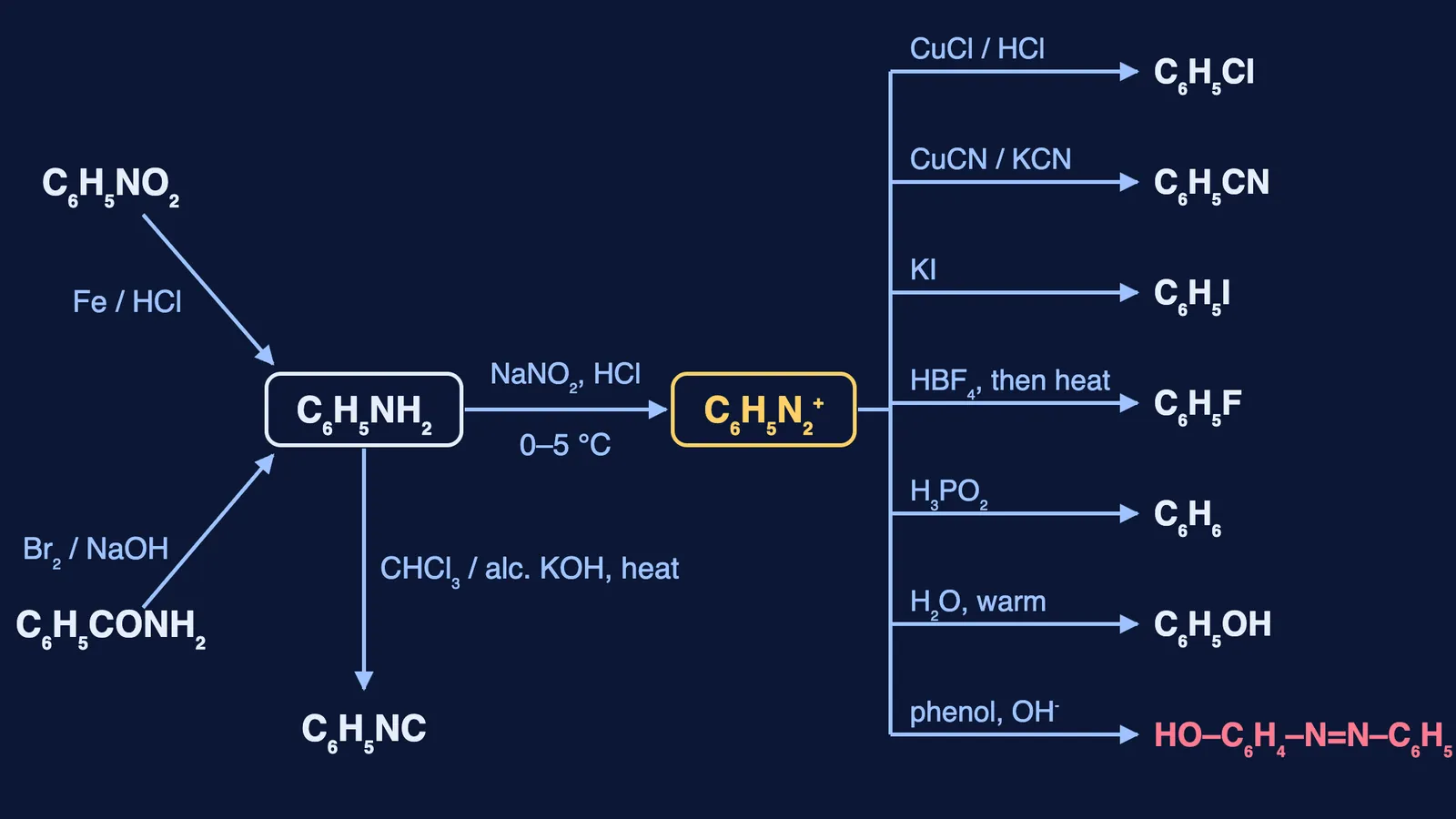
Benzenediazonium chloride is made from aniline, NaNO2 and HCl at 273-278 K and used at once, as it is unstable (NCERT). Learn its reactions as the map at the top:
Cu(I) salts swap N2+ for –Cl, –Br or –CN (Sandmeyer); copper powder with HCl or HBr does the same for halogens with lower yield (Gattermann).
KI gives iodobenzene; HBF4, then heat, gives fluorobenzene.
H3PO2 or ethanol replaces the group with hydrogen.
Warming to 283 K gives phenol.
Coupling keeps the –N=N– link: phenol couples at its para position to give p-hydroxyazobenzene, and aniline gives p-aminoazobenzene, the aniline yellow of the practical syllabus.
Phenol couples best in alkaline solution, where more of it is the strongly activating phenoxide ion/24%3A_Amines_and_Heterocycles/24.08%3A_Reactions_of_Arylamines); here is why phenol coupling is done in alkaline medium.
What is a good two-week plan for amines?
Days 1-2: read the NCERT unit; write every reaction from memory on one page.
Days 3-4: rank ten mixed sets of amines, with a reason for each step.
Days 5-6: for each preparation, name one amine it can make and one it cannot.
Days 7-8: write what each test shows for primary, secondary and tertiary amines.
Days 9-11: redraw the diazonium map blank, then solve three-step conversions.
Days 12-14: timed mixed questions; log each mistake as order, reagent or limit.
When a conversion goes wrong, the Fermi Problem Library has worked problems with a step-by-step solver that explains the reasoning rather than printing an answer.
Start with basicity today.