

On this page
Benzenediazonium chloride is a weak electrophile. It attacks only benzene rings that are rich in electrons, and the pH of the flask decides how rich the partner ring is. That explains the textbook rule "phenol in alkaline medium, aniline in acidic medium", and why too much acid or base stops both.
Why is coupling with phenol done in alkaline medium?
Phenol is a weak acid with a pKa of 9.99 at 25 °C, according to PubChem's phenol record. In neutral water almost all of it stays as un-ionised C6H5OH. Add sodium hydroxide and it becomes the phenoxide ion, C6H5O-.
The phenoxide ion is the active coupling partner. Its negative oxygen pushes much more electron density into the ring than a neutral -OH group does, so the weak diazonium electrophile can attack. The LibreTexts rules for azo coupling state that at alkaline pH (above 7.5) phenolic groups are the stronger activators "due to increased phenoxide base concentration". The same page notes that coupling happens para to the activating group if that position is free, and ortho otherwise.
The standard lab method in LibreTexts' azo dye from phenol page/Phenols/Reactivity_of_Phenols/Making_an_Azo_Dye_from_Phenol) follows this logic. Dissolve phenol in sodium hydroxide solution, cool it in ice, add cold benzenediazonium chloride, and a yellow-orange solution or precipitate forms. The product is p-hydroxyazobenzene, as in the NCERT-based coupling notes on ChemistryStudent.
Why does aniline couple in mildly acidic solution?
Aniline's -NH2 group already activates the ring strongly; it just needs to stay free. The anilinium ion, aniline's conjugate acid, has a pKa of 4.6 at 25 °C, per PubChem's aniline record, citing Perrin's tables. Below about pH 4.6, most of the aniline carries an -NH3+ group instead.
NPTEL's organic chemistry notes describe the ammonium substituent as a deactivating group that withdraws electrons from the ring. A diazonium ion is too weak an electrophile to attack a deactivated ring.
Base is no good for aniline either. The Wikipedia article on azo coupling notes that in alkaline media diazonium salts react with most primary and secondary amines at the nitrogen, giving triazenes instead of azo dyes. So the acid has to be mild: enough to stop that side reaction, not so much that the aniline gets locked up as anilinium. If you have read why amines dissolve in dilute HCl, this is the same protonation, now working against you.
What happens if the solution is too acidic or too basic?
Too acidic for aniline: the anilinium ion dominates, the ring is deactivated and coupling stalls.
Too acidic for phenol: almost no phenoxide forms.
Too basic for either: the electrophile itself disappears. LibreTexts reports that adding phenyldiazonium bisulfate rapidly to cold sodium hydroxide gives a relatively stable solution of sodium phenyldiazoate (same LibreTexts coupling page). An anion has nothing to offer an electron-rich ring.
Too warm: diazonium chlorides are unstable at room temperature and are classically prepared at 0-5 °C, as the Wikipedia article on diazonium compounds notes. Our post on why aromatic diazonium salts are more stable than aliphatic ones explains why they last even that long.
Worked example: how much partner is ready at each pH?
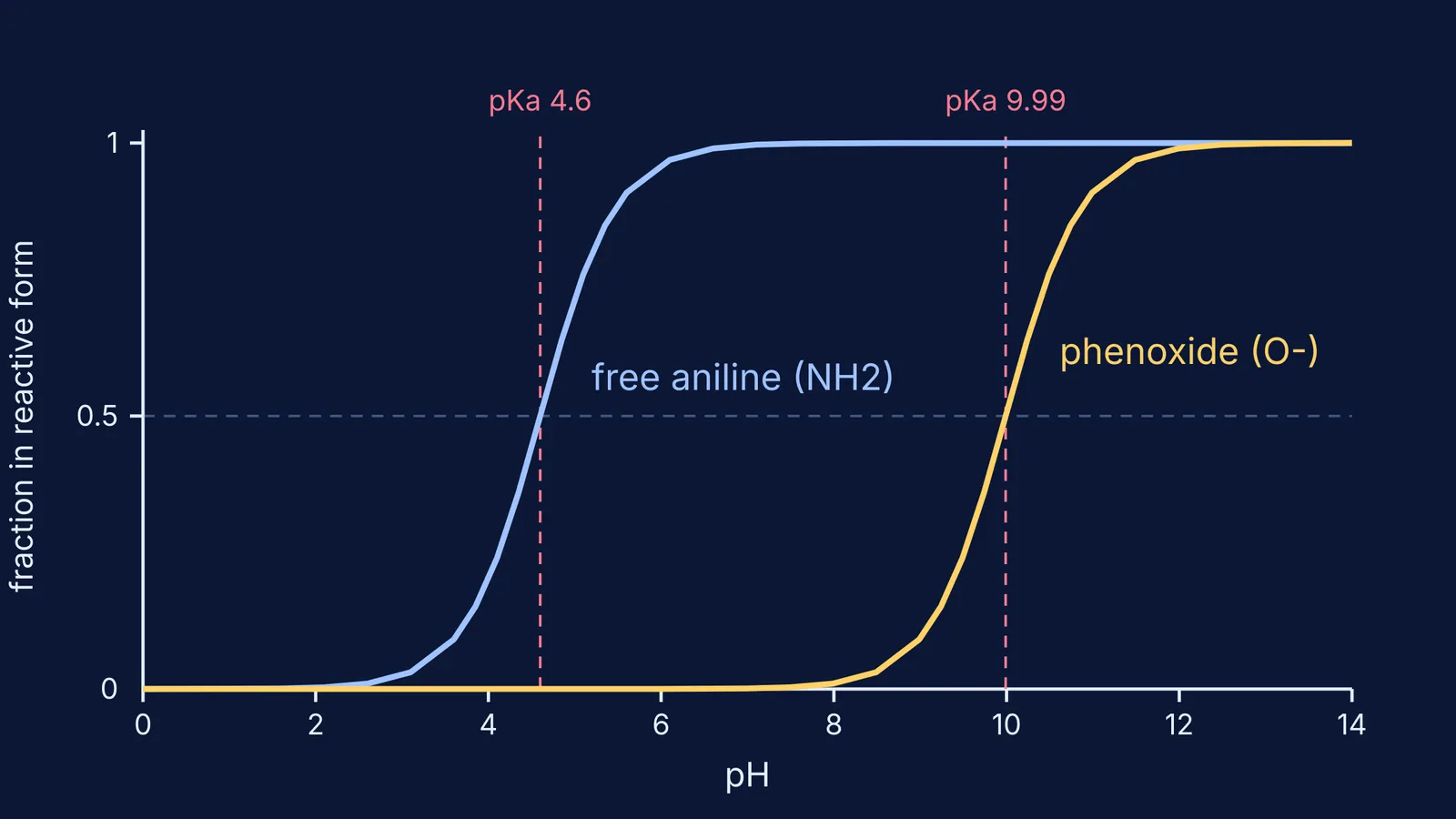
We used the pKa values above (9.99 for phenol and 4.6 for anilinium, both from PubChem: phenol, aniline). The fraction in the reactive form is 1 / (1 + 10^(pKa - pH)).
Phenol present as phenoxide:
pH 7: about 0.1%
pH 8: about 1%
pH 9: about 9%
pH 10: about 51%
pH 11: about 91%
Aniline present as free -NH2:
pH 2: about 0.25%
pH 3: about 2.4%
pH 4: about 20%
pH 5: about 72%
pH 6: about 96%
Moving a phenol solution from pH 7 to pH 10 raises the phenoxide share about 500 times. These numbers show only the partner's side. Push the pH higher still and the diazonium ion turns to diazoate, so the yield does not keep rising.
How do you write this in a board or JEE answer?
Name the electrophile: the diazonium ion, ArN2+, a weak electrophile that needs an electron-rich ring.
Phenol: NaOH converts it to phenoxide; -O- is a much stronger activator than -OH; attack at para gives p-hydroxyazobenzene.
Aniline: mild acid keeps -NH2 free; strong acid gives anilinium (-NH3+, deactivating); base gives triazene at nitrogen.
Both: too much base turns ArN2+ into diazoate, so keep the alkali mild and the mixture cold.
Test yourself: what happens if you add benzenediazonium chloride to phenol in dilute HCl? (Almost no phenoxide forms, so coupling is very slow.) To see the same coupling used as a lab test, read the azo dye test for aromatic primary amines.
To practise this reasoning rather than memorise the medium, the Fermi Problem Library has worked problems with a step-by-step solver that explains the reasoning rather than printing an answer. If pKa or activating groups still feel shaky, the Fermi Concept Library gives each concept in chemistry its own lesson.


