

On this page
Treat aniline with nitrous acid in an ice bath and you get benzenediazonium chloride, ready to use. Do the same with ethylamine and nitrogen bubbles off straight away. Here is why, and how to write it up.
Why are aromatic diazonium salts more stable than aliphatic ones?
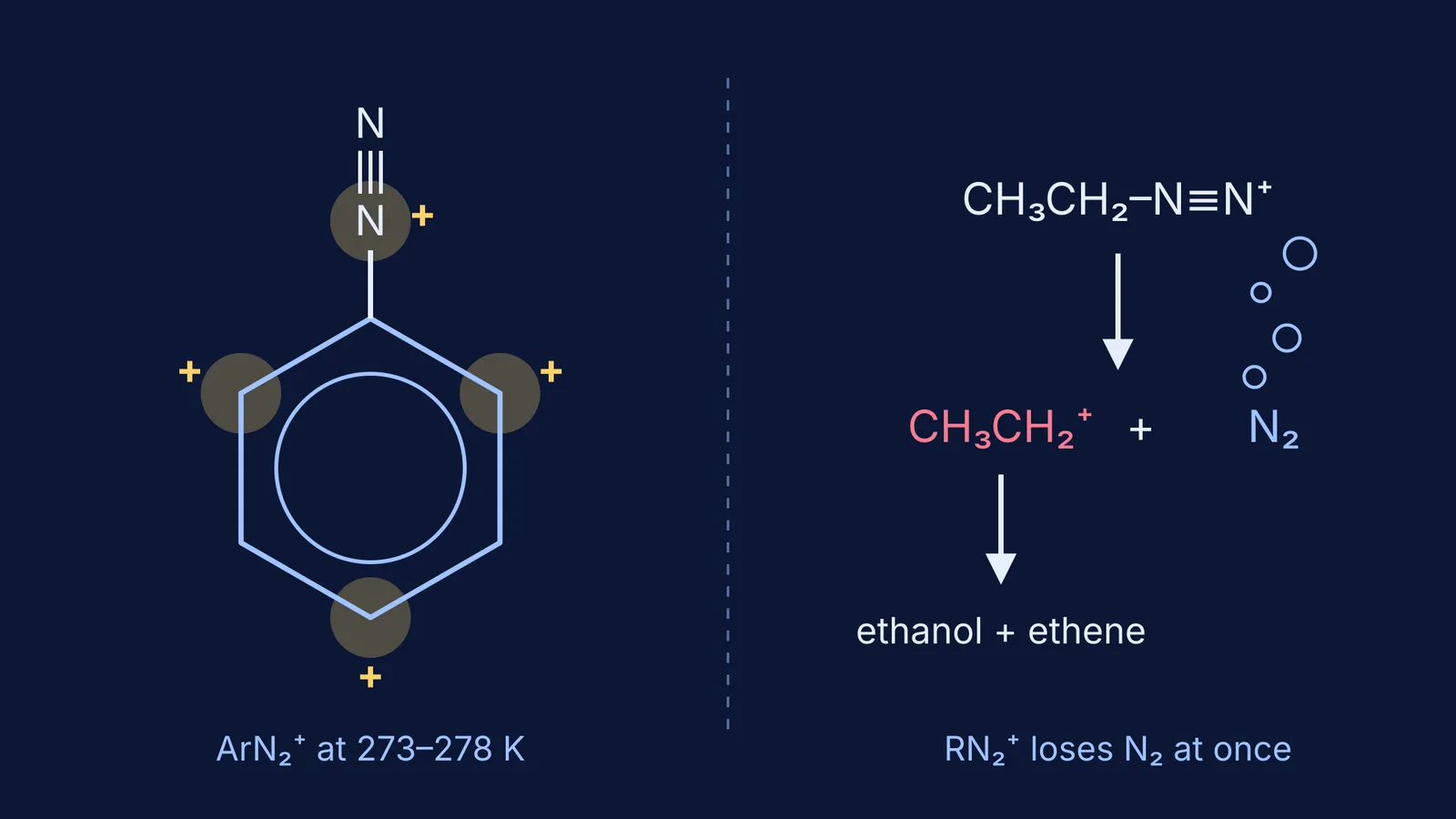
The NCERT Class 12 textbook gives resonance as the reason. NCERT's Unit 9 on amines says primary aliphatic amines form "highly unstable alkyldiazonium salts", while primary aromatic amines form arenediazonium salts "which are stable for a short time in solution at low temperatures (273-278 K)". The same page says the stability of the arenediazonium ion "is explained on the basis of resonance".
Here is what that resonance does. The diazonium group carries a positive charge. In benzenediazonium, the π electrons of the ring can shift towards the –N≡N group. NCERT draws resonance structures that put the positive charge on nitrogen and also on the two ortho carbons and the para carbon. A diazonium salts handout from the University of Lucknow puts it in one sentence: the relative stability of the aromatic diazonium cation comes from delocalisation of the positive charge on nitrogen onto the π system of the ring.
A charge spread over several atoms is lower in energy than a charge stuck on one atom. An ethyl or propyl group has no π system, so the charge of an alkyldiazonium ion has nowhere to go.
What happens when an aliphatic amine meets nitrous acid?
The alkyldiazonium ion forms and then loses N₂ at once. NCERT writes it as R–NH₂ + HNO₂ giving [R–N₂⁺Cl⁻], which with water gives ROH + N₂ + HCl. It adds that the nitrogen comes off quantitatively, which is why chemists use this reaction to estimate amino acids and proteins (NCERT Unit 9).
N₂ is a very stable gas, so it is an excellent leaving group, and when it leaves an alkyl group it leaves a carbocation behind. Wikipedia's article on diazonium compounds says ethyl and higher primary alkanediazonium ions decompose rapidly at room temperature, and secondary and tertiary ones are at best "extremely fleeting intermediates".
Worked example: pentan-2-amine
The Lucknow handout works through this case:
Pentan-2-amine + NaNO₂ + 2HCl at 273–278 K gives the pentan-2-diazonium ion.
It loses N₂ at once, leaving a carbocation on C-2.
Water attacks the carbocation (SN1) to give pentan-2-ol.
The carbocation can also lose a proton (E1) to give pent-2-ene (major) and pent-1-ene (minor).
You end up with a mixture of an alcohol and two alkenes, which is why the handout calls the diazotisation of aliphatic primary amines "of little or no importance" for synthesis.
How stable is benzenediazonium chloride really?
Not very. "Stable" only means stable compared with the alkyl case. NCERT Unit 9 says:
It is made at 273–278 K and, because it is unstable, is not usually stored but used straight after it is made.
If the solution warms to 283 K, the salt hydrolyses to phenol.
It decomposes easily in the dry state.
Benzenediazonium fluoroborate, by contrast, is water insoluble and stable at room temperature.
The counter-ion matters. Wikipedia describes benzenediazonium chloride as dangerously explosive, while the tetrafluoroborate has been described as shock insensitive. In the Balz-Schiemann route to fluorobenzene, NCERT has the fluoroborate precipitated first and then heated to give the aryl fluoride. For the temperature itself, read why diazotisation is carried out at 0 to 5 °C.
How do you write this answer for full marks?
Use this four-step frame for any "give reason" question on diazonium stability:
Name both ions: ArN₂⁺ (arenediazonium) and RN₂⁺ (alkyldiazonium).
Give the cause: resonance spreads the positive charge of ArN₂⁺ into the ring, at the ortho and para carbons.
Give the contrast: RN₂⁺ has no π system, so it loses N₂ at once and forms a carbocation.
Give the result: RN₂⁺ ends up as a mixture of alcohol and alkenes, while ArN₂⁺ stays in cold solution long enough for Sandmeyer and coupling reactions.
Draw at least two resonance structures with the + on a ring carbon.
Check for these common traps before you hand in:
Saying aromatic diazonium salts are stable at room temperature. Only salts like the fluoroborate are.
Saying aliphatic amines form no diazonium ion. They do form one, and it falls apart at once.
Mixing up the temperatures: 273–278 K to make the salt, 283 K when you want phenol (both from NCERT Unit 9).
Coupling needs the aryl ion to last long enough to react. NCERT shows benzenediazonium chloride coupling with phenol to give p-hydroxyazobenzene, an orange dye, and the same chemistry is behind the azo dye test for aromatic primary amines.
If you get stuck on the resonance arrows, the Fermi Concept Library gives every chemistry concept its own lesson, so you can go over resonance and carbocation stability before you come back to this chapter. For practice, the Fermi Problem Library has worked problems with a step-by-step solver that explains the reasoning rather than printing an answer, which helps with conversion chains that start from a diazonium salt.


