

On this page
The Balz-Schiemann reaction is the standard laboratory method for making aryl fluorides, such as fluorobenzene, from primary aromatic amines. You cannot easily add fluorine directly to a benzene ring because direct fluorination is violent and highly exothermic, making it difficult to control. Instead, you build the molecule in two controlled stages via a diazonium intermediate.
What is the Balz-Schiemann reaction?
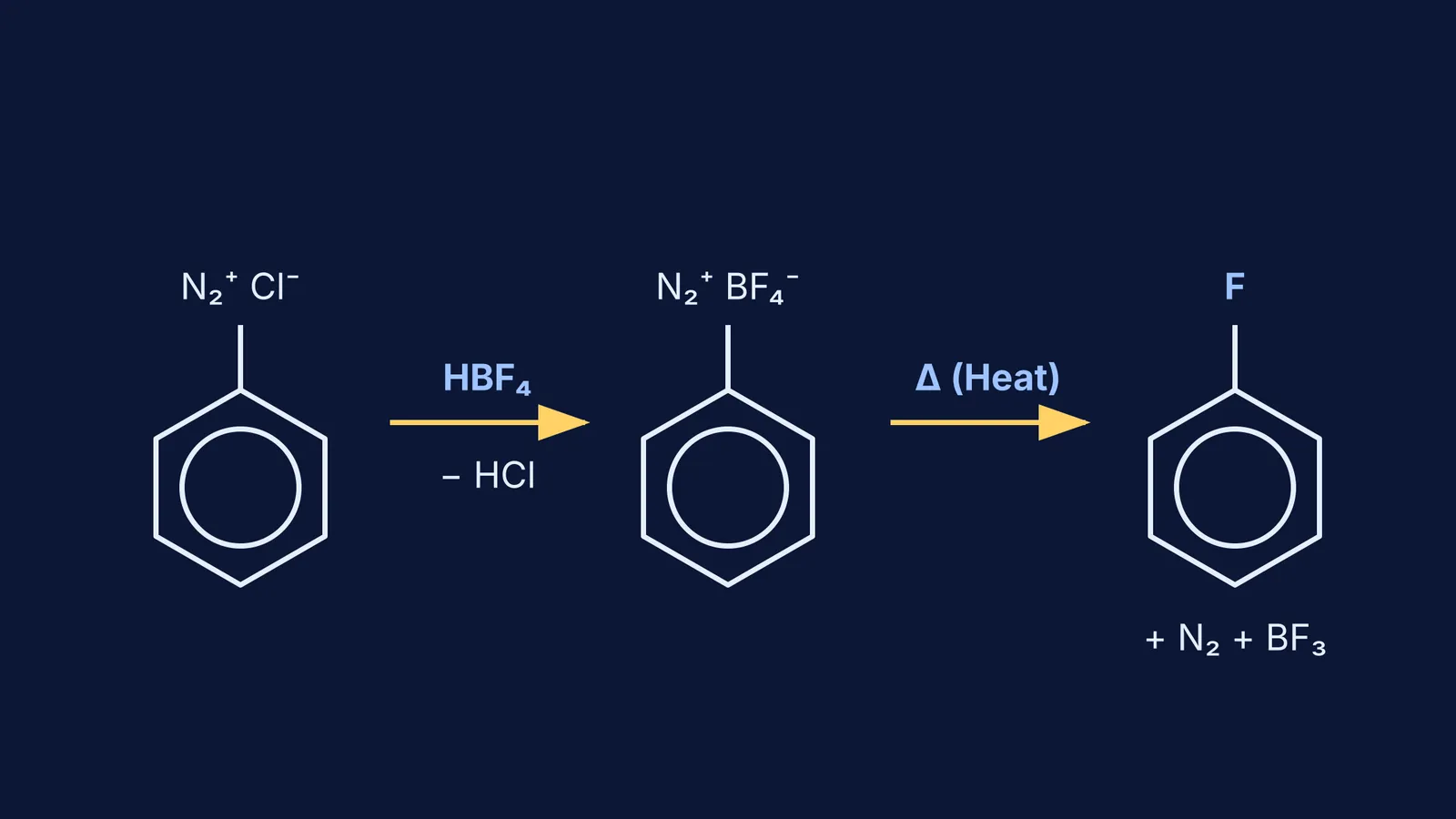
The Balz-Schiemann reaction converts an aryl diazonium salt into an aryl fluoride via thermal decomposition (Balz–Schiemann reaction, Wikipedia). You first treat a diazonium salt, such as benzenediazonium chloride, with fluoroboric acid (HBF₄). This creates a stable benzenediazonium tetrafluoroborate precipitate.
Next, you filter, dry, and heat the solid salt. Heating the dry salt up to 200 °C breaks it down to release nitrogen gas (N₂), boron trifluoride (BF₃), and your final product, fluorobenzene (Wikipedia). The reaction is known for its reliability and efficiency; for instance, the related compound 4-fluorotoluene is made in approximately 89% yield using this method on p-toluidine (Wikipedia).
If you find reaction mechanisms hard to picture, the Fermi Concept Library has every concept in chemistry, each with its own lesson and its place in the map, so you can see exactly where the electrons move.
Mechanism: how does it form fluorobenzene?
Unlike the Sandmeyer reaction, which uses copper catalysts to attach chlorine or bromine to a benzene ring, the Balz-Schiemann thermal decomposition proceeds entirely without a promoter (Wikipedia). The transformation happens in three distinct phases:
Precipitation: Benzenediazonium chloride reacts with fluoroboric acid in solution. The chloride ion is replaced by the tetrafluoroborate ion (BF₄⁻), forming benzenediazonium tetrafluoroborate. Because this new salt is largely insoluble in cold water, it precipitates out as a solid.
Decomposition: When you heat the thoroughly dried salt, the weak C–N bond breaks. Nitrogen gas bubbles away. This leaves behind a highly unstable aryl cation—a benzene ring carrying a positive charge.
Fluoride abstraction: The transient aryl cation instantly pulls a fluoride ion (F⁻) from the nearby BF₄⁻ counterion. This yields stable fluorobenzene and leaves BF₃ gas to escape.
Why use HBF₄ instead of HF?
You might wonder why we do not simply use hydrofluoric acid (HF) with a traditional Sandmeyer method to get fluorobenzene. The answer comes down to stability and moisture:
Regular diazonium halides (like chlorides or bromides) are highly explosive when isolated and dried.
The tetrafluoroborate (BF₄⁻) salt is highly unusual: it is stable enough to be filtered, washed, and dried safely at room temperature without detonating unexpectedly.
You absolutely need a dry salt for the heating step. If any water is present, it will react with the highly unstable aryl cation to form phenol instead of fluorobenzene. By forming the insoluble BF₄⁻ salt, you can easily separate it from the water used during diazotisation.
How do you convert nitrobenzene to fluorobenzene?
When an exam asks you to convert nitrobenzene to fluorobenzene, you have to chain a few reactions together. First, you must reduce nitrobenzene to aniline. Once you have aniline, follow this three-step script for the Balz-Schiemann sequence:
Diazotise: React aniline with sodium nitrite (NaNO₂) and hydrochloric acid (HCl) in cold conditions to form benzenediazonium chloride.
Exchange the ion: Add fluoroboric acid (HBF₄) to the benzenediazonium chloride to precipitate benzenediazonium tetrafluoroborate.
Heat: Filter and dry the benzenediazonium tetrafluoroborate, then apply heat (Δ) to yield fluorobenzene, N₂, and BF₃.
You can link this idea to other essential substitutions. For example, if you replace HBF₄ with a copper chloride catalyst, you are shifting to the Sandmeyer and Gattermann reactions to get chlorobenzene. Meanwhile, if you need an alkyl fluoride instead of an aryl fluoride, you would skip diazonium salts entirely and look to Finkelstein and Swarts reactions.
If you keep losing track of which reagent goes with which named reaction, the Fermi Problem Library has worked problems with a step-by-step solver that explains the reasoning rather than printing an answer.


