On this page
Most Class 12 students meet benzenesulfonyl chloride as a one-line answer: Hinsberg's reagent. Behind that line is a neat piece of reasoning from 1890 that still turns up in exam papers, including JEE Main. If you understand why it works, you never have to memorise the three outcomes.
Who was Oscar Hinsberg?
Oscar Hinsberg was a German chemist, born in Berlin on 21 October 1857, who took his doctorate at the University of Tübingen in 1882 and later taught at the universities of Freiburg and Geneva (Oscar Hinsberg biography). He also worked on oxindole, sulfone and thiophene chemistry, but the amine test is what carries his name into textbooks.
He described the reaction in a four-page paper in Berichte der deutschen chemischen Gesellschaft, volume 23, pages 2962 to 2965, published in 1890 (Crossref record of the 1890 paper). Its title translates as "On the formation of acid esters and acid amides in the presence of water and alkali". That last phrase matters: the reaction runs in plain aqueous base, which made it easy to use as a test. In 1905 Hinsberg and J. Kessler came back to the problem with a paper on separating primary and secondary amine bases (Crossref record of the 1905 paper).
How does the Hinsberg test tell primary, secondary and tertiary amines apart?
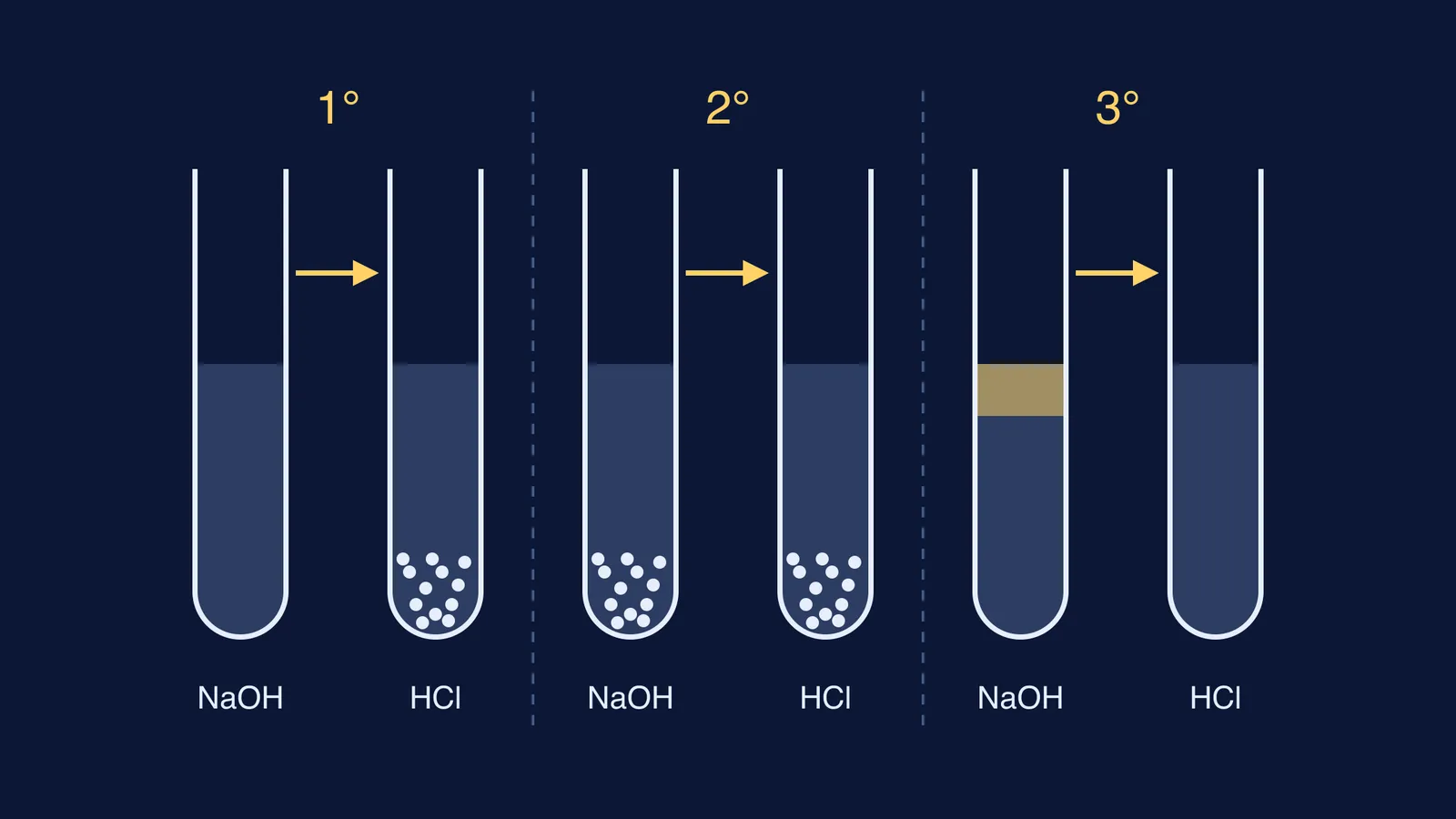
The Hinsberg test shakes an unknown amine with benzenesulfonyl chloride (C6H5SO2Cl) in aqueous sodium or potassium hydroxide, then checks what dissolves before and after adding acid (Hinsberg reaction overview). An NPTEL course solution sets out the three outcomes (NPTEL solution on amines):
Primary amine: forms a sulfonamide that dissolves in the alkali as a salt, then precipitates when you acidify.
Secondary amine: forms a sulfonamide that is insoluble in the alkali and stays insoluble after acid.
Tertiary amine: forms no sulfonamide; it stays undissolved in the alkali and, on acidification, can form an ammonium salt that dissolves.
Why does one sulfonamide dissolve and the other not?
It comes down to one hydrogen atom. The primary amine's sulfonamide keeps an acidic hydrogen on nitrogen, which sodium hydroxide removes to form a soluble salt; the secondary amine's sulfonamide has no such hydrogen, so it stays solid (NPTEL solution on amines). Adding acid puts that hydrogen back, so the neutral primary sulfonamide comes out of solution.
Here is a worked example with the aniline family, a favourite in Indian exams.
Aniline, C6H5NH2, has two hydrogens on nitrogen. One is replaced by the sulfonyl group, giving C6H5NH-SO2C6H5 with one N-H left. Alkali removes it: clear solution. Acid: precipitate.
N-methylaniline, C6H5NHCH3, has one hydrogen on nitrogen. It is used up, giving C6H5N(CH3)-SO2C6H5 with none left. Nothing for the alkali to remove: a solid in base, still a solid in acid.
N,N-dimethylaniline, C6H5N(CH3)2, has no hydrogen on nitrogen to begin with, so no sulfonamide forms. The amine is still a base, so acid turns it into a soluble ammonium salt.
Does the Hinsberg test always work?
No. In 1972 C. R. Gambill, T. D. Roberts and H. Shechter published a paper in the Journal of Chemical Education whose title says it plainly: "Benzenesulfonyl chloride does react with tertiary amines" (Crossref record of the 1972 paper). Tertiary amines can react with the reagent under a variety of conditions, so the test is valid only when reaction speed, concentration, temperature and solubility are taken into account (Hinsberg reaction overview).
The lesson is worth keeping beyond amines: a classification test gives evidence, not proof. Your textbook version is the clean, idealised one, and it is the one exams expect.
How do exams ask about the Hinsberg test?
Mostly as recognition. A JEE Main online paper on 9 April 2016 asked which test distinguishes primary, secondary and tertiary amines, with C6H5SO2Cl as the answer and the carbylamine reaction among the wrong options (JEE Main 2016 question archive). The carbylamine reaction picks out only primary amines, so it cannot sort all three (same source).
A three-step plan for any Hinsberg question:
Classify the amine by counting carbon groups on nitrogen, not carbons in the molecule. Tert-butylamine, (CH3)3C-NH2, is a primary amine: one carbon group on nitrogen.
Write the sulfonamide and count the N-H hydrogens left on it.
Predict two observations, in alkali and after acid, and name the hydrogen that explains each.
If the acid-base idea underneath still feels shaky, the Fermi Concept Library has a lesson for every concept in chemistry, each with its place in the map, so you can revisit amines and acidity first. For practice, the Fermi Problem Library has worked problems with a step-by-step solver that explains the reasoning rather than printing an answer.
Next time C6H5SO2Cl appears in an options list, count the hydrogens before you pick.