On this page
Board questions on amines follow a steady pattern: give a reason, name a test, write a conversion. Writing JEE Main too? Our Amines guide for JEE Main covers that side.
How many marks is Amines in CBSE Class 12?
The CBSE Chemistry curriculum for 2026-27 gives Unit 9, Amines, 6 marks out of 70 in the theory paper. The textbook is NCERT Class 12 Chemistry Part II, Unit 9 (Reprint 2026-27), the source for every fact below.
In the 2026-27 sample paper, amines appear in two MCQs (Q1 on isomeric amines, Q4 on the carbylamine test), one assertion-reason question on nitration and a 3-mark question with two conversions and one reason. No case-based or 5-mark question comes from this unit there.
Which basicity "give reasons" questions should you learn?
Alkylamines beat ammonia: the +I effect of alkyl groups pushes electron density onto nitrogen and stabilises the cation.
Gas phase: the inductive trend holds, so 3° > 2° > 1° > NH₃.
Water: solvation by hydrogen bonding and steric hindrance also act, so the order changes: (C₂H₅)₂NH > (C₂H₅)₃N > C₂H₅NH₂ > NH₃, but (CH₃)₂NH > CH₃NH₂ > (CH₃)₃N > NH₃.
Aniline is weaker than ammonia: its lone pair is conjugated with the ring. Aniline has five resonance structures, the anilinium ion only two.
For the solvation argument in depth, read why secondary methylamine wins in water.
How do you write a basicity order answer? One example, done twice
Try this: arrange CH₃NH₂, (CH₃)₃N, NH₃ and C₆H₅N(CH₃)₂ in decreasing order of basic strength in water.
First, by reasoning. Methyl groups are small, so in water solvation decides: CH₃NH₃⁺ has three N–H hydrogens to bond with water, (CH₃)₃NH⁺ only one, so the primary amine wins. Trimethylamine still beats ammonia, which has no alkyl group. In N,N-dimethylaniline the lone pair is conjugated with the ring, so it is weakest. So: CH₃NH₂ > (CH₃)₃N > NH₃ > C₆H₅N(CH₃)₂.
Second, by pKb. Table 9.3 of NCERT Unit 9 lists methanamine 3.38, N,N-dimethylmethanamine 4.22 and N,N-dimethylaniline 8.92, and the text gives ammonia 4.75. Smaller pKb means stronger base: 3.38 < 4.22 < 4.75 < 8.92, the same order. The trap: in water the methyl tertiary amine falls below the primary.
Hinsberg, carbylamine, diazonium salts and conversions: what to write?
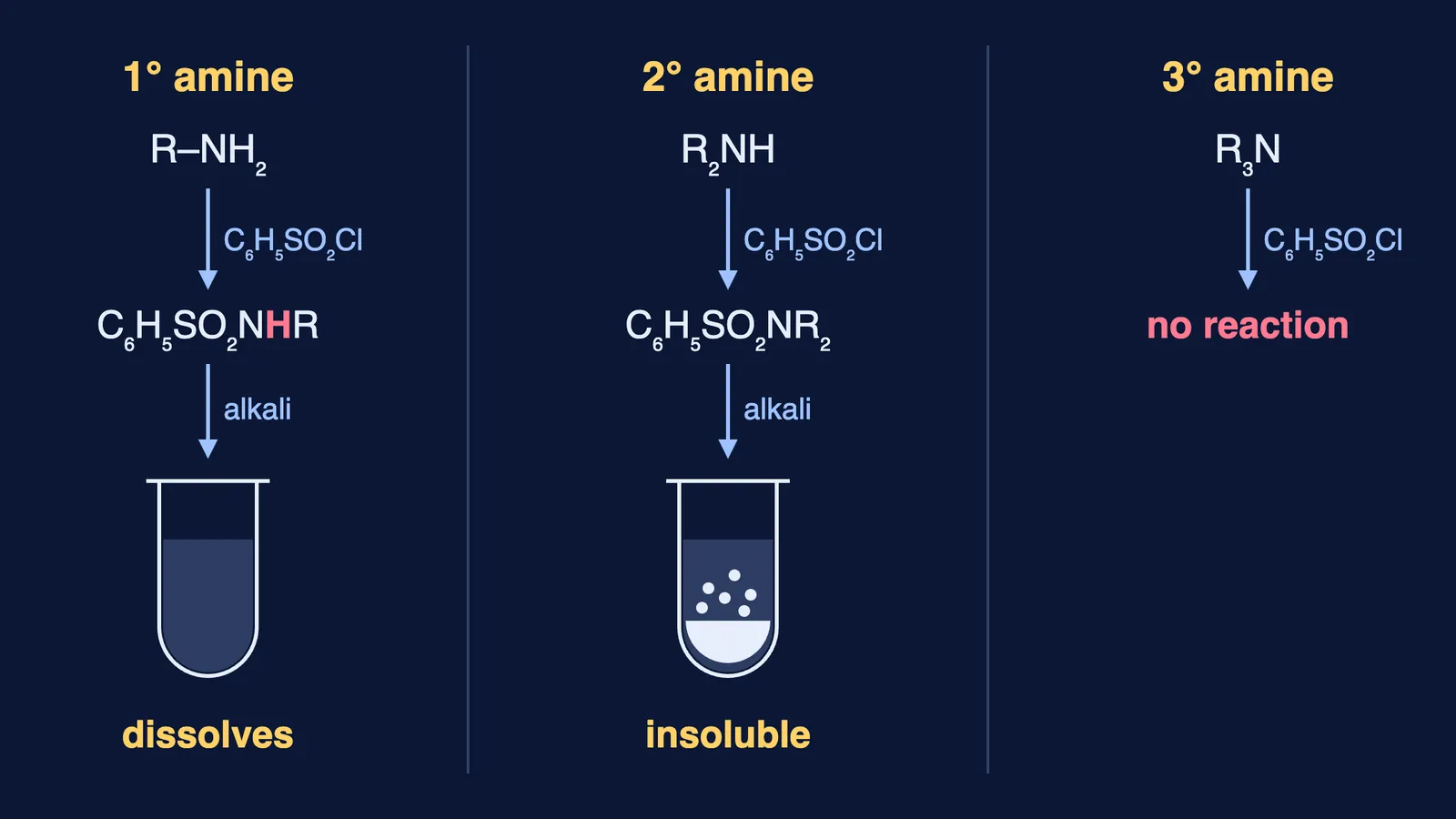
Hinsberg test: benzenesulphonyl chloride gives a 1° amine a sulphonamide whose N–H is acidic, so it dissolves in alkali. A 2° amine gives a sulphonamide with no N–H, insoluble in alkali. A 3° amine does not react.
Carbylamine test: only primary amines, aliphatic or aromatic, give foul-smelling isocyanides when heated with chloroform and ethanolic KOH.
Diazotisation: aniline with NaNO₂ and HCl at 273-278 K gives benzenediazonium chloride.
Replacing N₂: CuCl, CuBr or CuCN (Sandmeyer); halogen acid with copper powder (Gattermann); KI for iodobenzene; fluoroboric acid then heat for fluorobenzene; H₃PO₂ or ethanol for benzene; letting the solution warm to 283 K for phenol.
Keeping N₂: coupling with phenol gives p-hydroxyazobenzene; azo compounds are often coloured and used as dyes.
The 2026-27 marking scheme answers nitrobenzene to fluorobenzene as Sn/HCl, then NaNO₂/HCl, then NaBF₄ (NCERT uses fluoroboric acid, then heat), and benzoic acid to benzylamine as heating with NH₃ to benzamide, then LiAlH₄. Count carbons first: Hoffmann bromamide degradation removes one carbon; going through a nitrile adds one; reducing an amide keeps the count. If you get stuck on a route, the Fermi Problem Library has a step-by-step solver that explains the reasoning rather than printing an answer.
Why does nitration of aniline give so much meta product?
In the strongly acidic nitrating mixture, aniline is protonated to the anilinium ion, which is meta directing. NCERT shows direct nitration at 288 K giving 51% para, 47% meta and 2% ortho nitroaniline, along with tarry oxidation products (Unit 9). Acetylation to acetanilide first makes the para product major. See why nitration gives 47% meta-nitroaniline.
The traps:
Assertion-reason: sample paper Q13 claims a sizeable meta share, with the reason that –NH₂ directs ortho and para. Both are true, but the marking scheme answer is B: the reason does not explain the meta product. The anilinium ion does.
Data questions: sample Q1 gives boiling points and pKb values for three isomeric amines, and answer B rests on spotting the primary one. Boiling points rank 1° > 2° > 3°: two, one and no N–H hydrogens for hydrogen bonding.
How should you set out answers and revise?
2 marks: one fact and its cause, or one two-step conversion with reagents over each arrow.
3 marks: three conversion steps with reagents and conditions (273-278 K for diazotisation), or a reason split into its points. In sample Q26, the 1-mark reason earns half a mark for –NH₂ being activating enough to give trisubstituted products, half for acetylation making the less activating –NHCOCH₃.
A five-day plan:
Day 1: basicity orders and Table 9.3.
Day 2: preparation methods and carbon counting.
Day 3: Hinsberg, carbylamine and nitrous acid.
Day 4: diazonium reactions, NCERT Example 9.5 and intext question 9.9.
Day 5: the sample paper's amine questions, timed, then chapter-end exercises.
When a reason still feels shaky, the Fermi Concept Library has every concept in physics, chemistry, biology, mathematics and computing, each with its own lesson.