On this page
Every JEE Main and NEET-UG student learns that the amino group, -NH2, is a strong ortho-para director. Then the nitration of aniline turns up in the NCERT amines chapter with almost half the product at the meta position, and the rule seems to break. It does not. The group that steers the nitration is not -NH2 at all.
Why does nitration of aniline give meta-nitroaniline?
Nitration uses a mixture of concentrated nitric and sulphuric acids, and aniline is a base. In that strongly acidic medium, aniline is protonated to form the anilinium ion, C6H5NH3+, which is meta directing, as the NCERT Class 12 Chemistry chapter on amines states in its section on electrophilic substitution.
The reason is the lone pair. In aniline, nitrogen's lone pair is pushed into the ring by resonance, which builds up electron density at the ortho and para carbons. Once nitrogen takes a proton, that lone pair is used up in the new N-H bond. The -NH3+ group now carries a full positive charge and pulls electron density out of the ring. It slows substitution at every position, but least at the meta carbons, so the electrophile goes there.
If you want to see where that electrophile, the nitronium ion, comes from, our explainer on the role of sulphuric acid in the nitration of benzene walks through it.
How much meta-nitroaniline actually forms?
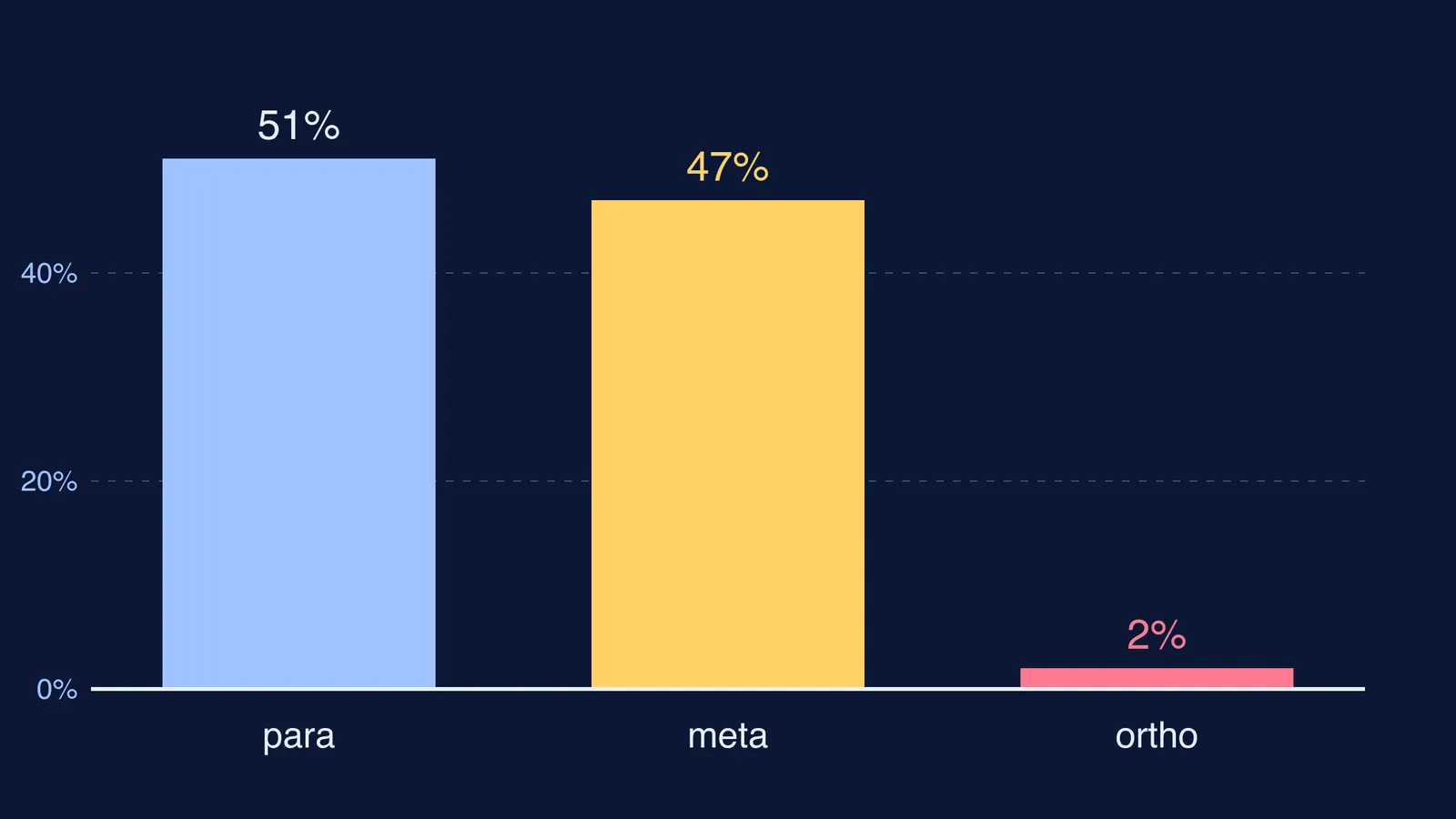
NCERT gives the split for aniline nitrated with HNO3 and H2SO4 at 288 K (NCERT Class 12 Chemistry, Amines, p. 273):
p-nitroaniline: 51%
m-nitroaniline: 47%
o-nitroaniline: 2%
The same passage notes that direct nitration also yields tarry oxidation products in addition to the nitro derivatives.
Why isn't the product 100% meta?
The usual explanation is that protonation is an equilibrium, not a switch. Most of the aniline sits as the anilinium ion, but a small share is free aniline at any moment. Free aniline is far more reactive towards the nitronium ion than the deactivated anilinium ion, so that small share still makes ortho and para product. Two substrates compete: a large, slow, meta-directing one and a small, fast, ortho-para-directing one, which is why you get a mixture rather than pure meta.
You can check how acidic the medium has to be with NCERT's own data: benzenamine (aniline) has a pKb of 9.38 in Table 9.3 of the NCERT amines chapter. Since pKa + pKb = 14 for a conjugate pair in water at 298 K, the anilinium ion has a pKa of about 14 - 9.38 = 4.62. Concentrated sulphuric acid is far more acidic than that, so most of the aniline stays protonated.
How do you get p-nitroaniline as the main product?
Protect the amino group first. NCERT's route is to acetylate aniline with acetic anhydride in pyridine to make acetanilide, nitrate it with HNO3 and H2SO4 at 288 K, then hydrolyse the amide with acid or base, which gives p-nitroaniline as the major product (NCERT Class 12 Chemistry, Amines). In acetanilide, nitrogen's lone pair is shared with the carbonyl oxygen by resonance, so it is less available to the ring, -NHCOCH3 is a milder activator than -NH2, and the reaction can be controlled. For the full reasoning, read why aniline is acetylated before nitration.
The same protonation explains sulphonation, where aniline first forms anilinium hydrogensulphate: see why sulphanilic acid forms a zwitterion.
How should you write this answer in the exam?
When a question asks why nitration of aniline gives a meta product, write four points in this order:
Medium: nitration uses concentrated HNO3 and H2SO4, a strongly acidic mixture.
Change: the basic -NH2 group is protonated to -NH3+, the anilinium ion.
Effect: -NH3+ has no lone pair to donate and withdraws electrons, so it deactivates the ring and directs meta.
Result: free aniline still reacts at ortho and para, so you get a mixture of p-, m- and o-nitroaniline, plus tarry oxidation products.
Then test yourself. For each reaction below, name the group that actually directs and the main product. All three are in the NCERT amines chapter.
Aniline with bromine water: -NH2 directs, no strong acid is present, and you get 2,4,6-tribromoaniline.
Acetanilide with HNO3 and H2SO4: -NHCOCH3 directs, and you get p-nitroacetanilide.
Aniline with HNO3 and H2SO4: -NH3+ and free -NH2 compete, and you get a mixture with meta close to half.
If you keep picking the wrong directing group, the Fermi Problem Library has worked problems with a step-by-step solver that explains the reasoning rather than printing an answer. To revisit activating and deactivating groups from the start, each idea has its own lesson in the Fermi Concept Library.
Next time a reaction breaks a rule you trust, look at what the reagent did to the group before you blame the rule.