

On this page
When you study electrophilic aromatic substitution, benzene is notoriously stable. Its delocalized π electron cloud resists reacting with weak electrophiles. Nitric acid (HNO₃) alone is not strong enough to break this aromaticity at a reasonable rate.
To make the reaction work, chemists use a "mixed acid" reagent: a precise combination of concentrated nitric acid and concentrated sulphuric acid (H₂SO₄). This mixture is typically kept below 50 °C to prevent multiple nitro groups from attaching to the ring, which would lead to unwanted side products like dinitrobenzene (Source). This is where the fascinating chemistry of the mixed acid begins.
What is the role of sulphuric acid in the nitration of benzene?
The primary role of sulphuric acid in the nitration of benzene is to act as a catalyst and generate the active electrophile: the nitronium ion (NO₂⁺).
Because concentrated sulphuric acid is a much stronger acid than nitric acid, it uniquely forces the nitric acid molecule to act as a base in this environment. The sulphuric acid donates a proton (H⁺) to the hydroxyl group of nitric acid. This protonation creates a good leaving group, allowing a water molecule to break away. What is left behind is the nitronium ion, a highly reactive species that is hungry for electrons (Source).
This initial protonation and subsequent dehydration step is absolutely essential for the overall reaction. Without it, the concentration of the nitronium ion would remain far too low to push the electrophilic substitution forward at a practical rate.
What are the three steps of the sigma complex mechanism?
Once the nitronium ion is generated, the main electrophilic substitution in benzene reaction takes place. It follows three distinct steps:
Electrophilic Attack: The electron-rich benzene ring uses two of its π electrons to attack the positively charged nitrogen atom of the nitronium ion.
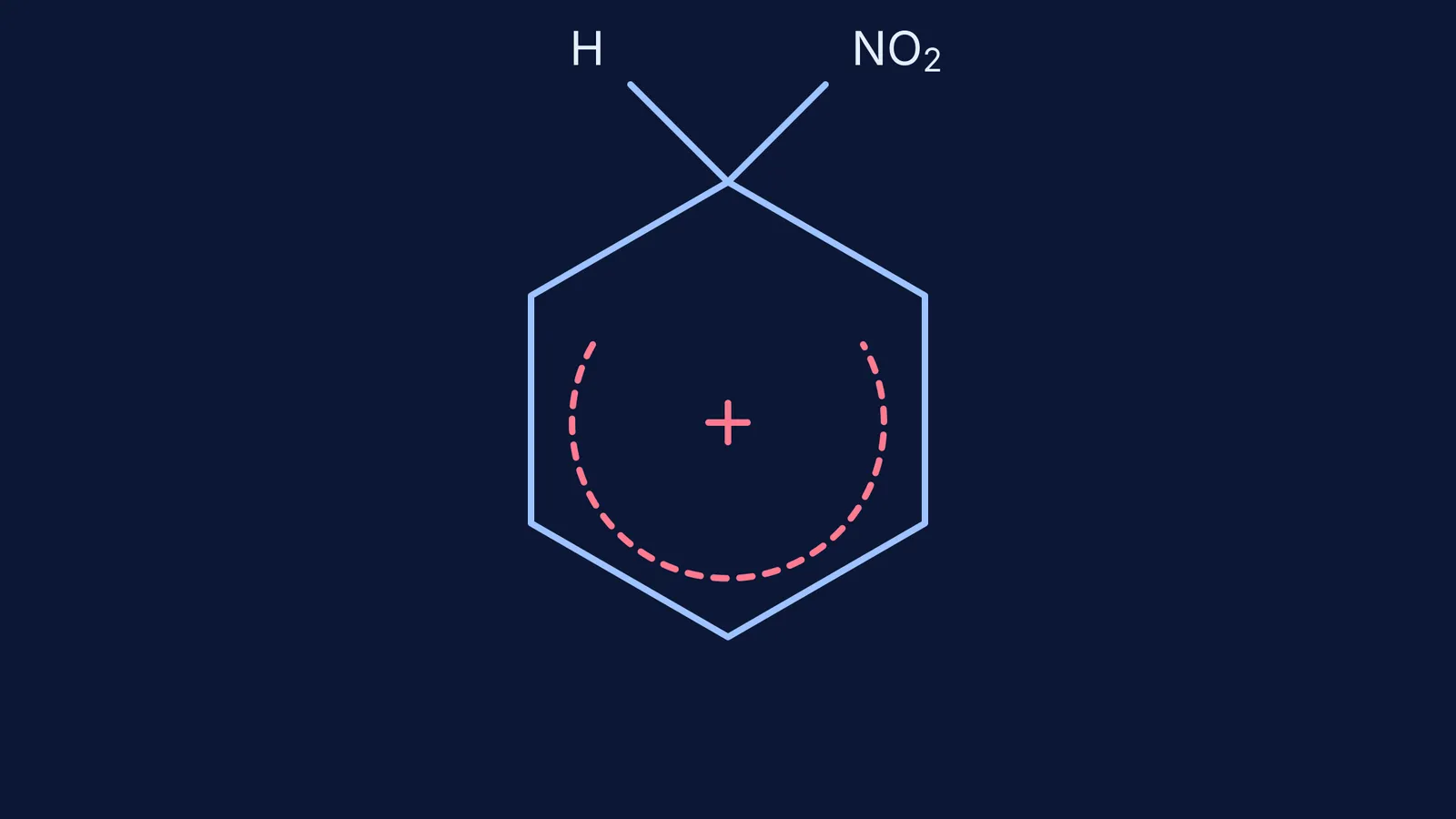
Formation of the Sigma Complex: This attack temporarily breaks the stable aromatic ring. The carbon atom that bonds to the nitro group changes its geometry, shifting from sp² to sp³ hybridization (Source). The resulting structure is called the sigma complex (or arenium ion). It is a high-energy intermediate where the positive charge is delocalized over the remaining five sp² carbons of the ring.
Deprotonation: To regain its stable aromaticity, the sigma complex must quickly lose a proton. A weak base in the mixture, such as the bisulphate ion (HSO₄⁻), pulls the hydrogen atom off the sp³ carbon. The electrons from that carbon-hydrogen bond collapse back into the ring, restoring the aromatic π system and leaving you with nitrobenzene.
How can you master organic mechanisms?
Mechanisms like this one can feel like alphabet soup if you just try to memorise them. If the difference between an electrophile and a nucleophile still feels fuzzy, the Fermi Concept Library has every concept in physics, chemistry, biology, mathematics and computing.
Instead of rote learning, use this three-question checklist every time you face a new aromatic substitution:
Where is the electrophile? Identify the electron-poor species (like the nitronium ion).
What breaks the aromaticity? Trace the arrow from the ring's double bond to the electrophile to form the sigma complex.
How does the ring recover? Find the base that removes the proton to restore the double bond.
Whether you are looking at the bromination of phenol or wondering why aniline is acetylated before nitration, this same underlying pattern holds true. Focus on tracking the electrons, and the steps will start to write themselves.


